

January, the first month of the calendar year, takes its name from Janus, the ancient Roman god of doors, gates, and transitions. His name, rooted in the Latin janua, meaning “gate” or “door,” is symbolic of beginnings and passages which is fitting for the month that opens the year.
Janus: God of Beginnings and Endings
In Roman belief, Janus presided over beginnings, endings, and everything that lay between. As the god of gateways, he was invoked at the start of any new venture. His connection to the opening of the day, the month, and the year made him one of the most significant deities in the Roman pantheon. When the Romans introduced a new month at the start of the year, it was naturally dedicated to Janus and named Januarius (January).
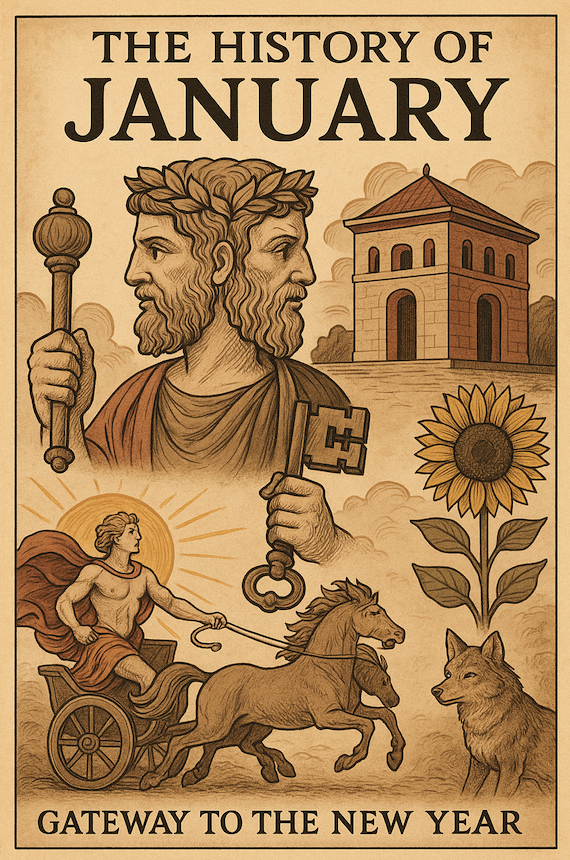
Janus was unique among Roman gods for his appearance. He was often depicted with two faces: one looking back into the past and the other gazing into the future. This duality symbolized reflection and foresight are qualities ideal for ushering in a new year.
On early Roman coins, Janus appeared with two bearded heads, holding a staff (representing authority) in one hand and a key (representing control over gates and transitions) in the other.
He was also considered a patron of trade and travel. On some coins, his likeness is paired with the prow of a ship, connecting him to commerce and seafaring.
As the god of the year, Janus was sometimes represented with the number 300 in one hand and 65 in the other, marking the 365 days of the calendar year.
The Temple of Janus
Janus had a sacred space in Rome known as the Janiculum, one of the city’s seven hills. A significant structure dedicated to him was the Temple of Janus Quadrifrons – a four-sided temple with a symbolic layout: twelve windows representing the months of the year, and four doors for the seasons.
The temple’s doors held political and spiritual significance.
In times of war, the gates remained open, symbolizing the god’s active guardianship as soldiers marched out and returned.
During peace, the doors were ceremonially closed.
However, peace was so rare that historical records suggest the temple’s doors were closed only three times in 700 years.
Sun Gods and Seasonal Lore

Janus was said to be a son of Apollo, the radiant sun god who drove his fiery chariot across the sky each day.
The poetic passage by John Milton in Comus captures Apollo’s daily journey from east to west:
“And the gilded car of day
His glowing axle doth allay
In the steep Atlantic stream…”
Apollo’s myths were rich with tragedy and transformation. His son Phaeton once demanded to drive the sun chariot and lost control, scorching the earth and darkening humanity. In another tale, Apollo’s love for Hyacinthus, a beautiful youth, ended in sorrow when the jealous wind god Zephyrus caused a fatal accident. Apollo transformed the youth’s spilled blood into the hyacinth flower to immortalize his memory.
Similarly, the myth of Clytie, a girl hopelessly in love with Apollo, tells of her transformation into a sunflower, forever turning to follow the sun’s path.
Aurora and the Tragedy of Tithonus
Aurora, the goddess of dawn, who opened the gates of the East for Apollo each morning, also plays a part in January’s lore. Her love for the mortal Tithonus ended in irony.
Granted immortality but not eternal youth, Tithonus aged endlessly until Aurora, weary of his complaints, transformed him into a grasshopper, his voice forever chirping.
Wulfmonath: The Saxon Name for January

While the Romans honored Janus, the Angles and Saxons called January Wulfmonath, or “Wolf Month.”
During this cold and hungry time, wolves, desperate for food, would come down from the forests into villages, bold with starvation.
The month carried not only spiritual weight but also the raw realities of survival.