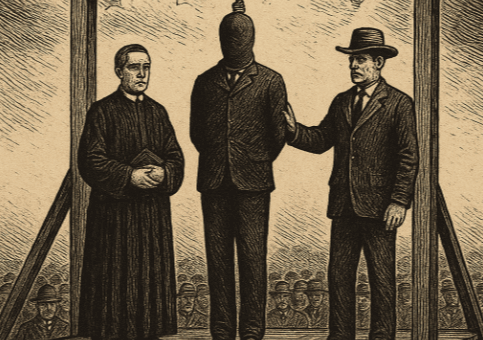
Over a hundred years ago, newspapers reported executions with unsettling detail. These were not brief mentions or sanitized blurbs; they were vivid, haunting descriptions meant to capture the final moments of a person’s life and the gravity of public justice. Below are three such accounts. They are true records of the gallows, preserved in the newspapers of their time.
1. The Gallows Scene

John White Webster, a professor of chemistry and geology at Harvard Medical College, was convicted of the murder of Dr. George Parkman. The trial captivated the public, and Webster’s final moments were described in vivid detail.
Published in The Daily Spy newspaper on August 30, 1850:
The Gallows Scene
At 25 minutes before ten o’clock, the Sheriff, with his deputies, the prisoner, and the officiating clergyman, advanced from the prison doors, to the scaffold. Professor Webster walked with a firm step to the gallows. He was dressed in deep black, but wore no neck cloth. He looked in good health, but he appeared reconciled to his fate, although his head was bowed.
As he stopped upon the drop, he looked round for his faithful friend, Dr. Putnam, who was by his side, and entered into an apparently earnest conversation with him. At almost every word, Webster bowed his head, as if what he was saying was emphatically the outpouring of his heart.
During this conversation, the Sheriff was reading the death warrant, which was in the usual form of such documents, commanding the execution of John W. Webster on the 30th of August, by hanging.
At the conclusion of the reading of the warrant, Dr. Webster shook hands with Dr. Putnam, who took of him a final farewell.
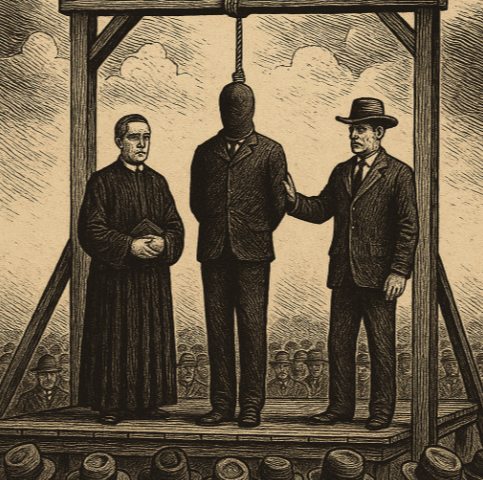
He was then placed in a chair to have his legs pinioned. After this was done, he again stood up. The touch of the rope upon his neck, caused his face, which had been before of a deadly pallor, to flush, and there was evident signs of a subdued but still powerful agitation. e then shook hands with the Sheriff, and spoke a few words to him.
The black cap was then placed over his face, and the light of day thus shut out from him in this world forever. The Sheriff then turned to the assembled spectators, and in a loud voice proclaimed that in the name and by the command of the Commonwealth of Massachusetts, he should now proceed to do execution upon the body of John W. Webster.
At this knell of death there was no motion of the body of the condemned, the features of the face being entirely hid from view; but he stood perfectly still, awaiting the fatal plunge.
After concluding his proclamation, the Sheriff turned round, and pressing a spring, the drop fell, with a sound once heard never to be forgotten. The fall was about 8 feet. There was scarcely a struggle, and death was probably almost instantaneous.
One spasmodic contraction of the limbs, and the corpse swung to and fro.
In a few minutes after, however, the legs were seen to move suddenly, and the knees quickly drew up. In a moment they fell and no other motion was perceptible.
About 10 minutes after 10 o’clock, the body was cut down, and removed to the cell lately occupied by the victim of the law.
Source: The Daily Spy. Worcester, Mass. August 30, 1850.
2. His Last Words
In Arkansas, 1879, Robert Lancaster was hanged for the murder of Thomas Johnson. Despite his fate, he met death calmly, asking for wine the night before and sleeping peacefully until dawn.
Published in the Batesville Guard:
On The Gallows
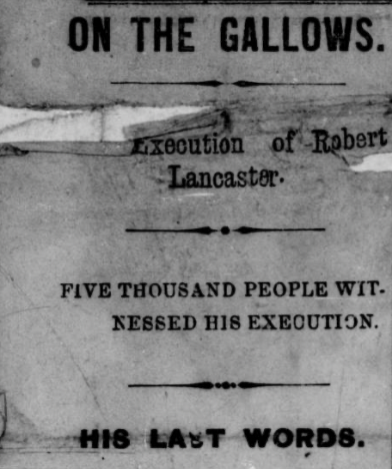
Today closed the earthly career of Robert Lancaster, who was declared by the proper tribunal to be guilty of murder in the first degree for the unlawful killing of Thomas Johnson.
He was sentenced by Judge Powell to be hanged by the neck until dead on the 12th day of September, and today this sentence was carried into effect by Sheriff Case.
Last night we visited the prisoner and found him in good spirits. He had just closed an interview with his brother, and when asked if he needed anything, said he would like to have a little wine to drink before he was executed in the morning. His request was complied with, and after writing about an hour he fell into a calm and peaceful sleep, and did not awake until 6 o’clock in the morning. He was then visited by ministers and several citizens, and expressed himself as fully prepared for his fate.
At 11 o’clock, two reverends were with him in his cell. Several hymns were sang, and prayers were offered up that God would be with him in the great trial through which he was about to pass.
He was then shaved and dressed, and at 12:30 Sheriff Case informed the jailor that the hour was at hand. The prisoner was then brought from the jail, and took his seat in a wagon provided for the occasion.
Sheriff Case had summoned 50 guards, and after the prisoner had been seated in the wagon, the order to march was given, and the procession moved to the place of execution.
The gallows had been erected at the foot of Main Street. An enclosure of 100 feet square was protected by a rope attached to stakes; outside of this stood the guards.
Lancaster was accompanied on to the scaffold by Sheriff Case, a reverend, and two others. The death sentence was read by Sheriff Case, when then asked him if he had anything to say.
Lancaster stood before the large crowd and spoke in a clear and audible voice the following words:
‘As I have previously made a statement through the newspapers, I did not intend to speak on the gallows, but I thought I would say a few words before I die as it may do good. If you don’t want to come to the gallows, don’t commit crime and keep out of bad company. I know where I am today, but know not where I will be tomorrow, but I trust in the mercy of the Lord Jesus Christ, and hope that I am going to a better world. I forgive everybody, and I hope they will be all pardoned as I feel that I have been. I thought I would say a few words to show that I was in my right mind, and that I was not afraid to die. I shall say no more.’
The black cap was then adjusted by Sheriff Case, but Lancaster requested him to remove it, and let him look once more upon the crowd that was assembled. His request was complied with, and after gazing at the throng for a few moments, he said, ‘I am ready.’ An instant after, the trap was sprung, and the body shot through with a sickening thud, and was left dangling in the air.
The drop fell at 29 minutes past 1 o’clock; in three minutes there was a slight twitching of the body and a slight movement of the muscles was noticed a minute after. In 10 minutes he was pronounced dead by the attendant physicians. At the expiration of 20 minutes his body was cut down and delivered to his friends.
After he was lain in his coffin, the black cap was removed, and his features were discovered to look as natural as they did in life, and it was evident that Lancaster had met with a quick and nearly instantaneous death.
Source: Batesville Guard. Batesville, Independence Co., Ark. September 12, 1879.
3. At the End of a Rope
This infamous double execution followed the shocking murder of Pearl Bryan, whose decapitated body was found near Fort Thomas. Her head was never recovered. Jackson and Walling, both dental students, were convicted amid massive public attention.
As reported in the Hopkinsville Kentuckian:
The Curtain Rung Down!
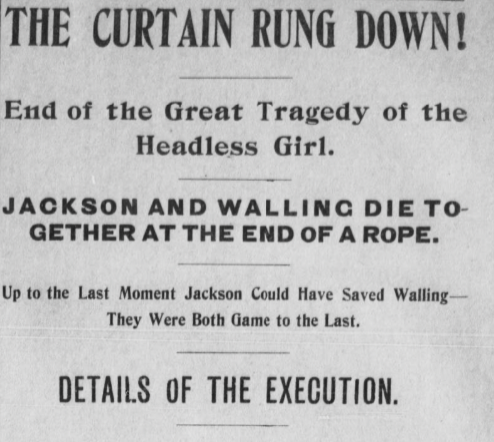
The once promising lives of Scott Jackson and Alonzo Walling, the young dental students, paid the penalty today on the gallows for the murder of the sweet-faced country girl, Pearl Bryan, of Greencastle, Indiana, and the extinguishing at the same time of the tiny spark of life that had driven her to desperation through fear of shame.
The scene was Fort Thomas, and the date February 1, 1896. The victim was decapitated to prevent identification and the head has never been located.
The arrests, trials with confessions, and the general progress of the awful sequel of today have been largely of the spectacular order, especially the closing hours of the tragedy this morning in Newport, Kentucky.
Nearly all forenoon Walling’s fate seemed swaying in the balance, and the 5,000 people, with a plentiful sprinkling of militia acting as guards, waited with interest at highest tension for the spring of the fatal trap or the announcement of the clemency extended by Gov. Bradley.
Walling went to sleep at 1 o’clock and slumbered until 6 o’clock. Jackson slept but little. From that early hour until the final announcement that both must hang at 11:30, the prisoners sat at the jail facing the crowded courthouse yard, with every appearance of unconcern.
On the gallows, neither was deserted by the gameness that has marked their conduct ever since they first posed before the public in the celebrated tragedy.
At 11:40 the fatal trap was sprung, and they hung in midair 20 minutes before the horrible work of strangulation was complete.
The hour originally set was 7 o’clock, but almost as the start was made for the gallows, Jackson made another confession in which he said Walling was not guilty of willful murder.
Gov. Bradley was then telegraphed to in the interest of Walling. This effort to save Walling delayed the execution.
In Jackson’s confession he said Walling was not guilty of murder. Jackson had Pastor Lee, the deathwatch, Walling, and all stand up as he repeated that Walling was not guilty. This proceeding stopped the march to the gallows, as Sheriff Plummer called in Walling’s attorneys and they wired Gov. Bradley. Jackson broke completely down just as the march to the gallows was ordered to start, and wept like a child as he cried out that Walling was not guilty.
The crowd outside the jail was kept fully advised, and became very impatient as the confession was generally considered another dodge to gain time for Jackson as well as a respite for Walling.
Walling dropped a note from the jail window to the newspaper men, saying: “Jackson has freed me.”
With his feet on the brink of the after-death condition, and within the shadow of the gallows, Scott Jackson recklessly and cruelly gave utterance to a lie that raised high the hopes of the wretch, Walling, and caused Judge Helm to make the wires sizzle with messages to Gov. Bradley.
As the delay lengthened, the crowd on the outside grew impatient, and over the walls there came a solemn and ominous murmur…
It was 11:32 a.m. when Jackson and Walling mounted the scaffold. The big crowd was silent and motionless for the first time since early morning.
[The Sheriff read the death warrant and both men declared their innocence. The reverend conducted services.]
The rope was then adjusted and the straps fastened. With downcast head, Rev. Lee made an eloquent prayer, closing with the words: “Scott Jackson, goodbye; Alonzo Walling, goodbye.”
The prisoners both stood with bowed heads. Walling’s eyes were closed in prayer, Jackson’s open…
Then the bolt was shot promptly at 11:40 and both men dashed downward.
As the bodies swayed to and fro, the silence and solemnity of the occasion were terrible.
Both died in great agony. Jackson raised his feet. Walling drew up his feet, and his body contracted several times in awful torture.
Walling’s body was placed in a casket and taken away from the jail…
Jackson’s remains were cremated.
Source: Hopkinsville Kentuckian. Hopkinsville, Ky. March 23, 1897.