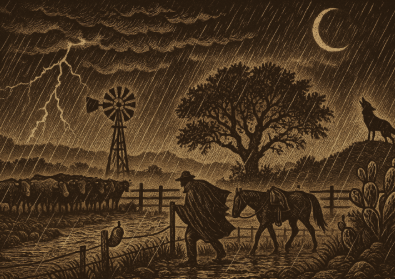
On the ranches that stretch along the Rio Grande, weather is not small talk. It is food for cattle, grass for sheep, and the boundary between a good year and a ruinous one.
Long before radios and radar, vaqueros, pastores, and cowboys built a living folklore of signs that promised rain, warned of a norther, or told you to quit hoping and keep hauling water.
What follows gathers that borderland “sky sense” into one place, honoring the people who watched animals, winds, and moonlight until patterns took on meaning.
Snakes, snails, and other ground-level prophets
Border country folk often say animals know before we do.
Snails that climb fence posts or the stems of weeds are taken as heralds of rain.
Rattlesnakes offer a richer set of signals. When cool or scorching weather breaks and days turn mild, rattlers emerge in numbers. Old hands watch not only for the snakes, but for their tracks. Many believe numerous trails that slant toward higher ground mean a storm is building.
There are stranger customs too. Some ranch families once hung killed rattlers in mesquite trees “to bring on” rain or to keep fiddle strings from turning damp, since a rattler “never wets its rattles.”
These practices belong to their time. They tell us how fierce the longing for rain could be, and how much of daily life was bound up with reading the land.
Coyotes at sunrise, burros at dusk
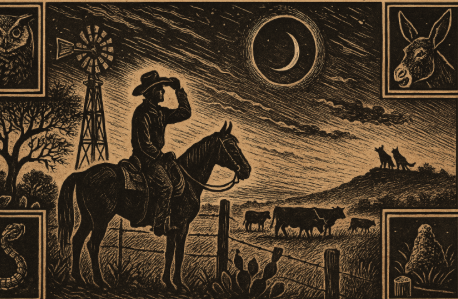
The hour matters. Coyote song after sunrise, especially from the hilltops, was prized as a sure sign that showers would soon cross the flats. The same coyote chorus at night did not count. Burros earned a place in the choir as well.
If several started braying right after dusk and distant burros answered, people laid out slickers and hoped to hear drips on the jacal roof before morning.
Goats, lambs, horses, and cattle
Pastores watched their herds like barometers.
A nanny that quickly accepts her twins is said to welcome a good season, while a nervous mother that must be forced to let her kids nurse warns of a dry one.
Lambs that frisk hard in the morning hint at rain. So do horses that kick up their heels and run for the sheer joy of it.
Cattle are considered the best forecasters. Early bedding in winter means they are “resting up” for a norther.
When beeves bunch tightly, heads all facing the same way, or they low more than usual, stockmen look north and make sure the stove wood is dry.
Migrations matter too. After a rain, herds drift far into the hills. If they do it ahead of a storm, the hopeful say the cattle smell water coming and want to be there first.
The small and many: insects, birds, and little neighbors
Flies that pour into camp, heel flies that pester cows in a roundup, gnats that thicken into a fog, or “Third Party” black flies that arrive in a cloud all push predictions toward rain.
Red ants topping their mounds foretell a heavy shower, and winged ants that rise like confetti are thought to be fleeing a flood below.
Prairie dogs that freshly rim their holes with dirt, earthworms that surface, terrapins on the move, and snails on the climb all point the same way.
From the air come more voices.
Quail calling from the brush, bob-white whistles, the water-crow’s cry, and frogs “asking for water” are read as petitions that heaven is likely to grant.
Owls hooting by day are given special weight in autumn, when many swear they can foretell a wet norther several days out.
Rings, sheep in the sky, and the color of evening
The moon has authority in the borderlands. A ring around it is la casa de la luna, the moon’s house. Some count the stars within the halo to guess how many days remain before rain. A “wet moon” is debated.
One camp believes a tipped crescent carries water in its bowl. Another insists a tipped moon is drained dry unless it lies on its back.
By daylight, high wisps of cirrus often earn the name borreguitos, little sheep in the sky, and are taken as a rain sign.
A red sunset, sometimes called Sangre de Cristo, promises a wet tomorrow to many.
Others repeat a different rhyme and prefer a red morning as the truer warning. Either way, color at the horizon keeps hope alive.
Watch the wind and haze as well. A steady east wind stirs optimism. A foggy morning or long south wind can feel like the start of a drought.
Showers that come out of the west may grow into “gully washers and fence lifters.” Rainbows still mean what they have always meant. If one arches after a storm, most borderers say the rain is over for now.
A rare sign: water that rises in the night
Every ranch has a drought story. One of the rarest omens comes when a hidden spring breathes to the surface.
Old-timers remember mornings when the hoof prints in the dry creek bed held a film of water only a paper’s thickness deep. That silver sheen set camps buzzing, because it meant the underworld was stirring and the sky might follow.
Bodies as barometers
Weather lives in the joints too. Drowsiness, an aching knee, a corn that wakes, or stiffness that will not shake off are folded into the daily forecast as confidently as the coyote’s howl.
No one needs a thermometer to know when a front has left its fingerprint on bones.
Counting the moon: La Epacta on the trail
Almanacs were scarce on long drives, but the moon was always overhead.
Trail drivers and vaqueros kept a simple rule of thumb called La Epacta, the age of the December moon on New Year’s Day. Keep that number, add eleven each year, and drop thirty when the total grows past that mark. With nothing more than that tally and a good eye, a night herder could plan for dark phases and bright ones months ahead.
“Has the weather changed?” depends on whom you ask
Ask three elders and you will hear four answers.
Some say winters run colder and droughts hit harder than they used to. Others blame dry creeks on overstocking and trampled turf rather than on the sky. Another camp insists “rain follows the plow,” pointing to places in central Texas that turned farmable as homesteads spread.
All agree that in the free range days the grass was better and the seasons felt more orderly, even if memory tends to round off the rough edges.