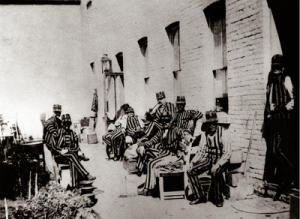
Long before the condemned took their final walk, the gallows at San Quentin was already alive with grim precision. Every rope, beam, and bolt was tested and retested in a ritual of mechanical perfection designed to deliver swift death and spare the living from seeing it twice.
In 1901, The San Francisco Call offered readers a rare, behind-the-scenes look into San Quentin’s “Hangman’s Hall,” where executions were prepared in near-scientific detail. While the story centered on Amos Lunt, the prison’s melancholy hangman who would later lose his mind to the ghosts of his duty, it was the description of the gallows itself that captured a macabre fascination.
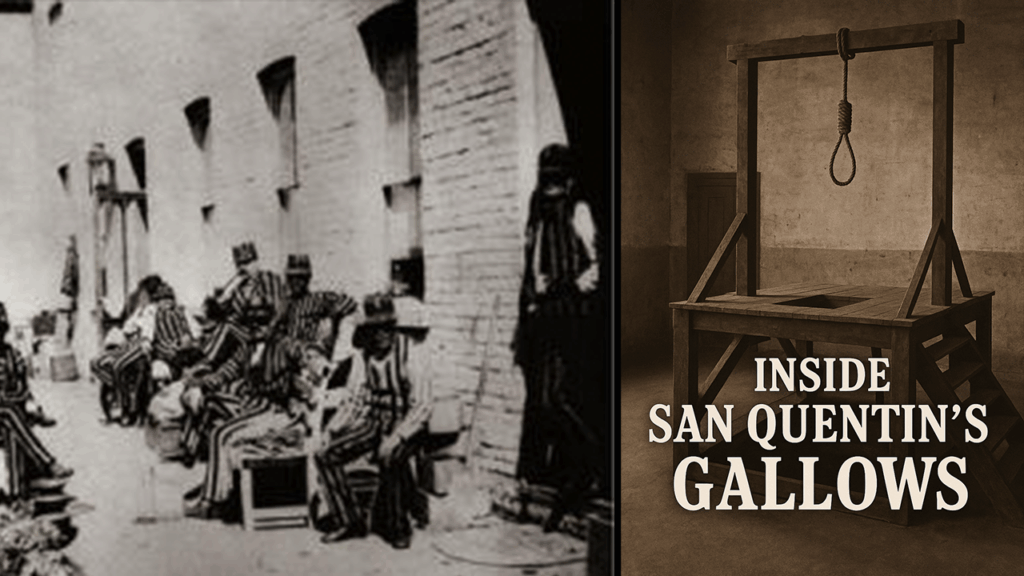
The report laid bare the methodical, almost industrial nature of state executions in early California. From the “stretching room,” where new ropes were weighted with bricks for months until they were “dead,” to the mysterious chamber of the “Invisible Three” who triggered the fatal drop, every aspect was governed by quiet efficiency. It was not a place of chaos or passion, but of cold, deliberate craft.
In this excerpt, the focus shifts from the condemned to the machinery of death itself: the gallows on the fourth floor of San Quentin, the weight boxes, the cannon balls, and the men who remained nameless even as they delivered judgment.
Here is the article:
The Haunting of Amos Lunt — Hangman
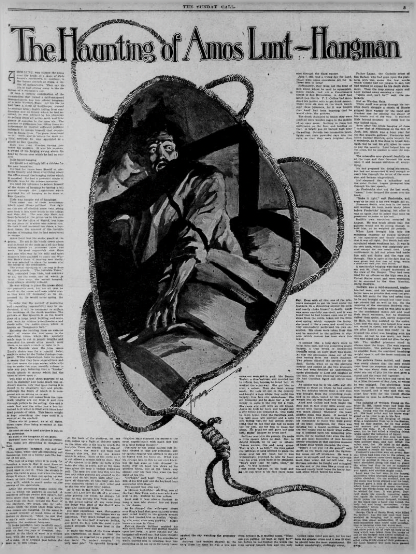
Amos Lunt, who slipped the noose over the heads of a score of California’s murderers, is confined in the insane asylum at Napa, a victim of melancholia. They say his life is fast ebbing away in the delirium of a madman’s cell.
It was a curious combination of circumstances that turned a mild-mannered Massachusetts boy into an official hangman of a wild Western State. All his life he had been a clerk or bookkeeper, unused to manual labor; health failing from confinement and an injury which he had received, he was advised by his physician to refrain from all active work and take plenty of exercise in the open air. The position of policeman just filling these requirements, he exerted sufficient political influence to secure himself that occupation in Santa Cruz. [Eventually] he was appointed as a guard at San Quentin.
Hale was then Warden, having just taken his position… [And] Hale hated hanging.
[Hale had previously been a Sheriff] and liked everything about the office except the hanging duties which it entailed. He also had a powerful [group] of friends.
[Hale] used his influence to relieve himself of the duties of hanging by having a bill passed… [that required] all hangings to be done at San Quentin.
[So, for a while, Hale was rid of hangings.]
[Some time later, Hale ran for the office of Sheriff once again, but was defeated. The position of Warden was offered to him, and he accepted it.]
Amos Lunt was the senior guard at the prison. He sat in his lonely tower above and in front of the main gate all day long taking signals as prisoners came and went. As the most responsible man there and one who was by his mild and quiet manners best qualified to carry out Warden Hale’s ideas of treating men kindly, he was selected to place the nooses over the necks of the condemned.
The actual springing of the trap is done by other guards. “The Invisible Three,” who, concealed from view, and unknown to all, cut the cords, one of which is fatal. This duty, the actual hanging, Lunt always sturdily refused.
In order that the method of scattering and concealing responsibility may be understood, it will be necessary to explain the workings of the death machine. The gallows at San Quentin is on the fourth floor of a large brick building and occupies, with its various ante-chambers and death cells, the entire space, which is known as “hangman’s hall.”
Entering the building from an exterior flight of stairs, the first room is the stretching room, where the specially made rope is cut in proper lengths and stretched for month after month until there is no more stretch or twist in it.
Much depends upon the rope. Amos Lunt’s choice was for a special twist, made to order by the Tubbs Cordage Company…
The rope is about three-quarters of an inch and looks much like ordinary manila, only that upon feeling, it is found to be soft and pliable, although the fibers of which it is composed are as strong as catgut.
When a fresh coil comes, lengths are cut from it and run through pulleys in the ceiling. One end is made fast and the other has a box attached to it which is filled with three hundred pounds of bricks. This heavy weight is kept stretching the rope until it is wanted at the scaffold.
There are at all times three ropes being stretched at San Quentin. As soon as one is used, another is put on the stretcher.
The test of a rope when it is ready for hanging a man is that it must have no more stretch in it. It must be “dead,” as Lunt used to call it. When the stretch and twist is gone, the body drops and stays. It does not spring up and down, or turn round and round. It stays very still, which is much easier on the nerves of the spectators.
After the stretching rooms comes the one in which the gallows is erected. The platform is perhaps 12 feet square, but little more than the height of a man’s head from the floor. Towards the front of the platform are two traps, side by side. Above the traps are a sturdy beam from which two nooses are dangling. In the noose is a round cylinder of wood, three or four inches in diameter. “Just the size that a man’s neck reduces to when hanged,” explains the assistant hangman.
Suspended from the block of wood is a weight box, with the weight in it equaling that of a man. It is dropped just before the man is, to test things.
At the back of the platform is a flight of 13 steps. On the other side is the box in which the Invisible Three are hidden. The strands upon which the man’s life rests pass through this box, but no one knows which is which. Each of the cords as it is cut allows a cannon ball to drop. One of the cannon balls jerks the bolts which holds the trap in place, and at the same time gives the trap a violent downward pull. The men are sent into this box before any other persons are allowed in the room and do not leave until after they have all departed, so that they are forever unknown to each other and to the one who drew their names.
Source: The San Francisco Call. San Francisco, Calif. September 15, 1901.
The rest of the article touches on some of the men who were hanged in San Quentin by Lunt, but we will touch on those cases at a later date.