In 1910, even a routine sweep of the parlor came with a dress code. Housekeeping guides of the era didn’t just tell women how to clean, but they told them exactly what to wear while doing it.
From shortened skirts that freed the legs to muslin head coverings folded with military precision, a proper “sweeping outfit” was considered as essential as the broom itself.
This old newspaper piece from The Washington Herald lays it out with remarkable detail, reminding us how tightly women’s daily labor was woven into expectations of neatness, modesty, and constant self-preservation from dust. Here’s the article in full.
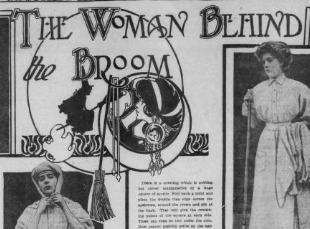
The Woman Behind the Broom
The broom is still an important factor in the good housekeeper’s supply closet, and when sweeping day arrives it is faithful in chasing the dust and dirt. My little talk today is to the power behind the broom.
Work, regardless of the fact that it is exhausting, is a natural and healthful outcome of housekeeping. It can be made much easier and decidedly less harmful if the woman who wields the brush be sensible and devote a little time to the proper outfit for cleaning day.
In the first place, a sensible sweeping dress should be owned by every woman. Use material that will stand a very necessary boiling after the cleaning, and select a comfortable size that will not restrict the movements in any way.
Short sleeves and a short skirt should figure prominently in the cut of the garment, while the soft collar will give neatness and comfort to the sweeper.
Now, dust is a foreign matter, and has no place in the openings of the body. The ears should be protected and the hair covered in such a manner that the particles of dirt should not be able to lodge in each strand, destroying the health and beauty.
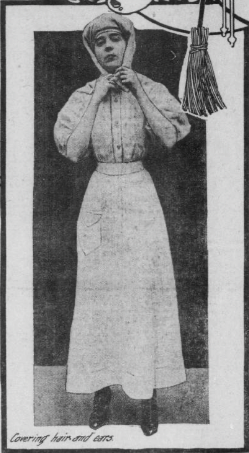
There is a covering which is nothing but clever manipulation of a huge square of muslin. Fold back a point and place the double bias across the eyebrows, around the crown and pin at the back. That will give the remaining points of the square at each side. These can then be tied under the chin.
Dust cannot possibly settle on the hair or in the ears when this headdress is worn.
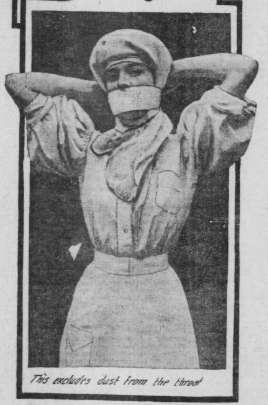
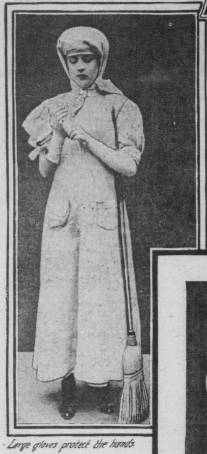
Large gloves protect the hands. They must be loose to offer no interference with the free and easy play of the muscles of the forearm. The hands can be kept soft and white, even by one who sweeps. The object is to keep the dust from closing the pores and from drying the skin.
One of the most harmful and easily acquired habits of the sweeper is to open the mouth while breathing. The mouth, you will remember, is for the passage of food only. There are no fine hairs in the membrane, as in the nose, to sift the particles of dust from the air. It was never meant for breathing purposes, and colds and throat troubles will surely result from mouth-breathing.
Dust must be kept out of the throat. A bandage of swiss or soft muslin is all that you will require. It will pay to take this precautionary measure.
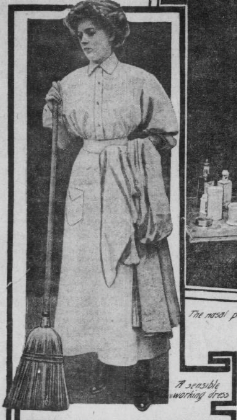
After the reign of the broom all nasal passages should be thoroughly cleansed of the irritating particles of dust. A weak solution of peroxide of hydrogen or of salt and water is within everyone’s reach. The atomizer is effectual in this step.
A cleansing, with cold cream, of the face that has been exposed to the dust is important for the healthy condition of the skin.
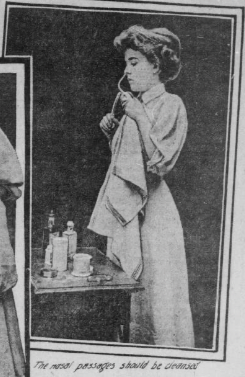
I advise a warm bath for the entire body after the work of the morning.
Source: The Washington Herald. Washington, D.C. February 27, 1910.