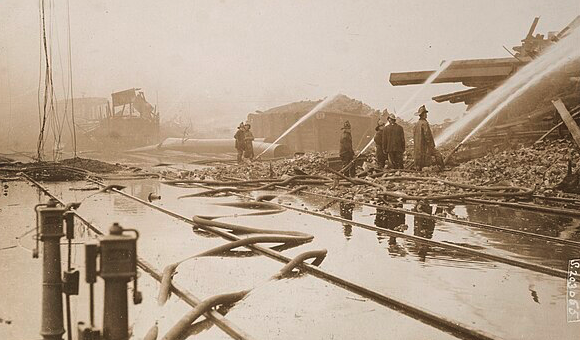
At 2:15 on a July morning in 1916, New York Harbor erupted.
A series of explosions tore through munitions cars, barges, and warehouses near the Statue of Liberty, sending fire, shrapnel, and debris into the sky. The blast was so powerful that it shook New York, New Jersey, Delaware, Connecticut, and Pennsylvania.
In Manhattan and Brooklyn, people ran into the streets half-dressed, believing the subway had exploded, a skyscraper had collapsed, or the world itself was coming to an end.
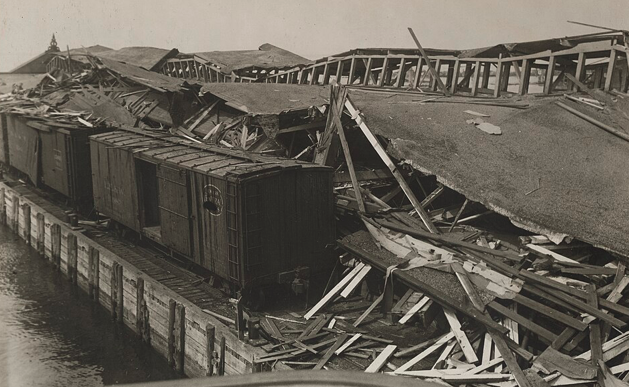
Windows shattered across the city. Broadway glittered with broken glass. Ellis Island immigrants were rushed from their beds as burning ammunition barges drifted dangerously toward the piers.
Shells fell from the sky, clocks stopped at the moment of the first explosion, and the shock was felt as far as ninety miles away.
The disaster centered on Black Tom Island, a munitions terminal on the New Jersey side of the harbor where railroad cars, barges, and warehouses were packed with explosives bound for the Allies during World War I.
Early reports put the death toll at fifty, with scores injured and property damage estimated at $50,000,000.
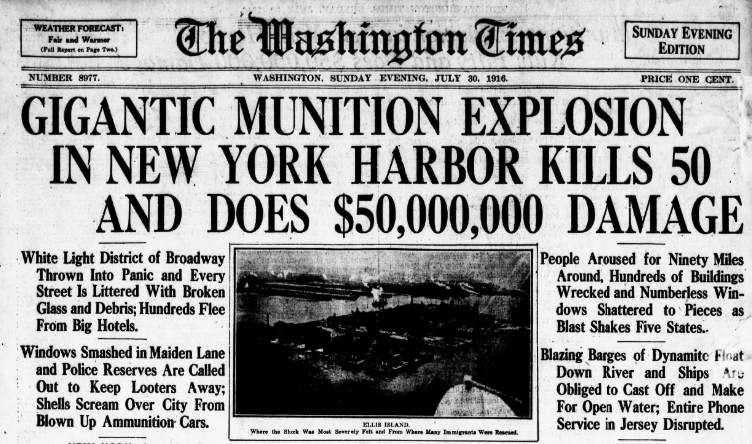
Gigantic Munition Explosion in New York Harbor Kills 50 and Does $50,000,000 Damage
NEW YORK. — Fifty killed, scored injured, $50,000,000 in damage, is the net result of a series of terrific explosions in munitions cars, barges, and warehouses near the Statue of Liberty shortly after 2 o’clock this morning.
New York, New Jersey, Delaware, Connecticut, and Pennsylvania, all were rocked by the upheaval which caused a panic in New York and Brooklyn.
The first explosion was followed by 30 minor explosions in railroad yards and terminals on the New Jersey shore.
Hundreds of fragments of shells rained on the lower city and bodies were hurled high in the air in plain view of police and firemen called frantically to the scene of the blazing warehouses.
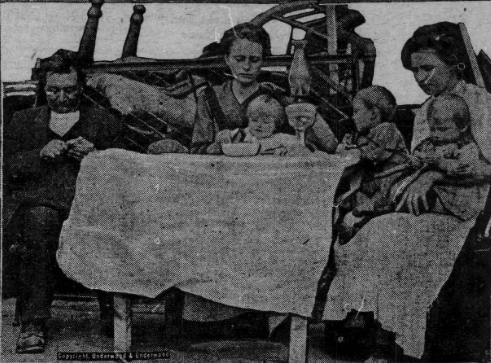
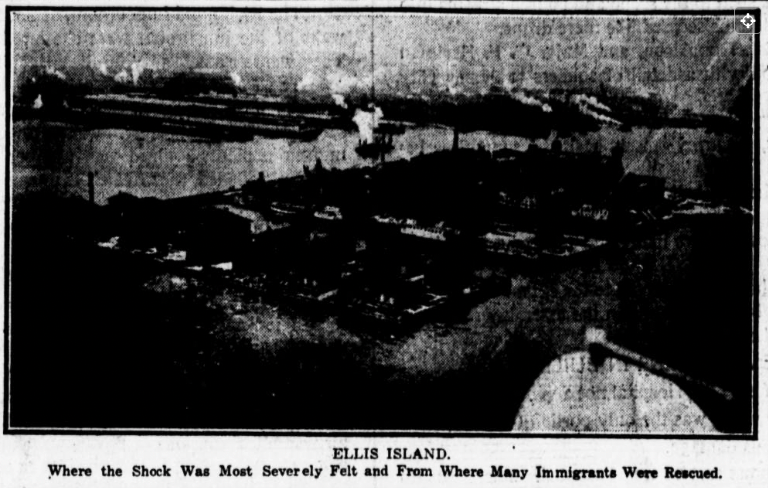
Rocked by the upheaval, Ellis Island immigrants ran screaming from their beds, were hurried aboard barges and rushed away as two lighters, loaded to the gunwales with explosives and blazing fiercely, bumped into the piers of the island.
People Aroused For Ninety Miles Around
For ninety miles into New Jersey, people were roused from bed by the thundering echoes of the catastrophe.
In Manhattan and Brooklyn the first effect of the reverberating quake was amazing. People rushed to the streets half clad from hotels and homes.
Windows in hundreds of stores were shattered, leaving the contents easy prey for looters who gathered a harvest.
Police headquarters flashed orders all over the city, bringing every available man on reserve duty to lower Manhattan to guard the prizes that had been exposed in Maiden Lane and in other wealth-laden streets of that district.
Reserves who had been detailed to car-strike duty were called off and scattered throughout the city.
Broadway was a sea of glass. Signs were torn down and crashed to the gutters.
Fulton Street, in Brooklyn, and even Bath Avenue, in Bensonhurst, were strewn with fragments of broken windows.
White Light District of Broadway Terrorized
Broadway’s white light district was terrorized. At first it was thought the subway had blown up or a building had collapsed.
Frightened guests ran from the Astor, the St. Regis, the Waldorf, the McAlphin, the Biltmore, and a score of other hotels in Manhattan,
On every lip was the frightened cry, “The world is coming to an end!”
Lower Manhattan, with its streets of great skyscrapers, seemed to rock like a tree in a gale. Behind the towering Woolworth building flared a ghastly light, adding to the terror of the thousands.
Brooklyn Bridge and Manhattan Bridge seemed for a moment to swing uncertainly. Crossing trolley cars seemed to hop into the air for inches and then to stumble back to the tracks. Passengers were crushed against each other, and glass was shattered.
Thousands rushed for subways, more thousands dashed for telephones to ask police headquarters and newspapers for information.
Numberless Windows Shattered to Pieces
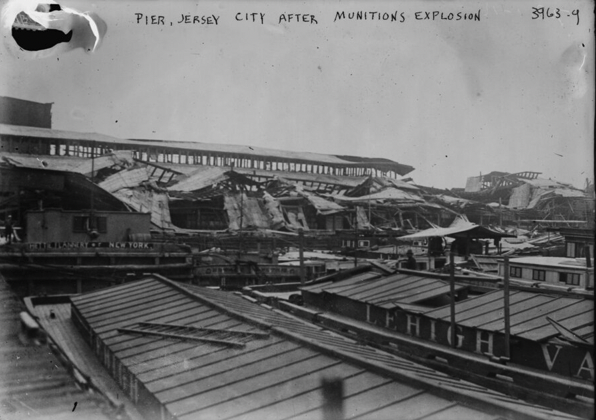
Numberless windows were shattered in Staten Island, Jersey City, and Bayonne and Communipaw, where the shocks were felt most.
Almost every building in York Street, Jersey City, was wrecked and the police closed the thoroughfare.
In the bay, dozens of captains got up steam prepared to leave to avoid barges which drifted like volcanoes with the tide.
Beyond the immediate radius of the greater city, Paterson, Passaic, Hackensack, and a score of other Jersey towns, including Camden, were violently rocked.
Two lighters, which had lain at the piers at the terminal, where the first blow-up occurred, were shaken loose and ignited from sparks. With their loads of ammunition afire they drifted down the bay toward Ellis Island, the shells on board exploding a hundred a minute.
Dr. Joseph Wilson, of the Immigration Hospital, reported his danger to the New York Police, and it was then that the immigrants were taken off. Army headquarters sent the Governors Island ferry to aid in the work, and the hundreds of panic-stricken aliens, mostly women and children, were landed safely at the Battery.
No Exact Estimate of Killed
Until later in the day it will be impossible to give exact figures on the killed, injured, and missing.
There are reports that many firemen were lost, but this is unverified.
Altogether there are 30 patients in Jersey City hospitals. Many of them are cut and bruised. Others suffered from inured ears. Surgeons say the condition of many is dangerous.
The most remarkable escape in the story of many strange escapes was that of Peter Razeto, a deck hand on Moran Barge No. 8, which lay a little off the Jersey Shore.
The explosion blew him clear of the boat and almost to the shore. He swam to shore and then collapsed. He was picked up and carried to the city hospital.
The cause of the explosion is a mystery. The warehouse destroyed was owned by the National Storage Company, which was engaged in the shipment of ammunition to the allies.
Edmund L. Mackenzie, its president, when notified of the explosion at his home in Plainfield, N.J., could not account for the accident, as he said every precaution had been taken to guard against any such accident.
Six Cars With Ammunition on Property
Six cars had been run onto this property yesterday with ammunition to be loaded on ships and 14 barges were tied to the piers with cargos of dynamite.
Black Tom Island, where the warehouse is situated, juts in the New York Bay and lies opposite the Greenville section of Jersey City. It is a terminal for the Lehigh Valley and Jersey Central roads.
On this island beside the six cars mentioned were 100 others, all loaded with shrapnel and shells.
Also on the island were 400 workmen and the fate of many is in doubt.
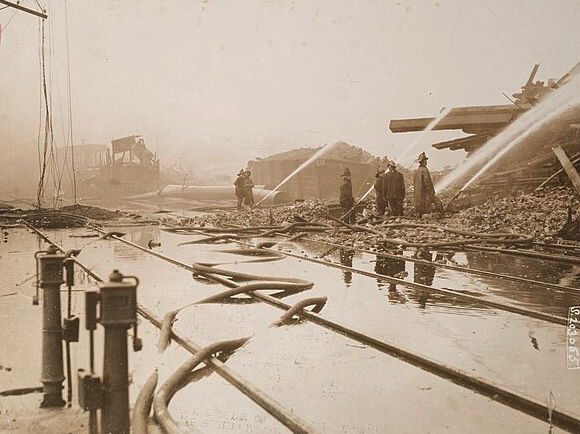
It was about 2:15 this morning when the first volcanic explosion terrified the city. This explosion was followed at intervals by others and even at 9 this morning the fires started by the upheaval were burning fiercely.
Owing to severance of wires it was some time before the source of the trouble could be definitely located.
When it was, every available ambulance in New York City was rushed across the river to the assistance of the Jersey hospitals.
New York doctors worked among vessels on which scores of women and children, cut or burned, were huddled in prayer.
Streams of Water Like Mere Drops
The fireboat New York sped to the scene and poured streams into the furnace, but the great streams seemed like mere drops.
Col. M.E. Horton, Col. Donaldson, and Major C.F. Hartman were sent by General Wood with a detail of soldiers to Jersey City on a launch.
With shrapnel bursting over them, the fire before them, and explosions every few seconds, the army officers hesitated some time before landing.
Finally they went to the city hall and offered Mayor Fagan their services.
The freaks of the explosion were many and covered a wide territory.
In Jersey City, the city hall was damaged to the extent of $20,000.The entire first floor of tile buckled up and in the assembly room girders were thrown down and columns fell.
Not a Window Remains in Building
In the main building of the city hospital not a window remained. The maternity ward, in one wing, was the only portion of the hospital which escaped without serious damage.
The New Jersey telephone service was disrupted. There was no service at all.
The Jersey City Public Library was badly wrecked.
Doors tightly locked were blown open and the framework thrown out of plumb. Locks were ripped out entirely through the splintered door jams. Thousands of clocks were stopped on the minute of the first explosion, 2:15.
The water pipe to Bedloe’s Island was put out of commission.
In New York every pane in the offices of J.P. Morgan & Co. in Wall Street was smashed. No damage was done to the stock exchange, but almost every other building in that district suffered heavily in shattered windows and lost signs.
A number of windows were broken at the New York Public Library. Firth Avenue and 42nd Street. Along Fifth Avenue, gowns in fashionable shops were flung to the street through shattered windows. Sixth Avenue, 42nd Street and other business thoroughfares were littered with glass and splintered signboards.
Real Shells Fall Out of the Skies
One of the remarkable oddities of the catastrophe was the dropping of shells from the skies. The army men on Governors Island got a taste of real warfare as these missiles came thudding from the skies.
The Richmond Lunchroom, at South Ferry, was wrecked and the walls of the lunchroom were shattered and three men cut severely. They were removed to Volunteer Hospital.
The traffic in high explosives in the Greenville section of Jersey City has been the cause of bitter protest by the residents of that section for months. In response to their complaints, the railroads and munitions plants doubled their number of guards.
Not satisfied, the Greenville people continued to object so strongly that James Connolly, Jersey City inspector of combustibles, was induced to make a complete investigation of the situation.
His report upheld the protestants, and the guards again were increased and further precautions were taken.
Striking Description of the Scene
A striking description of the scene in the bay is given by Capt. James Maher, of the tug Britannia. He was returning from Yonkers and was just north of Ellis Island when he saw a stupendous burst of flame.
“My tug swayed and rocked,” he said, “and almost at once the air was filled with bots of boxes, scraps of iron, and all sorts of debris, some red hot, which fell on all sides of us.
“Fearing for those on Ellis Island, I ran full speed for the station there. As I raced, one explosion after another hurled thousands of shells into the bay and filled it with a stream of lights.
“As we neared the island, we ran through a regular storm of descending wreckage. Afterward, I learned the shock did $1,000,000 damage to the immigration station there.
Source: The Washington Times. Washington D.C. July 30, 1916.