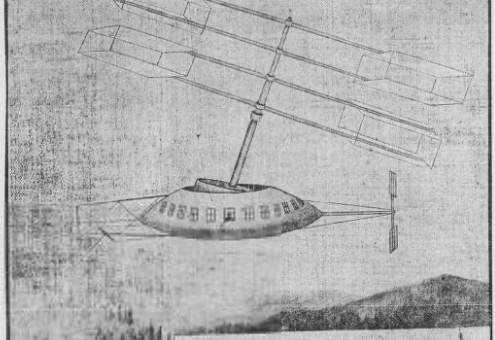
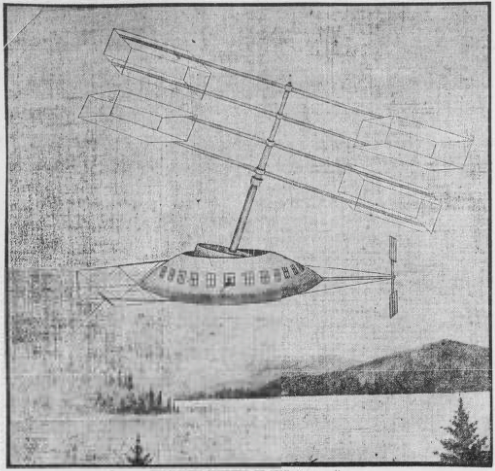
At first glance, the Coyne Helicopter looks less like an early flying machine and more like something pulled from a century of UFO lore.
The 1910 design, created by Dr. W.E.S. Coyne and George Foster of Spokane, had a rounded, saucer-like passenger compartment hanging beneath a set of broad revolving planes. It was intended to rise straight up, hover in place, and descend under full control, a dream that inventors had been chasing since the earliest days of aviation.
What makes the image so striking is its shape. The body of the craft resembles the classic “flying saucer” silhouette that would not become famous until decades later, while the upper structure gives it the strange hybrid appearance of a helicopter, airship, and impossible machine.
It is also hard to ignore the curious echo of another Coyne story: the famous later UFO encounter involving a helicopter and a cigar-shaped craft.
And so, long before flying saucers entered popular culture, two Spokane men were already sketching a machine that looked eerily ready to join them in the sky.
Invents Airship That Will Lift Self In Air

SPOKANE. — Dr. W.E.S. Coyne and George Foster, of Spokane, claim to have solved the problem of commercial aerial navigation. Their patents cover a machine of the helicopter type, intended to ascend straight up and come straight down again, under perfect control of the operator, and may be poised in the air indefinitely at heretofore impossible heights.
The problems that have so far retarded flight by man are lack of poise, safety, a direct lift and the inability to carry weight sufficient to make it of commercial importance. Dr. Coyne has arranged the lifting power in his machine in four units, any one of which having sufficient power to bring the craft to the ground with safety.
The revolving planes which furnish the lift are placed above the engine room and passenger compartments, so that the car hangs like a plumb-bob, making the poise of the machine automatic and thereby absolutely precluding the possibility of turning turtle. It seems that the elements of danger have been reduced to the minimum.
Its design enables it to start from or light on the flat top of a building, which, the inventor says, will be the ultimate landing place of the commercial airship, and that it will be able to leave the deck of a ship and come back to it with certainty.
The Coyne Helicopter is constructed with two vertical, hollow masts, one revolving inside the other, with a total height of twenty-four feet. The inner mast reaches seven feet above the outer one, and has rigidly attached to it two cross-arms three and a half feet apart. Each cross-arm is 32 feet long.
To the outer eight feet of each cross-arm is attached a plane surface of solid construction, eight feet long by eight feet wide, set at an angle of one foot in eight.
At the top of the outer mast, which begins three and one-half feet below the lower cross-arms of the upper mast, are two cross-arms identical to the two just described, with planes of the same dimensions, tilted one foot in eight, but in the opposite direction.
The two hollow masts pass down into the motor room of the car. Here the outer one is rigidly attached to a 35 inch beveled-cogged gear, turning in a horizontal plane. The inner mast passes down through the upper gear wheel, ending in a step-bearing in the bottom of the motor room, which it is rigidly attached to the outer mast. These two gears are seven inches apart in a vertical direction, the feet of the gear facing each other.
Enmesh with these 35 inch gear wheels are placed four seven-inch beveled pinion wheels, which are rigidly attached to the driving shafts of the four 100 horsepower motors, located in the bottom of the motor room, so that when the motors are in operation one of the big gear wheels is driven in one direction, corresponding to the tilt of the planes on its cross-arms, and the other is driven in the opposite direction, corresponding to the tilt of the planes on its cross-arms.
Thus is transmitted to the planes on a mean circumference of 75 feet a revolving motion, which can be increased up to four hundred revolutions per minute, thus giving a revolving speed in opposite directions of the planes equal to 30,000 feet per minute. This is equal to 340 miles per hour, as the speed of the revolutions of the planes, which gives the planes a thrust that will lift 38,000 pounds.
The ship is directly raised from the ground by the above described revolving planes and can remain poised in the air as long as the power lasts.
Source: Los Angeles Herald. Los Angeles, Calif. August 24, 1910.