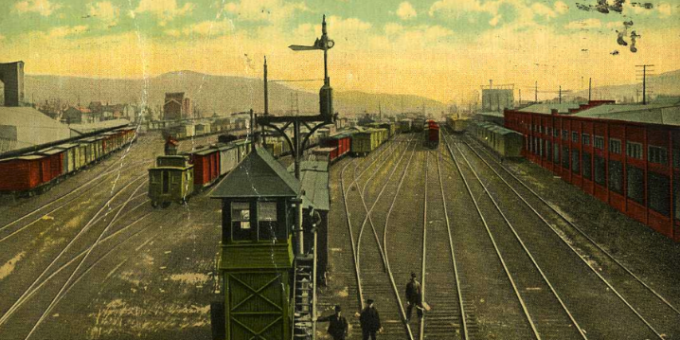
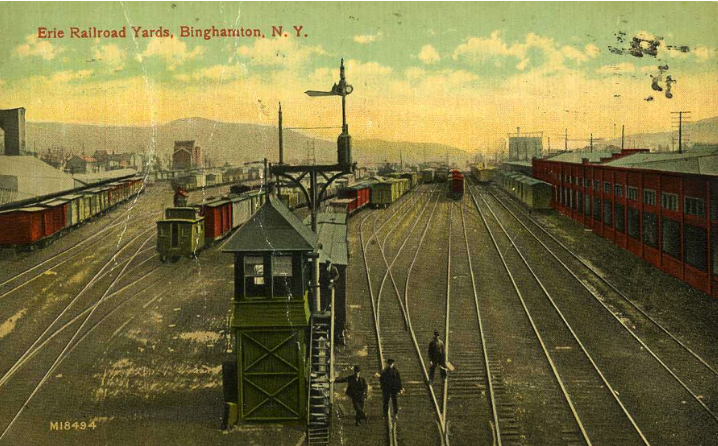
A freight car can feel like a forgotten place, a dark wooden box shunted from one track to another, carrying no one’s attention with it. But on a June morning in 1901, a Lackawanna switching crew in Binghamton, New York, looked inside one such car and found a dead man crumpled in the corner.
He was believed to be Timothy McCarthy, a lake sailor, though even that was uncertain. In his pockets were the scattered contents of a drifting life: ten cents, a razor, tobacco, newspapers, a bit of looking glass, a tattooing outfit, and a seaman’s disability certificate from Buffalo.
His body, marked with tattoos and dressed in sailor’s clothes, had been struck down by two bullets fired close to the heart.
The mystery seemed to stretch across the railroad yard. McCarthy had been seen the day before asking about his traveling partner, another sailor. He had loaned the man a dollar for food.
By the next morning, police were looking at strange clues: a boy-sized blue cap, a black slouch hat, a pawn ticket, and a suspicious sailor seen near the riverbank the night before.
There was also the man who stopped a policeman in plain clothes early that morning, asking the time and the name of the street while carrying a fresh newspaper. His odd behavior stayed in the officer’s mind.
Whether the dead man was truly Timothy McCarthy, and whether his missing partner knew more than he should, the box car had become the center of a grim little puzzle on the tracks.
Found Dead in Box Car
BINGHAMTON, New York. — A lake sailor, believed to be Timothy McCarthy, was murdered last night in this city and his body was found in a Lackawanna freight car this morning. A veil of mystery hangs about the murder, but there are clues which may lead to the discovery of the perpetrators of the crime, though at present it seems doubtful.
About 11 o’clock this morning a switching crew employed in the yards of the Lackawanna went to the east end switch to pick up a freight car which was near the factory of Crandall, Stone & Co. Early this morning it had been taken from the Syracuse tracks in the vicinity of the Stickley-Brandt chair factory and kicked up to the main line switch. When the yard crew went after the car, one of the men looked inside and there he saw in a heap in the corner the body of a man.
Examination showed that he had been killed by two shots from a 32-caliber revolver fired into his left side near the heart. The bullets either passed through the heart or severed the main artery.
The car was brought down to Liberty Street and Coroner Smith and Chief Moore were called. They examined the body and car and found a black slouch hat and a small blue cap, which was of a boy’s size.
The remains were removed to Strait’s undertaking rooms, and there a more thorough examination was made. The man was attired in a pair of sailor’s trousers, brown coat and vest. The body was profusely tattooed and upon the breast was the French motto, “Dieu et mon droit.”
Disability Certificate
In his pocket was found a seaman’s disability certificate signed by William Griffin, master of the port of Buffalo.
The certificate was made out in the name of Timothy McCarthy, and it was stated that he was 28 years old, had dark hair, blue eyes, was 5 feet, 6 inches in height, and was tattooed on the wrists. The certificate was dated May 29 last and showed that the bearer had been employed as a wheelman on the Monteagle of Oswego. It was also stated that Timothy McCarthy had been in the United States service 20 years.
The description on this paper corresponds somewhat with the description of the murdered man, though it might have been more explicit.
Besides the certificate, there were found ten cents in money, an outfit for tattooing, razor, a copy of the Leader of last Wednesday, a copy of yesterday’s Scranton Tribune, a bit of looking glass, a match safe, tobacco and a handkerchief, as well as a pawn ticket that may assist in establishing the man’s identity.
Coroner Smith saw the body at 11 o’clock and thought that the man could not have been dead more than 8 hours.
The murdered man was seen about the yards yesterday. He inquired of some of the railroad men if they had seen his partner, also a sailor. From what he told the railroad men, it was evident that the two had been traveling together, and he let his partner have a dollar to go and get something to eat.
A Probable Quarrel
It is considered a probable theory that the partner did show up at the box car in which the two were staying late in the evening, and then a quarrel ensued, in which McCarthy, if that is his name, was shot.
As the car was on the Syracuse tracks until this morning, it is probable that the shooting occurred in that vicinity.
Last night when the searchers were near the factory of Crandall, Stone & Co., looking for the body of James Moriarity, a sailor came along and remained there for some time. He told those present about being engaged on the lakes, and gave pointers as to how to search for the body. Detective Stephenson saw him there.
This morning about 7:30 o’clock Policeman Hanley was coming from his home with his wife, and at the corner of Chenango and Munsell Streets, a man accosted them, asking the officer the time of day and the name of the street.
His description tallies almost exactly with that of the sailor on the river bank last night.
Policeman Hanley was attracted to the man by his peculiar actions. He had in his hand a copy of the morning paper, which he had probably stolen from some porch, and it is a theory that this was McCarthy’s partner; that he had shot him while the car was on the tracks in the vicinity, and had come out on Chenango Street to avoid being seen.
Policeman Hanley was in his citizen’s clothes and accordingly did not strike the man as being an officer. He had picked up the morning paper, probably, to learn if the murder had been discovered. This man was short in build, wore a soft hat and a small badge upon his vest, and his face was covered with a week’s growth of beard.
Source: The Scranton Tribune. Scranton, Pa. June 29, 1901.