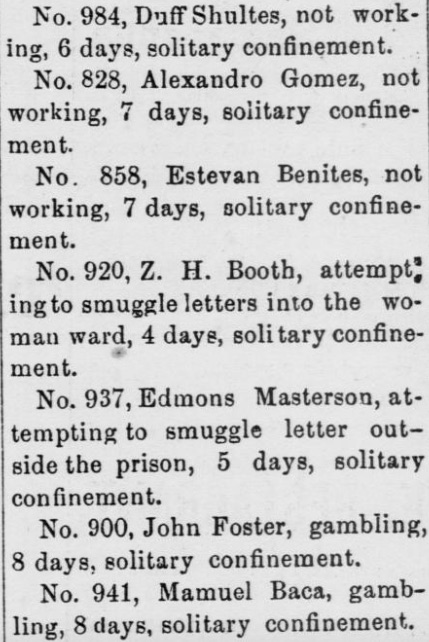
When most of us think of solitary confinement, we picture a small bed and a small room. We expect it would be like a vacation without the daily pressures of everyday life, but that simply was not the case back in the early 20th century.
Bread and Water
When thrown into solitary confinement, you could expect your daily diet to suffer. The common meal for those in confinement was bread and water. It was part of the method used to break a person’s spirit and for many it worked. [1]
Thirst
Prisons were not the only places that used solitary confinement. The Pontiac State Reformatory, a school for boys who were committed for a crime, also practiced solitary confinement on their students.
During a hearing about the tortures used at the school in 1913, many of the boys mentioned the solitary confinement rooms where they were placed. One of the tortures was to not give the boys enough water to quench their thirst. Needing more to drink, the boys had to resort to drinking toilet water just to stay alive. It was a humiliating experience, meant to break their spirits, but all it did was turn them into angry, hardened criminals. [2]
Bedding
Where did inmates sleep when they were placed in solitary confinement? More often than not, they were forced to sleep on the cold, hard floor. Other prisons had the men in solitary confinement shackled up to the wall and, in which case, they had to sleep while dangling in pain. The more fortunate prisoners in confinement were given wood boards to sleep on so that they would wake up sore the next morning. Blankets in solitary were extremely rare. [3]
No Heating
Back in 1912, the suffragettes were often arrested and placed in solitary confinement as punishment for their struggles to gain equality. One woman, Mrs. Emmeline Pankhurst, was one of these women. She was arrested and placed in solitary confinement in the Holloway prison, London, and shortly afterwards she developed a bad case of bronchitis.
Her friends were, of course, concerned over her condition and the condition of the confinement. After all, the damp, dark, little room had no heating in it whatsoever. [4]
Like Being Buried Alive
Amilcare Cipriani, an Italian socialist, spent many years in an Italian prison where he was placed in solitary confinement. In an article, published in 1908, there was a debate on which was more cruel: the death penalty or solitary confinement. Cipriani had this to say on the matter:
“[F]or solitary confinement is a thousand times more cruel than a blow from an ax and a leap into eternity. Solitary confinement in a cell is a lingering agony, after two or three years of which the strongest man must die or must go mad. He is literally buried alive. His food is just enough to keep life in him. He may neither read nor write and gets no news from outside, even of his family. He may receive no visits and have no intercourse with anybody. He may not talk, and if he does ask a question of one of his jailers the jailer does not answer or answers by a sign.” [5]
Death was an Option
For many men who had already endured time in solitary confinement, the idea of going back in the hole was too much for them to endure. Instead, they opted to take their own lives and avoid the starvation, beatings, and loneliness. [6]