
The article, published in 1916, gives a look at how the U.S. goverment was beginning to look into the magic mushrooms of Mexico and how they might be used to benefit society at large.
The Mystery of Mexico’s Sacred Mushroom
A long puzzling mystery of ancient Mexico is now being worked out by scientific experts of the United States government, with the expectation of turning it to useful and profitable account. It relates to the “sacred mushroom” of the Aztecs, revered by them as a holy plant, and to this day is eaten by some tribes of Mexican Indians in religious ceremonies.
It is a powerful narcotic, producing the most fantastic visions, and is regarded by the Indians as a key which, in the ceremonial, opens to them all the glories of another and better world.
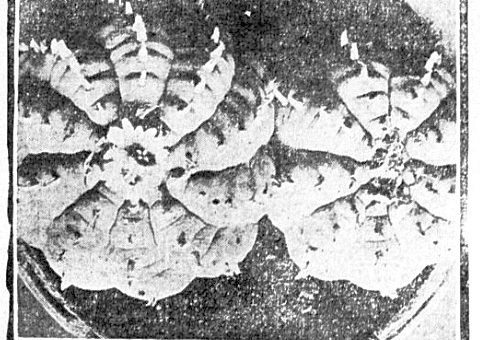
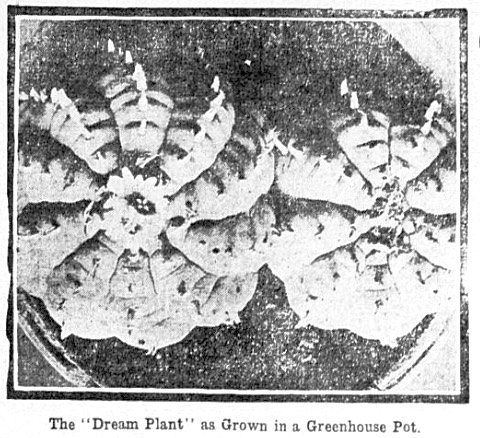
The plant grows wild, though not plentifully, in the valley of the Rio Grande, in barren and even rocky soil. But the government experts have recently undertaken successfully to raise it under glass in pots; and the active principle, a hitherto unknown alkaloid, has been separated from it in the form of white, needle shaped crystals.
In all likelihood this alkaloid – called anhalonin, after the botanical name of the plant – will prove very useful in medicine. Dr. Lyman F. Kebler, chief of the division of drugs in the chemistry bureau at Washington, is at present conducting preliminary experiments with it.
Its Virtues as a Bracer
For one thing, the narcotic is said to have a wonderful potency in subduing the unpleasant after effects of over indulgence in alcohol. It is likely, therefore, to achieve great popularity as a bracer, when, after a while, it finds its way into the hands of the apothecary. The ease with which (as newly ascertained) the plant may be cultivated under glass would suggest that the cost of the drug derived from it ought not to be excessive.
Indeed, it has been found that a tincture made by simply chopping up the plant and allowing it to soak in dilute alcohol for a couple of weeks is a most serviceable remedy for nervousness, headache and insomnia. When chewed (the Indians say) it stops the painful coughing of consumptives.
So far as ascertained, the narcotic does not affect in any way the intellectual faculties, even after long and habitual use. Furthermore, it is remarkable in having no Nemesis. In other words, there is no depressive or other disagreeable after effect.
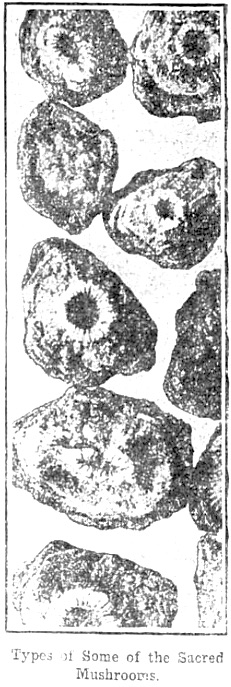
It was Mr. W. E. Safford, a botanist of the government plant bureau, whose original researches identified the plant with the “sacred mushroom” of the Aztecs. But it is not a mushroom at all. It is a species of cactus, somewhat resembling a radish in shape, covered with sharp prickles, and with a button-shaped top – the latter being all of it that appears above ground.
The army Spanish missionaries in Mexico, finding it employed for vision-producing purposes in the native religious ceremonials, naturally disapproved of the plant. They called it “devil’s root,” and pronounced the eating ot it a crime not less heinous than that of eating human flesh.
Even at the present time the buying and selling of it is forbidden in Oklahoma, where the Kiowa Indians (who formerly dwelt in the Rio Grande Valley) still use the plant in their religious festivities, obtaining it from traders. The missionaries complain of it, and – though none of them, nor any agency physician, has tested it or taken the trouble to witness the ceremonial – their representations have caused the federal government to inflict severe penalties for the offence of using or possessing it.
The government experts, however, have recently made a number of interesting experiments with the plant. In one of these a young chemist was the subject. Before going to bed, he swallowed three of the “buttons” (cactus tops), and then awaited results. The first sensation he felt was one of slight nausea. This soon passed, and, closing his eyes, he experienced a series of curious optical impressions. Beautiful designs, more or less geometrical, in brilliant and ever-changing colors, floated before him.
He swallowed a fourth button, and thereupon passed in review a series of delightful visions. His mind, in the meantime, remained clear and active. Stretched on his bed, he watched with utmost pleasure an ever changing panorama of infinite beauty and grandeur. To some extent he was able to control the visions. By fixing his mind on something unpleasant, he summoned into view myriads of crawling monsters and multitudes of gruesome forms with human faces. But, though horrible enough to frighten anybody under normal circumstances, these nightmare phantasms were to him merely jolly and amusing.
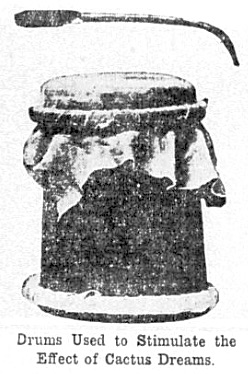
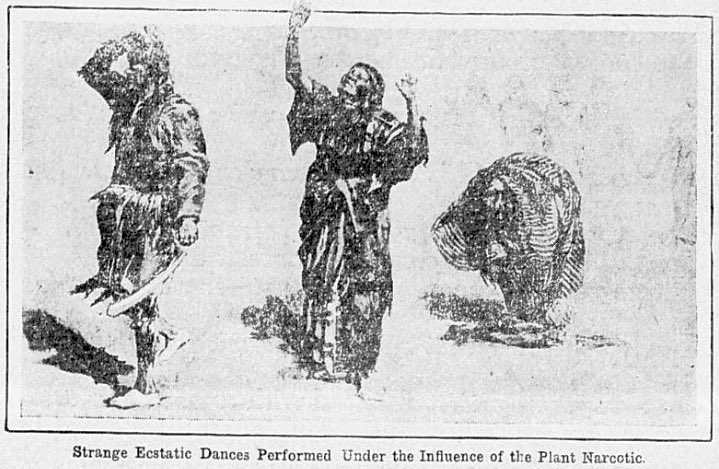
There was no distressing subsequent reaction. But experiments with other persons proved, rather curiously, that the sound of a monotonous drumming (such as the Indians make when they eat the plant in the ceremonial) greatly enhances the beauty and variety of the visions. It is easily understood, then, why the aboriginal cactus eater indulges in this performance – the group thus engaged sitting all night with their blankets drawn about them, and each man ready to take his turn with drum and rattle.
The sensation they experience is said to be one of ecstatic happiness. Their hallucinations are supposed by them to be a supernatural grace, by which they are permitted to pass through the portals of Paradise and communicate with the gods. Some of the religious societies among the Mexican natives look upon the ceremonial as a kind of communion, in which the cactus is eaten as an incarnation of Deity. A popular name by which it is known is “flesh of God.”
The plant is believed to possess not only medicinal value, for the cure of many diseases, but also to sustain the body against fatigue. One who eats it, it is claimed, feels neither hunger nor thirst, but it gives him courage to fight, and protects him from danger. Nay more, it is even said that it gives to the person under its narcotic influence the power to penetrate beyond the barier that limits normal knowledge, to see into the future, and to predict what it soon to happen – for example, a change of weather, or an attack by an enemy.
The prickly root as well as the top contains the narcotic alkaloid, but, for some reason unexplained, the buttons have commercial preference. In the dried state they are brown in color, hard and brittle, but soften quickly in the mouth. They have a rather nauseous and bitter taste. The “button” of the growing plant forms a sort of compact tuft and at the proper season bears a flower.
Analysis of Wild Dream Plant
Incidentally to the process of taming the wild dream plant here described, with a view to rendering it useful to mankind, the government experts have subjected it to a thorough analysis. Dr. Kebler obtained from it, by maceration in alcohol, a brown sirupy liquid which, on being taken to pieces by laboratory methods, yielded not only anhalonin – the active principle already mentioned, which took the form of brilliant white, needle shaped crystals – but also another alkaloid, very poisonous.
The possible importance of this newly discovered alkaloid, anhalonin, is not to be lightly underrated. One should remember that two of the most valuable of known medicinal substances, quinine and cocaine, were made known to modern civilization through a previous acquaintance with them by Indians who had ascertained the usefulness of coca leaves and cinchona bark – the latter as a remedy for malaria.
Source: The Sunday telegram. (Clarksburg, W. Va.), 03 Sept. 1916.