
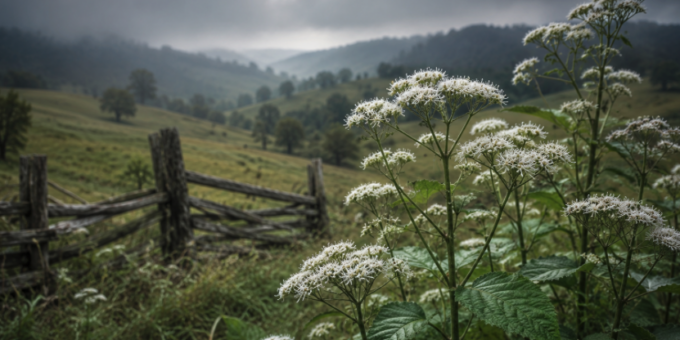
Milk sickness was once one of the most dreaded mysteries of rural America. It appeared without warning, striking both families and livestock with violent thirst, trembling, weakness, and death.
By 1905, when the following article was published, people understood that the illness was connected to milk from cows that had grazed on a poisonous plant. What they did not yet fully understand was why that plant was so deadly.
Today, milk sickness is known to have been caused by cows eating white snakeroot, a plant that contains a toxin historically identified as tremetol. The poison could pass into a cow’s milk and then sicken anyone who drank it. Modern farming practices have made the disease rare, but in the 1800s and early 1900s, especially in rural and frontier regions, it could devastate entire communities.
This 1905 article from Tennessee captures the fear and confusion that surrounded the disease before science had completely solved it. The writer describes “Milksick Mountain” in White County, the failed theories about minerals, dew, and fungus, and the grim suffering of both people and animals caught in the path of this strange and deadly sickness.
Tennessee Milk Sickness
From time to time in the last five decades Tennesseans have been stirred to a profound sense of interest in the State’s mysterious malady, “milk sickness,” as its deadly reappearance in certain sections of the State has been followed by fatal results to human beings and to stock.
No one has ever discovered the cause of the malady from which death relieves the victim, after such physical agony as almost deprives the human species of the power of speech and dumb brutes express their sufferings by frenzied search for water to cool the thirst which consumes them. Once by a stream, they plunge or fall into it, and quickly drink themselves to death.
The fatal sickness is known to a limited extent in several sections of the State, but exists principally near Sparta, in White County. It is contracted through drinking the milk of cows that have eaten a certain weed, known as the “milk-sick weed,” which looks somewhat like clover, and grows thickly on the infected land.
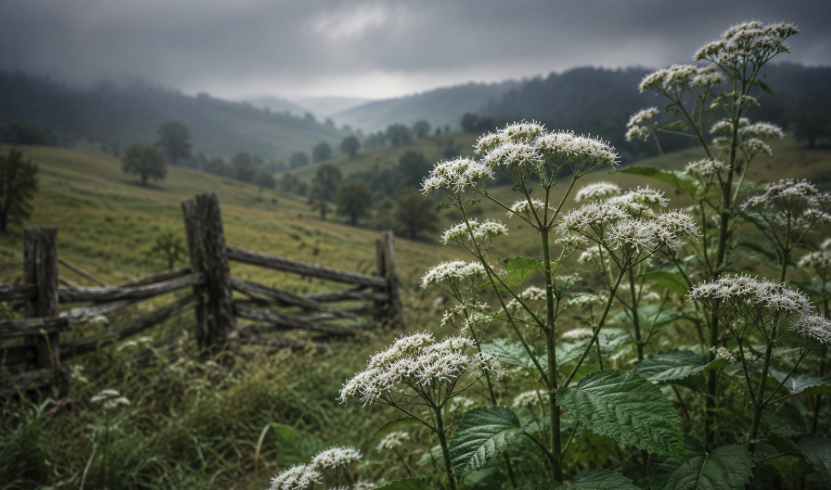
But what constitutes the poison in the weed is no more determined today than it was when first located by the keen-witted nature-wise mountaineers, who have been its chief victims. It has been ascribed at various times to minerals, whose poison is absorbed in the roots of the “milk sick” plant; to a vapor from some fungus, and to the action of the dew, producing, in connection with the life of the plant, a certain poisonous acid.
But all of these theories have failed under tests applied by practical science. On the largest section known to exist in the limits of the State, “Milksick Mountain,” in White County, no mineral whatsoever exists; cattle which ate the “milk sick weed” after the dew had dried died in agony, just as those which ate it when the dew was fresh and sparkling, and the strictest search failed to find any fungous growth whatever.
Source: Elk City Mining News. Elk City, Idaho. April 29, 1905.