When 84,000 Bottles of Milwaukee Beer Were Dumped Into the Sewer
In 1919, as Prohibition tightened its grip across the United States, beer did not always disappear quietly. Sometimes, it went out in a spectacle.
The following article describes one of those strange public dramas: the destruction of tens of thousands of bottles of Milwaukee beer in Zion City, Illinois, after authorities seized shipments believed to be headed toward Chicago saloons.
What began as a steady stream of beer-laden trucks passing through town turned into a legal fight involving local officials, federal courts, saloon interests, brewers, truck drivers, lawyers, and Judge Kenesaw Mountain Landis, one of the most famous judges of the era.
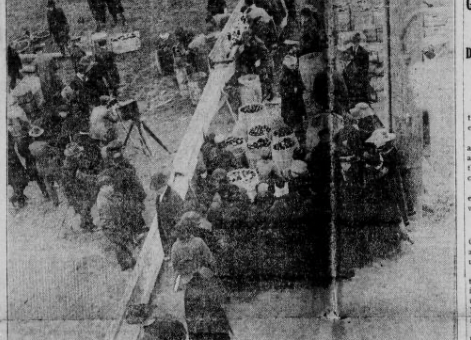
The article has all the theatrical language of the temperance movement. Beer becomes “John Barleycorn,” marched to its scaffold. Firemen in rubber boots serve as executioners. A long wooden trough becomes the instrument of destruction.
Photographers and moving picture cameras gather to capture the moment for newspapers and audiences far beyond Zion City. Even the empty bottles had a second life, reportedly being sold to help fund a concrete road.
Behind the spectacle was a serious conflict over alcohol enforcement just before national Prohibition fully took effect in January 1920. Communities, courts, brewers, and saloon keepers were all testing the limits of new laws and local authority.
For dry reformers, the dumping of the beer was a public victory. For the “wets,” it was a symbol of government overreach and wasted product.
Today, the story reads almost like dark comedy: a town spending two full days pouring beer into the sewer while cameras rolled and a crowd looked on. But in 1919, it was part of a much larger battle over alcohol, morality, law, and American daily life.
Milwaukee Beer Dumped in Lake By Court Order
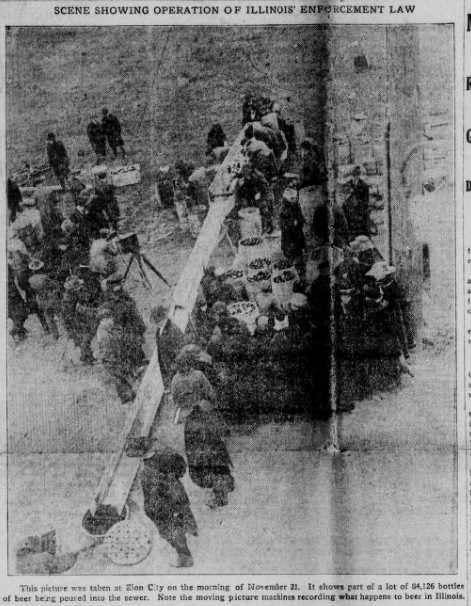
On November 21st, Zion City staged the final act in the great beer smuggling drama in which Judge Landis, dozens of lawyers, hundreds of saloon keepers, members of the Legislature, rich Milwaukee brewers and poor Chicago truck drivers took part. This final scene consisted in the dumping of 84,126 bottles of beer into the sewer. This was only a little more than half of the total of 138,997 bottles seized at Zion City before the importation of beer from Milwaukee stopped.
John Barleycorn’s Scaffold
A specially constructed wooden trough 45 feet long was built to facilitate the work of emptying the beer bottles. Firemen wearing rubber coats and rubber boots opened the bottles and turned them upside down in the trough. Chief of Police, Theodore Becker, superintended the work of executing John Barleycorn while a crowd of onlookers surrounding the scaffold watched the proceedings.
Three moving picture machines were trained on the scene and a dozen newspaper photographers got pictures to be sent all over the country and all over the world.
Bottles Bring $2,148
The beer was destroyed by oder of Judge C.C. Edwards of the Lake County Court. The empty bottles were sold to a Waukegan junk dealer for $2,148. The proceeds, it is said, will be used to build a concrete road through Zion City. Considering the advertisement of what happens to beer illegally transported through this neighborhood it is safe to predict that not much of the forbidden Milwaukee beverage will be hauled over the road built from proceeds of the empty beer bottles.
The five men employed to pour the captured beer into the Zion City sewer worked from 9 o’clock in the morning to 9 o’clock at night, and in that time were able to dispose of only 53,000 bottles. The balance was emptied next day by a force of high school boys who volunteers for the work.
How Beer Case Started
The Zion City Beer smuggling episode began when Theodore Forby, village attorney, noticed droves of motor trucks loaded with beer cases going southward through the city. Many times they were compelled to go two abreast. Looking through the law books, Mr. Forby found nothing that would give him power to stop these beer laden trucks.
Unable to procure any information on the provisions on the new search and seizure law, he was baffled, temporarily, and compelled to watch real beer pass by unhindered on its way from the breweries of Milwaukee to the saloons in Chicago.
The Search and Seizure Law
Then one day, Dr. T.R. Quayle came to Mr. Forby’s office direct from Springfield with a precious copy of the search and seizure law passed by the last session of the Legislature. Within one hour the proper papers were made out and three beer trucks captured.
In the days following, many more were brought into Zion City and held under the provisions of the new law.
The Wets’ First Move
A deputy U.S. Marshal promptly made his appearance with a writ of replevin and demanded that the trucks be released. Attorney Forby was called out of bed, for it was late at night, refused to release the trucks and spent the balance of the night fighting to keep them from being taken out of the jurisdiction of the local officials.
Attorneys for the truck drivers then secured a temporary injunction from Federal Judge Sanborn, under which the trucks were released to the owners under the guardianship of a federal receiver.
Then the Fun Began
Next, the truck men’s attorneys endeavored to have the temporary injunction made permanent, thus taking the trucks entirely out of the hands of the state authorities. They also started proceedings to recover the beer.
The case came before Judge Landis. Enough said. What happened is now well known.
Source: The American Issue. Westerville, Ohio. December 5, 1919.