When X-rays were first announced to the world in late 1895, they seemed almost miraculous. For the first time, doctors and experimenters could look beneath the skin without a knife, seeing bones, bullets, and hidden injuries by means of invisible rays.
The discovery spread quickly, and by 1896 and 1897, X-ray machines were being used in medical offices, laboratories, public demonstrations, and private experiments. But the early operators did not yet understand the danger of repeated or prolonged exposure.
Protective shielding was crude or absent, exposure times could be very long, and patients were sometimes placed close to the tube while experimenters tried to get a clear image.
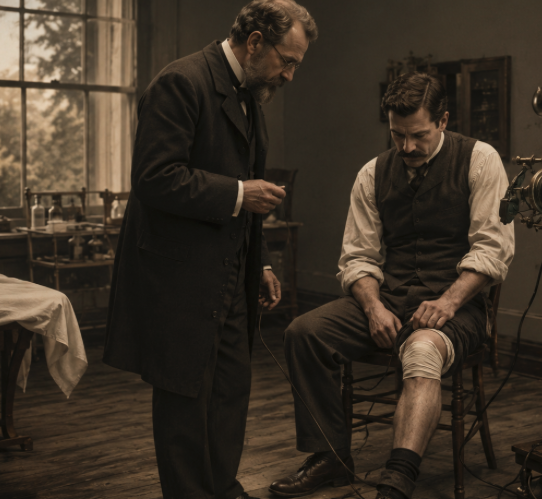
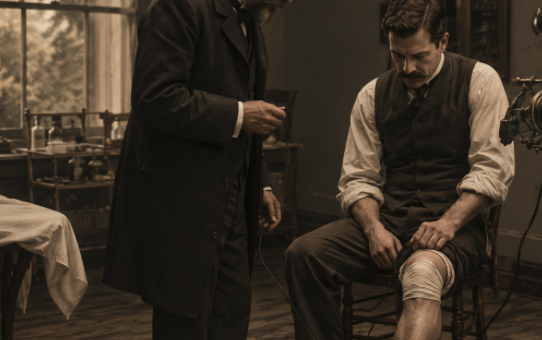
Early injuries included redness, blistering, hair loss, deep skin ulcers, and wounds that refused to heal. These injuries were often called “X-ray burns,” though many people at the time still debated whether the rays themselves, electricity, heat, ozone, or some other force caused the damage.
The following 1897 report shows just how dangerous these early experiments could be. George F. McCulloch of Muncie, Indiana, submitted to an X-ray examination because of trouble with his leg. During the procedure, his knee was burned by what the article called “cathode rays,” a common early term connected to the experimental tubes used to produce X-rays. Instead of healing, the wound worsened. Blood poisoning set in, and doctors feared he might lose his left leg.
An X-ray Victim
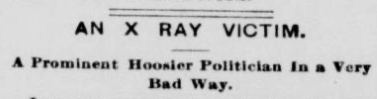
INDIANAPOLIS, Indiana. — George F. McCulloch, of Muncie, who succeeded “Oom Jack” Gowdy as chairman of the republican state central committee, is at a sanitarium in this city, and likely soon to lose his left leg on account of an X-ray burn several months ago.
Blood poisoning has set in, and even worse consequences are to be feared.
Mr. McCulloch submitted to an X-ray experiment on account of trouble he had been having with his leg, and in the experiment his knee was burned by the cathode rays. The burn refused to heal.
Source: The Forrest City Times. Forrest City, Ark. July 16, 1897.