In the early 1900s, death was not always as certain as it seemed.
Doctors had fewer tools, homes often served as sickrooms, and the line between deep unconsciousness and death could sometimes be terrifyingly thin. A person who had been ill for weeks might fall into a state so still and quiet that even trained men believed the end had come. Once the body was pronounced dead, the undertaker was called, and preparations for burial began quickly.
That is what makes this 1913 story from Ulysses, Pennsylvania, so unsettling, and, in its own strange way, darkly funny.
Henry Bilden had been sick for several weeks when he was believed to have died early one morning. A physician reportedly pronounced him dead, and undertaker Stephen Long arrived to begin the embalming process.
Then, just as Long was preparing to make an incision in Bilden’s arm to inject embalming fluid into the arteries, the “corpse” sat up.
Instead of gasping dramatically, delivering a ghostly warning, or frightening everyone with a speech from beyond the grave, Bilden did something far more human: he yawned and asked for breakfast.
“Corpse” Asks For Food
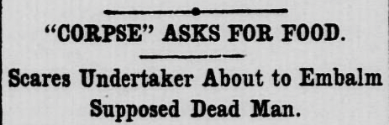
ULYSSES, Pennsylvania. — In the act of making an incision in the arm of the “dead” body of Henry Bilden, preparatory to pumping the embalming fluid into the arteries, Stephen Long, an undertaker, received the fright of his life yesterday when the “corpse” sat up, yawned and asked for some breakfast.
Long, who on the first appearance of life, had dropped quickly away from the “corpse” of Bilden, was stunned at the cool demand of the dead man.
Mistaking Long’s astonishment for a refusal to accede to his request, Bilden began a tirade of abuse, which the undertaker declares no “live one” ever did.
Bilden, who has been ill for several weeks, was supposed to have died early yesterday morning. Physicians pronounced him dead, and Undertake Long was sent for. After Bilden’s hunger had been satisfied, he declares that he had been away to a strange land, where the people had refused to give him anything to eat.
Source: Evening Star. Washington, D.C. January 25, 1913.