War has a way of reviving old industries.
In 1918, as World War I reshaped American manufacturing and pushed prices skyward, charcoal burning suddenly became important again near Omaha, Nebraska. What had once been one of the oldest and simplest trades became a wartime necessity, feeding demands for medicine, chemicals, fuel, and even gunpowder.
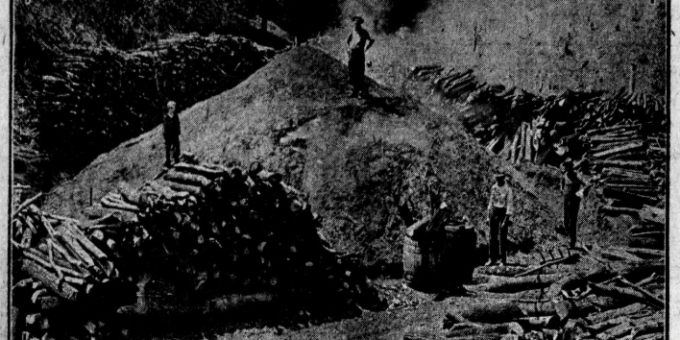
North of Florence, on the farm of Roy Brown, the bluffs along the Missouri River were being stripped of willow and other native woods. Small armies of woodchoppers supplied the great conical kilns, where stacked billets of wood were sealed beneath hay, manure, and sand, then slowly burned for days.
From those smoldering mounds came charcoal, wood tar, methyl alcohol, acetone, creosote, and other useful products.
The newspaper account makes the industry sound both practical and strangely enchanted. By day, the kilns were part of wartime commerce. By night, they became miniature volcanoes, sending colored vapors into the moonlit air while the charcoal burner kept watch over deadly gases and hidden fire.
Fortunes of War Locate New Industry in Omaha: Charcoal

OMAHA, Nebraska. — The fortunes of war have located a new industry, and yet one of the oldest of industries extant, within the environs of Omaha.
It is that of charcoal burning.
There is a big demand for charcoal in the mechanical arts and in medical and other sciences. Previous to the war the principal source of supply for the country was in the south.
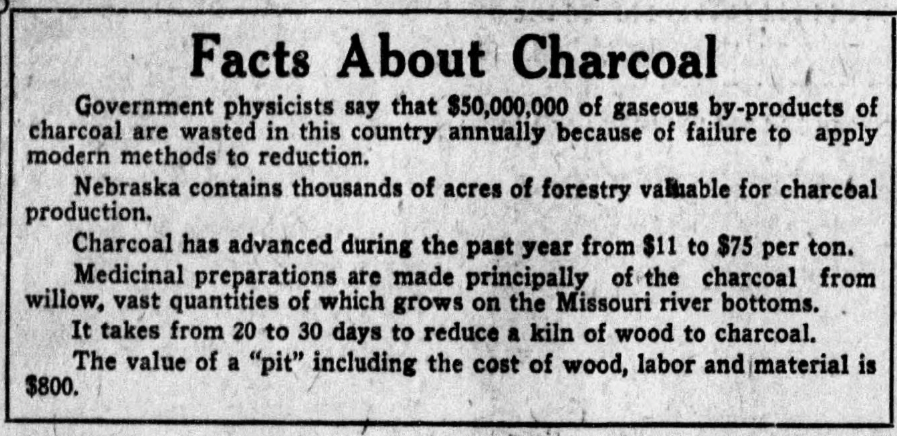
War demand has caused the price of charcoal to advance from $11 per ton to $75 per ton.
The native woods of this section are admirably adapted to the production of charcoal for fuel and scientific uses, and the charcoal industry here, located on the farm of Roy Brown, a short distance north of Florence, is of considerable importance.
Most of the charcoal produced from the Florence kilns is purchased by a local manufacturing concern as raw material from which is produced medical preparations of absorptive values. Wood tar, a derivative of species of wood which grow in abundance along the bluffs of the Missouri River close to Omaha and Florence, is used for the manufacture of rare chemicals through a process of combustion and distillation. From it is produced pyroligneous acids, wood tar, methyl alcohol, acetate of lime, acetone, furfural and creosote. Box wood charcoal is prolific of these products.
Used For Gun Powder
Freshly made dogwood charcoal is used in making the best grades of gunpowder.
The trip to the Omaha charcoal fields is made along a picturesque river road with the verdure clad bluffs, caved into many fantastic shapes by the effects of ages of erosion, forming a rampart on one side. The bluffs are clad with timber of many species and is a refuge for birds of brilliant plumage, graceful flight and sweet song.
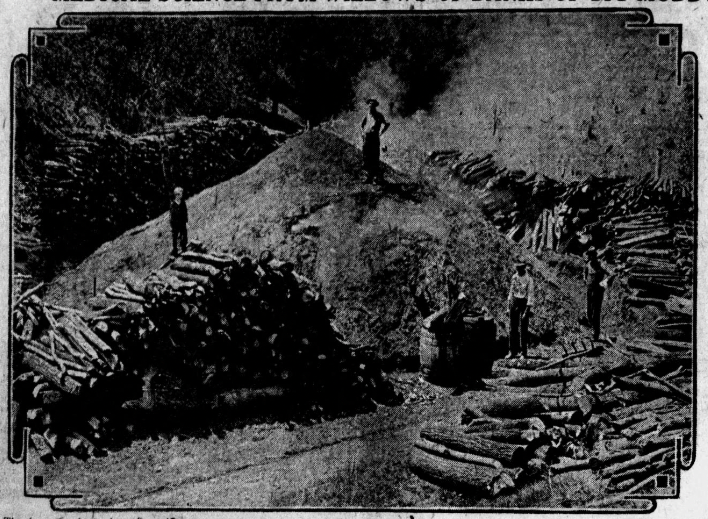
Near the park-like woodlands which are yet unchanged, a small army of woodchoppers are denuding the hills of their growth of trees in feeding the insatiable fires of the kilns which burn for days and produce their wealth by the destruction of timber.
The wood, principally of willow, is stripped of its bark and cut into cord lengths. This is placed in kilns located between two low hills to protect them from the brisk winds of the different seasons. The kilns are conical shaped and are made of piles of wood billets and are approximately 15 feet high and 150 feet in circumference. When completes they look like gigantic Indian tepees. After the wood is piled up a layer of hay or manure is spread completely over the mound for the purpose of excluding too great a draft into the retort too great a draft into the retort where the wood must smolder for days. Sand is then spread over the whole to a thickness of six inches and tis covering absorbs superfluous moisture and adds to the strength of the structure.
There are air intakes at the base of the mound to regulate the draft and the combustion which must be watched every hour during the day and night.
Combustion Downward
Fire is kindled at the top of the mound and the combustion is downward, the opening at the top being covered with ground mixture and hay to seal it up.
If there is any poetry in the soul of the charcoal burner who watches the kilns at night, he must unconsciously become an atavistic worshipper of fire and a Druidical devotee of the woods. There is beauty in the slender, spiral streamers of steam that flow from the miniature volcanoes under his charge and if he is a dreamer he can see in them many a fairy castle, or one in Spain or some other land of romance. The deep shadows of the woods, the silvery gleam of the waters of the might Missouri, as they glint and shimmer in the mystic moonlight, the whispering plaints of vagrant breezes, the sleepy call of night birds, and the sighing of unknown things in the dead watches of witching hours all must evoke in him the subconscious spiritual longings of his primal state.
Clouds of Gases
Later, in the process of combustion, his eye is delighted by the play of a myriad of ethereal clouds of gases, sometimes of mauve, again of heliotrope, of the most fascinating pinks and purples, of cerulean blue, flashing to angry bronzes and livid reds. Their play is like that of the emotions of a beautiful Circe of the woods with all the allurement of dancing coquetry and consuming passion.
The colors are indicators of the various stages of combustion and when a glorious cloud of vapor of an indigo tinge arises from the different small openings they are closed and new ones are made nearer the base.
The kilns, as they burn, decrease in size and when flames, like hissing serpents, squirm from the foot holes they tell the charcoal burner that the proper stage of charring has been reached and he shuts off all of the draft and smothers the fire.
The charcoal is then ready for the uses of commerce.
Perilous Occupation
The business of charcoal tending is a perilous one, for the gases generated are of an insidious and deadly nature.
An instance is related of a charcoal burner who inhaled gas while he was in the act of closing one of the draft holes at the top of the retort. He was strangled and blindly attempted to reach a place of safety. Hidden from his view, as he groped along was a bed of red hot coals. He crashed through the thin covering of dirt and fell into a fiery pit and was instantly burned to death.
A pile of wood used in an ordinary kiln loses 80 percent of its weight in being reduced to charcoal and 50 cords of wood will yield about 1,500 bushels of charcoal.
Source: Omaha Daily Bee. Omaha, Neb. June 9, 1918.