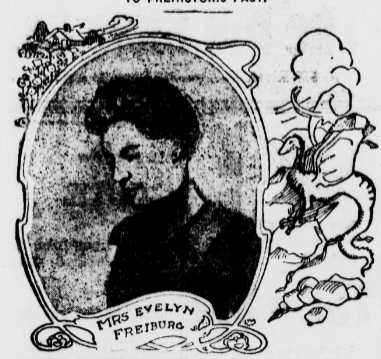
According to a 1902 report, Freiburg’s love of flowers led to a horrifying and bizarre end. She would gather roses and sweet peas in great armfuls, pressing her face into them to breathe in their perfume. From there, the story claims, a small worm entered her nostril, traveled into her brain, and lodged near the pineal gland
(the so-called “third eye”).
What followed was described as a months-long descent into a prehistoric nightmare.
Doctors and scientists, the article says, were baffled as Freiburg began describing monstrous creatures, strange birds, reptiles, unknown mammals, and human beings who spoke in a language no one recognized.
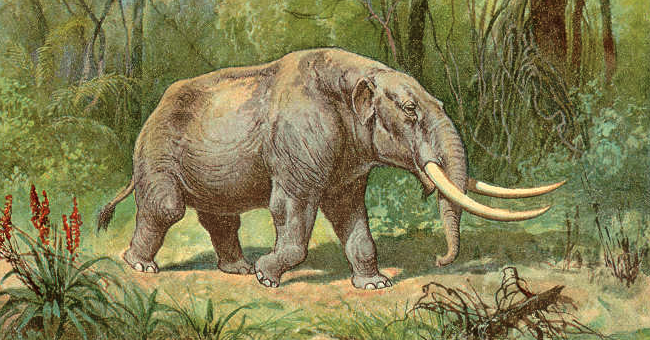
She seemed to believe her bed was a cave or high refuge, where she hid from mastodons and other ancient beasts. The newspaper framed her condition as a case of atavism, suggesting that the worm had somehow awakened a lost ancestral sense and forced her mind backward into a pre-human world.
Modern readers will likely see sensationalism, misunderstanding, and medical fantasy woven through the report. But that is part of what makes the article so fascinating. It offers a glimpse into a time when science, superstition, evolutionary theory, and newspaper exaggeration could combine to create one of the strangest diagnoses imaginable: a woman supposedly living in fear of mastodons because of a worm in her brain.
Lived in Fear of Mastodons
COUNCIL BLUFFS, Iowa. — By a strange accident, due to her fondness for flowers, Mrs. Evelyn Freiburg not only came to her death, but lived for months, so far as her mind was concerned, in a prehistoric age.
Her case has been the marvel of physicians and scientists and only the autopsy offered any solution of the mystery.
Mrs. Freiburg used to gather great armfuls of roses and sweet peas and bury her face in them to inhale their fragrance. A small worm lodged in one of her nostrils and penetrated the brain to the pineal gland, or “third eye,” where it was found during the autopsy.
This gland is believed to be the vestige of a third eye possessed by prehistoric man. The theory is that the presence of the foreign body revived the functions of this extinct eye, forcing the unfortunate woman to witness prehistoric scenes and making her the strangest case of atavism on record.
After she was seized with her unique form of insanity, Mrs. Freiburg frequently saw before her and perfectly described strange monsters, mammals, reptiles and birds. Many of these corresponded with the dinosaurs, megalosaurus, megatheria, pterodactyls and mastodons known to geology; but others were such as scientists have never heard of.
She often beheld and attempted to converse with strange human beings. Occasionally she repeated a few words in an utterly unknown tongue, speaking the syllables slowly and distinctly as though repeating them after dictation.
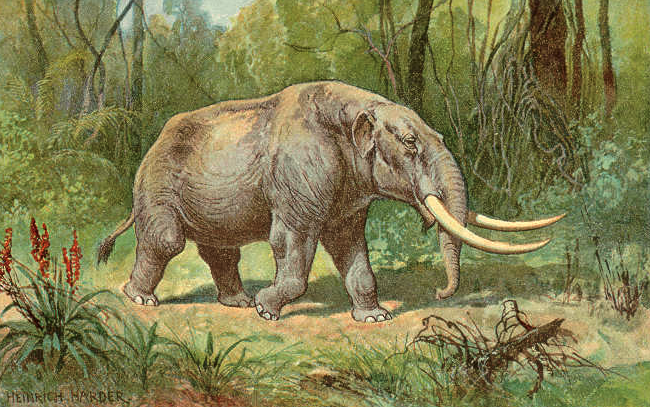
Sometimes she rushed to her bed, climbed on it and lay down, peering cautiously over the edge at some animal she “saw” far below. From her description, the vision is believed to have been that of a mastodon. It inspired in her greater fear than any other of her strange sights, causing her to scream and wave her arms, as though to frighten away the monster or summon assistance.
She evidently thought her bed a cave or high place of refuge, as she invariably sought it when alarmed. She seemed to be living a wild life in an unknown country, fearful of destruction by huge animals closely corresponding to those of the Mesozoic age. She ate without knife or fork and seemed ignorant of the uses of clothing or furniture.
After she had lost all of her ordinary senses, she seemed to have regained another, lost for ages, in her ability to recall scenes and sensations of the time when the almost extinct organ of the brain was active.
It was not until the autopsy that it occurred to anyone that the patient had been living, intellectually, in a pre-adamite era. So no adequate or accurate record was kept of her seemingly incoherent words and acts.
Now scientists are trying to record, as minutely as possible, all that her relatives and attendants observed.
Source: The Spokane Press. Spokane, Wash. November 10, 1902.