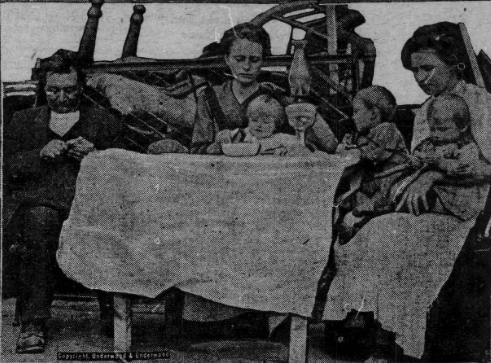

In 1924, jazz was more than music. To its critics, it was a symbol of everything fast, restless, and dangerous about modern life.
The dances were quicker, the cities were louder, women were entering offices and factories, and some doctors believed the human body, especially the female body, was not built to withstand the strain.
Dr. Max G. Schlapp, a New York neurologist and children’s court clinic director, claimed that the “modern jazz life” was damaging women’s nerves, upsetting their glands, and even affecting the children they bore.
His warning reflected the anxieties of the era as much as its medicine: a fear that modern work, pleasure, and independence were pushing society toward nervous collapse.
Jazz Life Breaking Women, He Claims
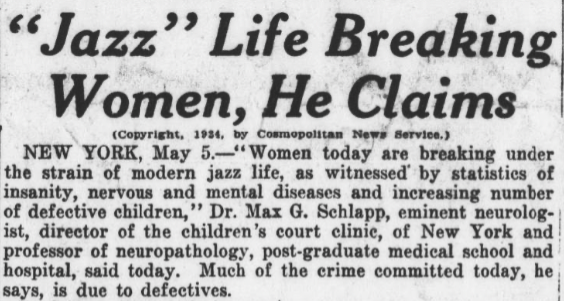
NEW YORK. — “Women today are breaking under the strain of modern jazz life, as witnessed by statistics of insanity, nervous and mental diseases and increasing number of defective children,” Dr. Max G. Schlapp, eminent neurologist, director of the children’s court clinic, of New York and professor of neuropathology, post-graduate medical school and hospital, said today. Much of the crime committed today, he says, is due to defectives.
Dr. Schlapp disputes the common theory that insanity is purely a brain condition. Its seat, he says, to a great extent, is unquestionably in the endocrine glands, which absolutely control brain function.
“Disturbance of the internal secretor glands, owing to shocks, thrills, fears and excitements through which modern woman daily pass,” said Sr. Schlapp, “is the far more frequent cause of such damage to nerve groups and centers.
Healthy Body Needed
“There is today little or no repose, one of the chief factors in a well-balanced mind and a healthy body.
“Neurotic mothers are producing neurotic and worse still, defective children.”
Dr. Schlapp’s conclusions were reached after many years’ work and a study of more than 20,000 cases largely of a clinical nature.
“If we may postulate an ideal man, mentally,” says Dr. Schlapp, “he must be an individual possessing the largest number of neuron groups, all of them in complete health and so attuned, each to all the others, that perfect, nervous harmony will exist. Such a man or woman would react brilliantly, judiciously and normally under all circumstances and environments. He or she would, indeed, be a creation beyond the superman or superwoman.

“That no such fabulous creature exists or could exist, we may be tolerably certain. No human being may hope to defy the forces of constant evolutionary change, vast environmental mutations, the strain of living and struggling and the ravages of the years.”
Instability and flightiness, lack of responsibility and crime, the attributes largely to the damage inflicted on the endocrine gland system by modern method of living and its attendant strain.
Expend Reserve Energy
“Under modern social and economic conditions,” continued Dr. Schlapp, “increasing numbers of women are expending the energy intended to be reserved for their vital function for what was formerly considered man’s work. It is only natural that such women are likely to bear poor children and thus to add materially to the afflictions of society.
“The constant shocks to which a woman is subjected in industrial and business life have the effect of upsetting her glands and nervous system. We have already seen what results from such disturbances. It is a fact, well understood by all neurologists, that women are peculiarly sensitive to emotional stresses and to all manner of thrills, fears, and excitements. Woman is by nature more unstable than man. She is ill-adapted to the struggle for subsistence and her projection into the vortex of industrial life is daily proving a more and more serious menace to the future of the race.
“Abnormal behavior is caused to a great extent by disturbances of the glands and neuron centers and this trouble may be corrected very often through treatment of the endocrines. It requires no feat of the imagination to understand the connection between these grave or dramatic cases of malfunction in the central nervous system and the less obvious peculiarities of conduct and character in mankind up and down the social scale.”
Source: The Washington Times. Washington, D.C. May 5, 1924.