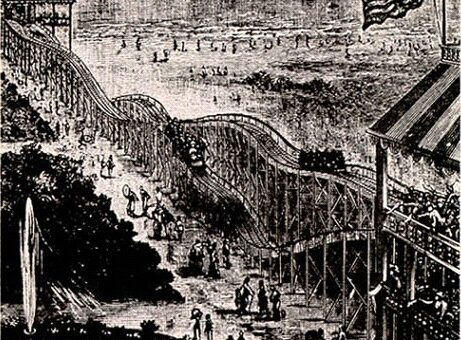
Before looping steel giants, “switchbacks” delivered thrills and danger. Inspired by Pennsylvania’s famed Mauch Chunk Switchback Railway, early gravity rides sent bench cars racing down steep runways and hauled them back up by cable, a direct forerunner of the modern-day roller coaster.
1. A Horrible Accident
On Sunday afternoon, August 5, 1906, danger turned tragic at Fort George in upper Manhattan. Nineteen-year-old Katherine R. was jolted from a car on the switchback at 193rd Street and Amsterdam Avenue; her clothing caught, and the car dragged her up and down the incline in full view of crowds along the Harlem River Speedway. Police closed the ride and arrested the proprietor.
The New York Tribune article tells us that:
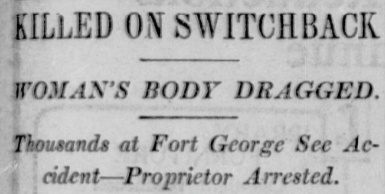
Killed on Switchback — Woman’s Body Dragged
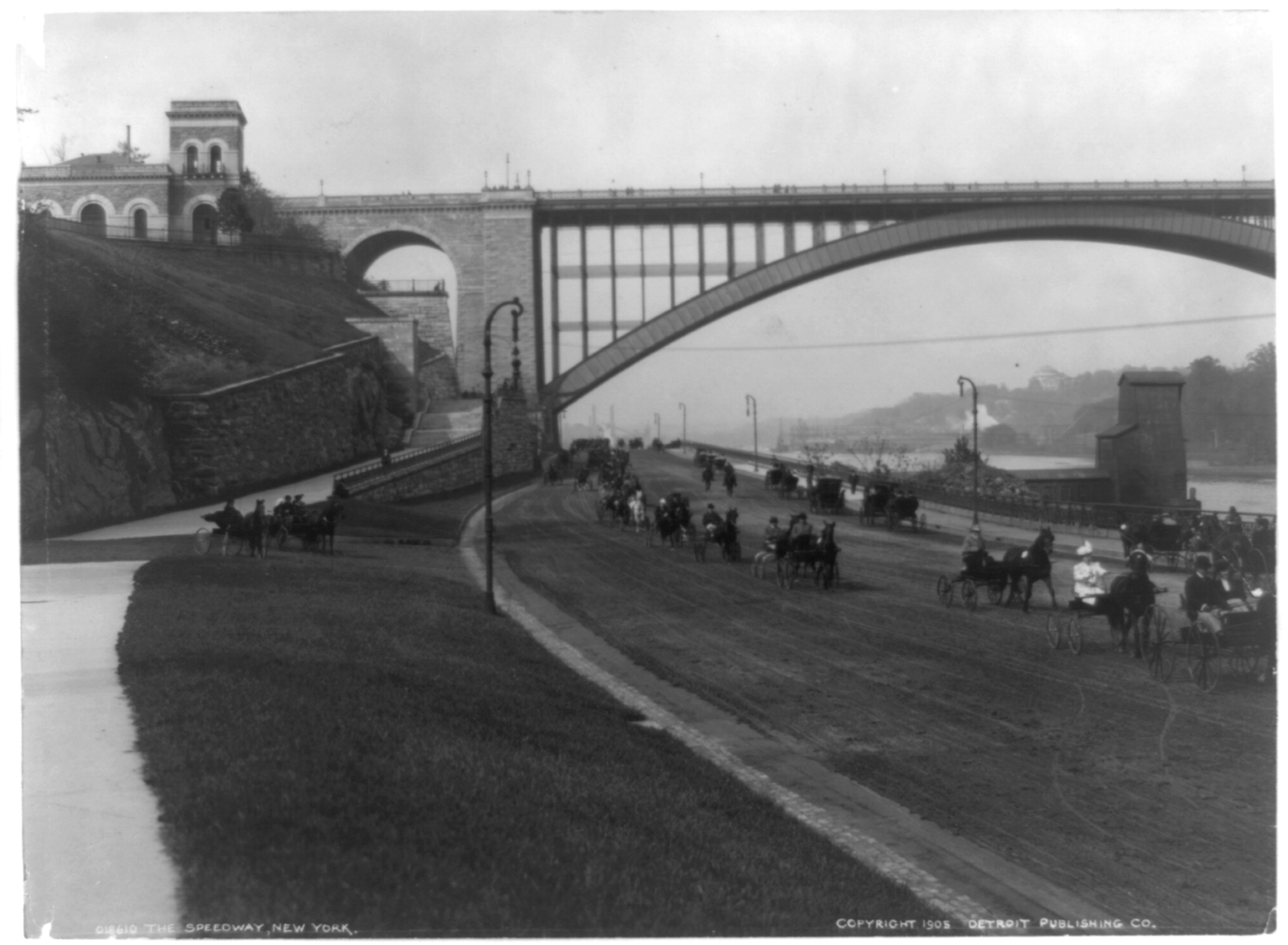
Several thousand pleasure seekers at Fort George, and other spectators on the Speedway, saw a young woman jolted out of a swiftly speeding car on a switchback railway at 193rd Street and Amsterdam Avenue yesterday afternoon, and her body dragged up and down the inclines until she was killed. The switchback is on the side of a steep hill running from the Speedway up to Amsterdam Avenue, and the accident was in plain sight of persons who were only a few feet away, but helpless to attempt a rescue.
Laughing with excitement, the young woman, who was Miss Katherine R., nineteen years old, of No. 302 East 89th Street, and a girl friend, seated themselves in a car and were pushed off at the top of a 60-foot runway. Then as the car travelled downward with increased momentum, the girls screamed with pleasure until, with a jolt, the car struck the bottom of an upward incline.
Miss Katherine, who had been trying to adjust her ruffled dress, was half raised in her seat when the car shot up the hill. The upward jolt threw her backward out of the car. Her dress caught in the back of the seat.
For the rest of the way up and down the runways her body was dragged.
Employees of the place rushed to the foot of the last incline and tried to stop the car, but it was moving too rapidly, and threw them heavily to the ground. The car then went on to a raised runway which has a cable running up it, to which the cars automatically fasten themselves when they reach it. The car began to ascend the incline, dragging the body after it. Then the dress gave way, and the lifeless form of the girl dropped between the ties and fell twenty feet to the ground.
It had no sooner done so than another car, with all seats filled, which had been started before the accident took place, rushed over the spot where the body had been. The occupants of this car had been forced to witness the tragedy, as they had followed the other vehicle on its way. There were two women in the second car, and both fainted on reaching the starting point.
Surrounding the switchback are beer gardens, in which were seated hundreds of persons, who saw the accident. The screams of women drew the attention of hundreds in the Speedway below, where they had been watching the usual exhibition of fast horses, while on the top of the hill, which is Amsterdam Avenue, were others, who gazed at the sight.
When the car from which Miss Katherine fell returned to the shed from which it started, Miss Jennie and a little girl about 2 years old, both of whom had accompanied Miss Katherine, were helped from the car. Miss Jennie was hysterical and fainted repeatedly.
Policemen were hurriedly called and an ambulance was summoned from the Washington Heights Hospital. Dr. Bernstein went to the foot of the incline and pulled out the body of the young woman. She was dead, and the surgeon said that her skull had been fractured several times and her legs and ribs broken. Death, he thought, had been instantaneous as her neck was also broken.
The police then began an investigation, and finally arrested the owner of the switchback. He was locked up and charged with homicide.
Source: New York Tribune. New York, N.Y., August 6, 1906.
2. Tossed Out
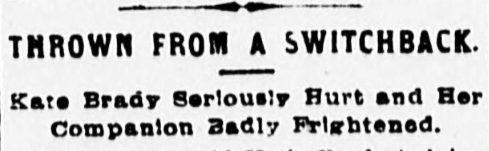
This wasn’t the first time a New York switchback hurled a rider from her seat. On July 5, 1893, The Evening World reported that an 18-year-old identified as “Katie B.” was pitched headlong from a Rockaway Beach switchback car, falling nearly thirty feet and suffering a broken nose and a dislocated shoulder.
The article reads:
Thrown From A Switchback
Eighteen-year-old Katie B. is lying at her home in East 30th Street, nursing a broken nose and a dislocated shoulder. Her injuries were received in a peculiar manner.
Katie and a friend, William W., went to Rockaway Beach. In the evening they decided to try the excitement of a switchback ride.
They entered a car on one of these structures and were whisked along until halfway down the incline when Katie pitched headlong out of the car. Her companion was so paralyzed by fear that he made no attempt to save her, and Katie whirled through space for a distance of nearly 30 feet and struck the ground with terrible force.
The crowd about the switchback rushed to where the girl lay on a pile of sand expecting to find her corpse. She was alive, but unconscious, and was sent home.
William was so frightened at the accident that he went into convulsions, remaining unconscious for over an hour.
Source: The Evening World. New York, N.Y. July 5, 1893.
3. Operator Danger

Passengers weren’t the only ones at risk. Operators, too, could be thrown from their cars. As The Evening Star reported on July 11, 1920, a Coney Island scenic-railway attendant was hurled to his death.
Published in the Evening Star, July 1920:
Killed on Roller Coaster
In the first fatal roller coaster accident of the season at Coney Island an operator of a scenic railway train was hurtled to his death from the top of a precipitous incline.
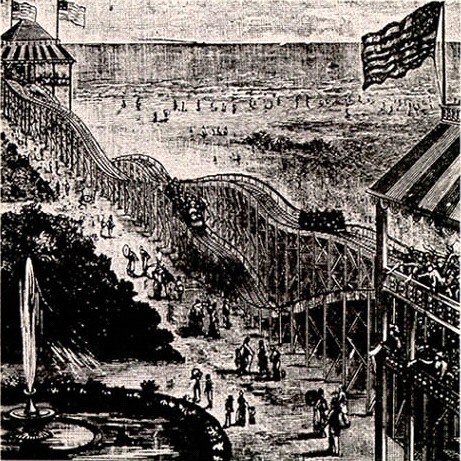
A passenger climbed into the driver’s seat and threw on the brakes, stopping the racing cars.
The dead man was blamed by the police for carelessness which they said caused the mishap.
Source: Evening Star. Washington, D.C. July 11, 1920.
4. Two Killed, Over 20 Injured
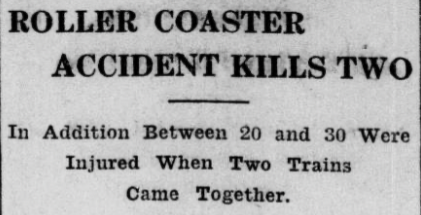
And it wasn’t only New York. At New Jersey’s Palisades Amusement Park in 1913, a rear-end collision between two coaster trains left two dead and scores injured, after the first train stalled on the incline.
A newspaper article reported:
Roller Coaster Accident Kills Two
Two men were killed and between 20 and 30 persons were injured in a rear-end collision of two trains on a roller coaster at Palisades Park in New Jersey. Arthur Olson died soon after being extricated from the wreckage of the two trains on the coaster and Frank Leclair died in the hospital. A score are suffering from broken bones and internal injuries.
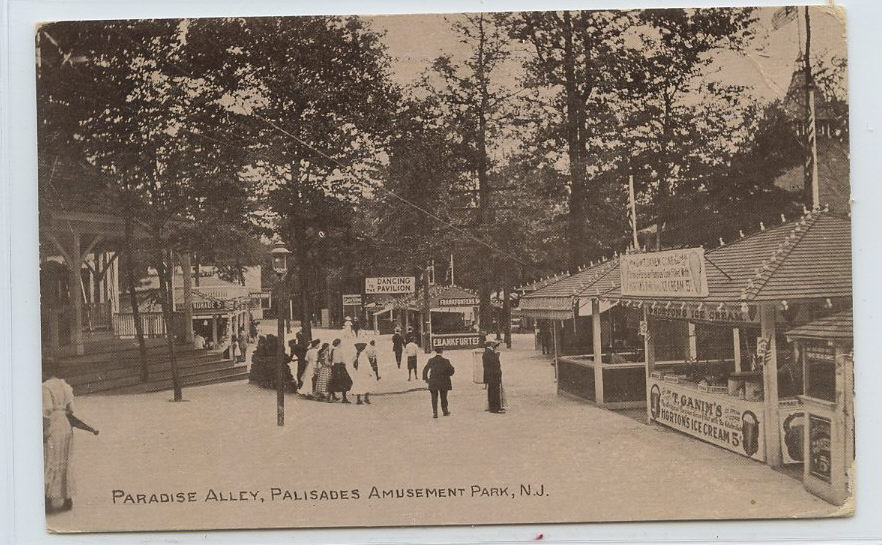
The accident occurred after the first train of two cars had ascended the first incline and descended to the dip beyond, where it was cradled when the electrically propelled cable failed to carry it up the next slope. The second train of two cars meanwhile reached the top of the first incline and dashed down the dip into the stalled first train. The occupants of the two trains were thrown from their seats to the wooden structure 15 feet above the ground, to which many fell.
The cries of the injured caused a panic in the park and among the injured were many who rushed to the scene of the accident and were crushed in the jam. The more seriously injured were taken to nearby hospitals while the others were given emergency treatment at the park.
The park officials were unable to explain the cause of the failure of the safety devices designed to prevent just such an accident as occurred.
Source: The Brattleboro Daily Reformer. Brattleboro, Vt. July 7, 1913.