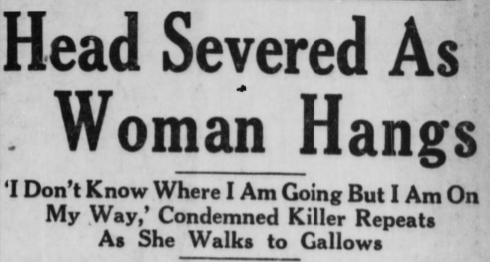
In the dark early hours of February 21, 1930, Eva Dugan stepped onto the gallows at Arizona State Prison in Florence. Composed and defiant, she was moments away from becoming the first woman to be executed by the state of Arizona. What followed would shock the witnesses and ultimately change the course of capital punishment in the state forever.
From Gold Rush to Gallows
Born in 1878 in Salisbury, Missouri, Eva Dugan’s life was marked by hardship and grit. After being abandoned by her husband, she raised two children on her own.
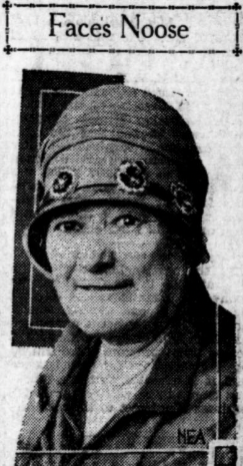
She chased opportunity during the Klondike Gold Rush, working as a cabaret singer and prostitute in Alaska to make ends meet.
Eventually, she relocated to Pima County, Arizona, where her fate would take a sinister turn.
There, she became the housekeeper for Andrew J. Mathis, an irascible and wealthy chicken rancher with a criminal past of his own.
Mathis, who had served time for the lynching of two Native American teenagers in Oklahoma, was reportedly domineering and difficult. His relationship with Dugan quickly soured.
When Mathis fired her and told her to leave his property by the next morning, he was never seen alive again.
Disappearance, Arrest, and Trial
On January 27, 1927, Mathis vanished, along with his cash box, some personal items, and his Dodge coupe. Dugan also disappeared around the same time and was later caught trying to sell his car in Kansas City. She was ultimately tracked down and arrested in White Plains, New York, after police intercepted a postcard addressed to her.
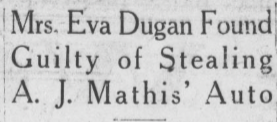
Initially charged only with auto theft, Dugan served nine months in prison. But in October of that same year, a camper discovered Mathis’s decomposed body hidden on his ranch. The murder trial that followed was short and largely circumstantial, but damning.
While testifying in her defense, Dugan admitted to prostituting herself on the ranch, with Mathis allegedly collecting a cut of her earnings, and confessed that they had a sexual relationship.
She claimed that the real killer was a teenage boy named “Jack” who struck Mathis during an argument and accidentally killed him. Dugan described a desperate attempt to revive the man with mouth-to-mouth resuscitation before Jack disposed of the body.
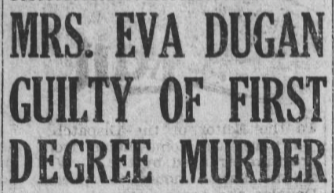
The jury wasn’t convinced. Prosecutors argued that she had killed Mathis with an axe. She was convicted of murder and sentenced to hang.
“Well, I’ll Die With My Boots On”
Despite her sentence, Dugan remained lively and unrepentant behind bars. She sold hand-embroidered handkerchiefs and gave press interviews for a dollar each to pay for her own coffin, refusing the state’s standard-issue pine box. Time magazine dubbed her “Cheerful Eva.”
She even sewed a beaded silk “jazz dress” to wear to her execution but ultimately opted for a simpler garment, not wanting to ruin her finest clothes.
Rumors swirled that she might try to take her own life first. A search of her cell uncovered a bottle of ammonia and hidden razor blades.
She cooked her own last meal, played cards with fellow inmates until midnight, and faced the scaffold early the next morning.
While playing cards, it was reported that “Dugan requested that her guests be served with orangeade. Several minutes passed before the drink was served, and the condemned woman called to a guard: ‘Please bring on the orangeade. I want it now. Tomorrow will be too late.'” [1]
A Grisly Spectacle
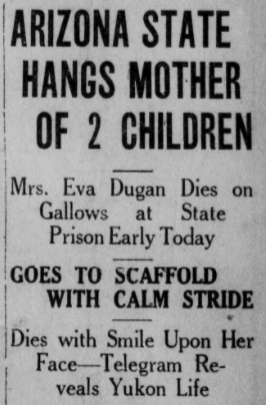
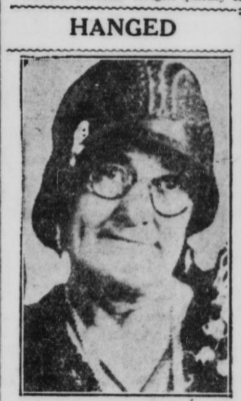
At 5 a.m. on February 21, 1930, Eva Dugan mounted the gallows.
The Daily Alaska Empire reported that: “She smiled as she stood on the trap while prison officials adjusted the black hood about her head, unshaken in her resolve to show the world she can take her medicine.” [2]
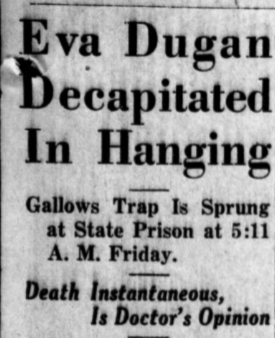
She declined to make a final statement. The trapdoor opened at 5:11.
What followed was a horror.
The drop was miscalculated. The force of the fall snapped Dugan’s neck so violently that she was decapitated. Her head rolled to a stop in front of the spectators, many of whom were women, attending under a new rule allowing female witnesses at executions. Five people fainted on the spot.
Blood continued to spurt from her neck as her heart kept pumping, making the execution one of the most gruesome in Arizona’s history.
Aftermath: From Rope to Gas
Eva Dugan’s death marked a turning point. Public outrage over the botched execution, combined with the spectacle of a woman’s decapitation in front of witnesses, led to swift change. Although a few more hangings occurred in the state, including Refugio Macias in 1930 and Herbert Young in 1931, Arizona formally abolished hanging as its primary method of execution by 1934.
The state adopted the gas chamber instead, a supposedly more humane alternative at the time. Lethal injection would not be used in Arizona until 1993.
Direct Quotes:
[1] Brownsville Herald. Brownsville, Tex. February 21, 1930.
[2] The Daily Alaska Empire. Juneau, Alaska. February 21, 1930.