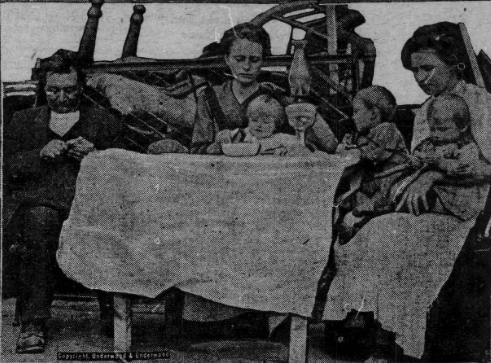
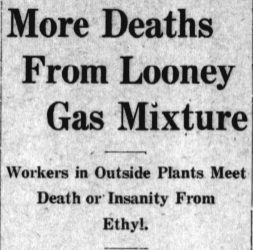
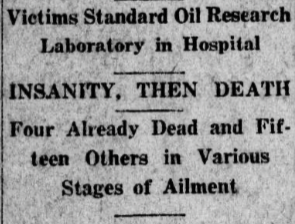
In 1924, a group of workers at the Standard Oil refinery in Bayway, New Jersey, began to suffer bizarre and terrifying symptoms. They twitched uncontrollably, raved incoherently, and collapsed into convulsions. Some died screaming in straitjackets. Five men would be dead before the year was out. Dozens more were hospitalized.
The common denominator? They all worked in the building the workers themselves had nicknamed the “Looney Gas Building,” the site where Standard Oil was producing tetraethyl lead (TEL), a chemical designed to reduce engine knock in gasoline.
What began as a scientific breakthrough quickly spiraled into a public health crisis, a media firestorm, and one of the earliest industrial cover-ups of the 20th century.
A Deadly Innovation
Tetraethyl lead was hailed as a miracle compound. Developed by Thomas Midgley Jr., a chemist at General Motors, TEL made engines run more smoothly. In the era of rapid automobile expansion, this was big business.
But there was a problem: lead. Even by the 19th century, lead’s poisonous effects were well documented. European countries had already banned TEL due to its extreme toxicity. But in the United States, GM and Standard Oil pressed forward, forming the Ethyl Gasoline Corporation to mass-produce leaded gasoline, deliberately omitting the word “lead” from the name.
Workers in the Bayway plant weren’t told the risks. They were told TEL was safe.
Collapse at Bayway
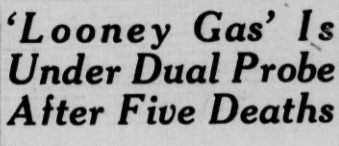
In the fall of 1924, the truth exploded into public view. Of the 49 men working with TEL at the Bayway facility, 32 were hospitalized. Five of them died. The survivors suffered from tremors, memory loss, hallucinations, and violent psychosis, textbook symptoms of severe lead poisoning.
The company’s immediate excuse? Overwork.
Standard Oil claimed the men were simply tired. But New Jersey’s State Labor Commissioner Dr. Andrew F. McBride found otherwise. He concluded that no amount of protective equipment could shield workers from such a volatile compound.
The Gettler Investigation
The toxicology team from New York City was called in to determine what, exactly, had killed the workers.
Enter Alexander Gettler, the legendary forensic chemist, and Charles Norris, the city’s chief medical examiner. In an era before toxicology was considered a science, Gettler was a pioneer.
He painstakingly examined the victims’ bodies, testing everything from their lungs to their bones. He found high levels of TEL and lead byproducts, most heavily concentrated in the lungs, proving the poison had been inhaled, not just touched. Standard Oil’s gas masks and gloves were woefully inadequate.
Gettler’s findings were groundbreaking and damning. TEL was a potent neurotoxin, easily absorbed through skin or lungs, and resistant to normal forms of detoxification. The “looney gas” moniker was no exaggeration.
Industry Spin vs. Science
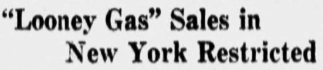
The public was alarmed. In rapid succession, New York City, New Jersey, and Philadelphia banned the sale of leaded gasoline. The story dominated newspapers across the country.
But industry leaders feared what would happen next, not just to their reputations, but to their profits.
They pressured the federal government to take over the investigation, hoping to regain control of the narrative. And they succeeded.
President Calvin Coolidge, a pro-business Republican, ordered the U.S. Public Health Service to conduct its own study. The resulting federal panel included Midgley and other industry representatives, but none of the independent scientists who had actually investigated the deaths.
As expected, the panel’s 1926 report concluded that TEL was safe, so long as workers were properly protected. The dangers to the general public were “minimal,” they said. Any long-term risks could be studied later, “by another generation.”
The Aftermath: A Poisoned Century
TEL production resumed. The bans were lifted. And by the mid-20th century, leaded gasoline was everywhere.
But Charles Norris hadn’t forgotten. He quietly began measuring lead levels in New York City street dust. Within a decade, lead levels had increased by 50 percent. It was an ominous warning of the widespread contamination to come.
It took until 1986, more than sixty years after the Bayway disaster, for the United States to finally ban lead as a gasoline additive. By then, the damage was massive. Estimates suggest that 68 million American children suffered from toxic levels of lead exposure during the TEL era. Thousands of adults likely died from lead-induced cardiovascular disease.
More chillingly, recent research has linked lead exposure from gasoline to increased violent crime, diminished IQ scores, and a generational decline in cognitive health.
Legacy of Looney Gas
What happened at the Bayway plant was not just an industrial accident, it was a harbinger. The deaths of those five men should have served as a wake-up call. Instead, they were dismissed, spun, and sacrificed on the altar of progress.
Today, as we reckon with the long-term effects of toxic industry practices, the story of “looney gas” remains a sobering reminder: when profits come before people, the cost is incalculable.
The consequences linger for generations.