Across Europe and well beyond, builders once believed that a structure needed more than timber and stone. It needed a guardian.
To make a new bridge or church “hold,” people offered a life, a life-substitute, or a trace of life at the moment the first stones met the earth. The custom appears in folklore, in ballads, and in scattered historical notes, and while the practice changed shape over centuries, the fear behind it stayed the same: disturb a place and its spirit may strike back.
“London Bridge” and the fear beneath the stones
A nursery rhyme seems harmless until you hear what older generations whispered under it. “London Bridge is falling down” is often read as a memory of ritual “strengthening,” when a human life was thought to fix a failing foundation.
Nineteenth-century rumors revived the fear during large projects.
The Brooklyn Bridge inspired tales of people who disappeared without a trace.
Lord Leigh was once accused of sacrificing a person for Stoneleigh Bridge’s safety.
When Blackfriars Bridge in London was dismantled in 1867, workers reportedly uncovered assorted human and animal bones in its base, exactly the sort of discovery that fed the imagination of those who already believed such things were done.
Stories like these were not unique to Britain.
In 1865, while the Ottoman authorities were building a blockhouse at Ragusa, locals said two Christian children had been seized to be buried in the foundation. Whether any given tale was true mattered less than the fact that many listeners found them plausible. The idea was already in the air.
Why blood at the cornerstone?
Older belief systems treated every patch of ground as inhabited. Raise a tent or set a cornerstone and you trespass on a resident spirit.
One response was simple propitiation. Slaughter an animal on the spot, speak a request for “permission,” and trust that the gift turns away harm.
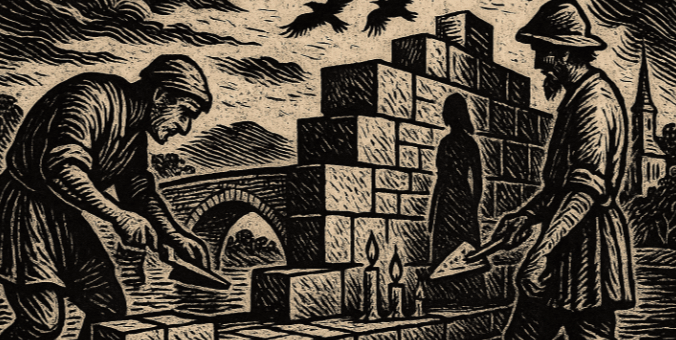
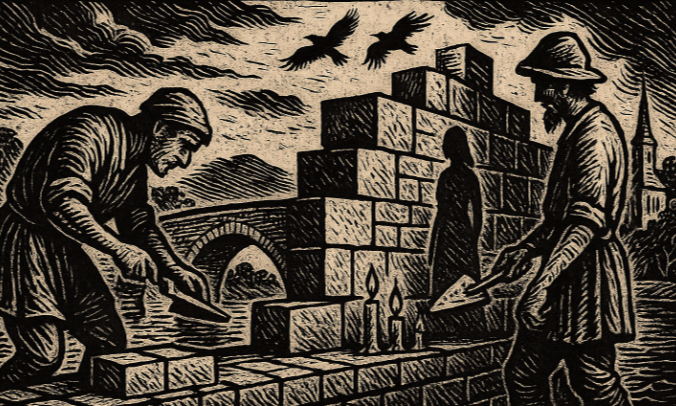
Another response was more severe and more enduring: place the spirit of a freshly killed person under the building so that their restless force will defend it forever.
In this logic, the murdered dead are the most powerful guardians of all, bound to the exact place of their death and ferocious in protecting it.
Because taking a life is costly and risky, communities shifted to substitutes.
An animal stood in for a person. Later, only a token of life was required.
In parts of France, people buried a frog or other small creature beneath a threshold.
In corners of England and Scotland, builders hid clippings from a man’s nails, a cow’s hoof, a cat’s claws, or a coin beneath a post.
Elsewhere a chicken was struck until its blood covered a hearthstone.
In some places an animal heart, stuck with pins, went into the trench.
Medieval Romans sometimes walled small statues into foundations, a symbolic echo of a living guardian.
Among the Māori, carvers placed figures of prostrate slaves on the ground-plates that supported a house, turning a once-literal sacrifice into a carved reminder.
The ingredients changed, but the purpose stayed the same: fasten life to the building so the building would live.
Blood became the most common stand-in. It was seen as the seat of life and spirit, so a few drops promised protection without the horror of a killing.
Sacred texts preserve traces of the idea, such as marking doorposts with blood to ward off danger. With time, even blood felt too raw.
Wine replaced it at ship launchings, likely red at first for the look of blood, then celebratory champagne. In Romanian villages, water poured from a red jar served as a gentler “life” for a new home.
Why bridges and churches led the list
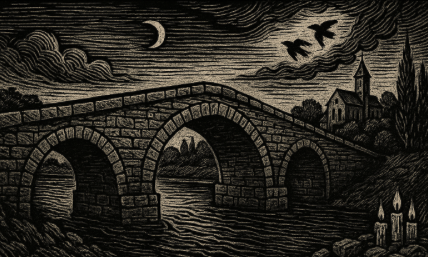
Bridges and temples stood at the frontier between human order and the unpredictable. Rivers rise. Marsh banks shift. Traffic shakes timbers loose.
A bridge was sacred labor, watched by priests in Rome and later built and tended by monks in medieval Europe.
Churches and shrines claimed holy ground and invited crowds to an exact spot. If any structure needed a supernatural guardian, it was one of these. Only later did the logic extend to fortresses and city walls.
The Balkan ballads: Art built on dread
Folk poetry in the Balkans preserves the belief with aching clarity. These ballads do not read like engineering notes. They read like tragedies.
Scutari (Shkodër, Albania/Montenegro, sung by Serbs): Builders cannot raise the city until one of their wives is immured in the foundation.
Deva (Hungary/Transylvania, told by Magyars): The new stronghold calls for the sacrifice of a builder’s wife to win the land spirit’s goodwill.
The bridge of Arta (Greek tradition): The bridge collapses each night until the wife of the master builder is buried within its piers.
Fox’s Bridge over the Dibra river (Albanian tradition): The same pattern appears, the living wall traded for lasting stone.
The most fully formed tale attaches to Curtea de Argeș in Wallachia, Romania, a royal mausoleum and cathedral. In the ballad, nine famous builders, led by Manole, serve a Black King who wants a church that will outlast him. Each day the walls rise. Each night they fall.
Manole dreams an answer: the first wife who comes bringing food must be built into the wall. At dawn, other men quietly warn their wives to stay away. Manole does not. He prays for flood, for wind, for darkness, anything to slow his wife’s step.
Nothing stops her. She comes smiling, faithful and unaware. He leads her to the wall with a playful touch.
Her smile breaks. She cries that the stones hurt. He begs her to endure so the church can live. She thinks of their baby. Who will feed it? “The fairies,” he says. Who will bathe it? “The rain.” Who will rock the cradle? “The wind.”
The church rises at last, but the price is permanent. The guardian under the wall does not leave.
What survives today
The old fear that a place might push back has not vanished. It has thinned into gestures.
A coin under a threshold.
A splash of wine at a launch.
A ribbon cut at the door.
These are ceremonies of consent, ways to say that a human work belongs here and will hold. Ballads and nursery rhymes keep the darker roots alive, not to endorse them, but to remember how people once reasoned with rivers and spirits and risk.
Foundation sacrifices belong to a world where the unseen was everywhere and the margin for failure was slim.
Bridges fell.
Fires started at the hearth.
For ancient and more modern communities, giving a life, or a sign of life, to the stones felt like a bargain with fate.