
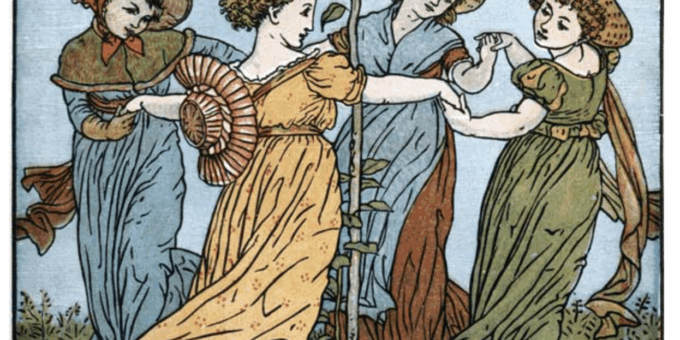
The month of April brings with it the warm breath of spring, a time when the earth stirs from winter’s slumber and bursts open with life.
Though April is the fourth month on today’s calendar, it once held a different position and name, deeply rooted in both Roman mythology and Saxon tradition.
The Origins of the Name April
The name April is thought to come from the Latin word aperire, meaning “to open.” It was an appropriate title for the month when the land, long bound by the cold and ice of winter, began to open under the strengthening sun.
Buds swell and burst, blossoms reveal their hidden colors, and fields return to green life.

Some historians and linguists, however, have suggested another possible origin. They believe April may be derived from Aphrilis, which itself comes from Aphrodite, the Greek name for the Roman goddess Venus.
Venus, goddess of love and beauty, was especially honored during this time of year when nature seemed to celebrate beauty and new life.
Venus and Her Myths
Venus, according to Roman legend, was born from the foam of the sea. She emerged fully formed and radiant, ascending to Mount Olympus where she was welcomed as the goddess of love and beauty.
Though all the gods desired her, Venus rejected them. To punish her pride, Jupiter, king of the gods, forced her to marry Vulcan, the god of fire.
Vulcan was not considered handsome. Rough in manner and lame from a great fall from Olympus, he lived in a forge among the mountains where he crafted thunderbolts for Jupiter, fine palaces for the gods, and the magical arrows for Venus’s mischievous son, Cupid. Vulcan became the patron of blacksmiths and workers in metal, and a festival called Vulcanalia was held in his honor.
Cupid, the god of love, is famously portrayed as a winged child carrying a bow. His arrows were said to cause love at first sight, piercing hearts and binding people together in romantic union.
Another of Venus’s sons was Aeneas, the great Trojan hero who fled the burning city of Troy and eventually settled in Latium, Italy. His descendants, so the story goes, would go on to found the city of Rome. The tale of Aeneas’s journey is preserved in Virgil’s Aeneid, a national epic that connected the divine lineage of Venus to the Roman emperor Augustus himself.
The Fall of Troy and the Trick of the Wooden Horse
The story of Aeneas begins with the tragic fall of Troy. After ten years of brutal siege, the Greeks could not breach the city walls. It was Ulysses, famed for his cunning, who devised the plan that would end the war. A colossal wooden horse was constructed, hollow and large enough to hide armed men within. The Greek army pretended to retreat, leaving behind the horse and a slave named Sinon, who convinced the Trojans to bring the object inside their gates as a supposed offering to Neptune.
Ignoring the warnings of those who suspected a trick, the Trojans pulled the horse into the city. That night, as they feasted in celebration, the hidden warriors emerged from the wooden belly and opened the gates to the returning Greek army.
Troy fell not by force of arms, but by deception. According to myth, this entire war had been caused by the actions of Venus, whose influence over love and desire played a fateful role in its origin.
Saxon Roots: Eastre and the Spring Festival
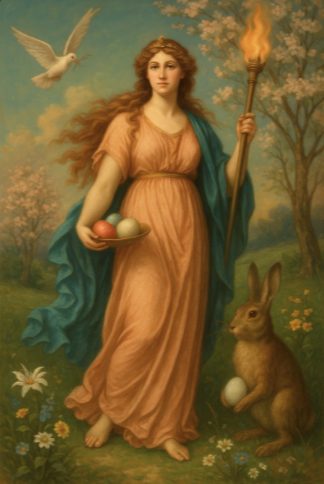
In ancient England, April was called Eostre-monath or Easter-monath, named for Eastre (also known as Ostara), the Saxon goddess of spring and fertility. Her festival celebrated the awakening of nature and the return of the sun’s warmth.
People exchanged decorated eggs as symbols of rebirth and new life, a tradition that remains part of our modern Easter celebrations.
Although Easter is now a Christian holiday marking the resurrection of Christ, its name and several of its customs, like the giving of eggs, have pagan roots in the old spring festival of Eastre.
The egg, ancient in symbolism, represented life emerging from the darkness of winter, just as flowers burst from the earth in April.
The Number of Days in April
April’s length was not always fixed. Under Romulus, the month had thirty days. The king who followed him reduced it to twenty-nine.
Later, Julius Caesar reformed the calendar and restored April to thirty days, where it has remained ever since.