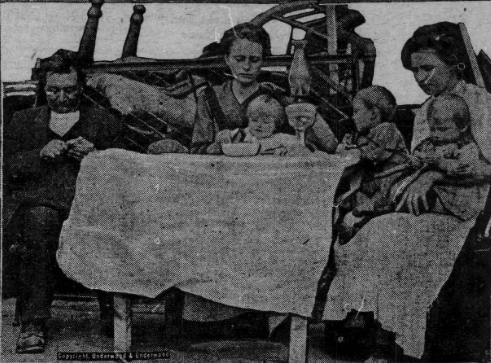
On the lower Rio Grande in the early 20th century, Mexican and Mexican-American families kept close to traditions brought north long before the railroad and “modern” towns arrived.
What follows is a snapshot, drawn from period accounts, of language, celebrations, courtship, mourning, and folk belief along the Texas border.
Editor’s note: This article summarizes practices as recorded in 1923, using respectful modern language while preserving historical detail. Descriptions of folk cures appear for context only and are not health advice.
A valley with deep roots
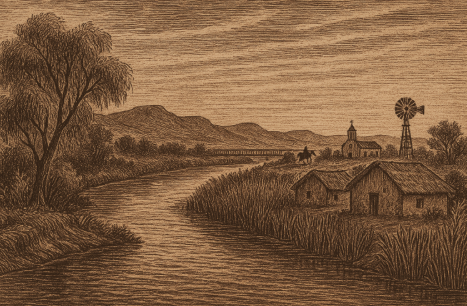
Before paved highways and busy depots, the river valley was a world of ranches and kinship.
Land on both sides of the Rio Grande had been parceled into porciones under Spanish rule.
For decades, sand dunes and distance kept the region semi-apart from the rest of Texas.
When the St. Louis, Brownsville & Mexico Railroad opened the way in the early 1900s, American-style towns sprang up, yet next to new storefronts stood clusters of jacales: small houses framed with willow, packed with mud, thatched or adobe-coated, and often shared with a few dogs, chickens, and the indispensable milk goat.
Language at home and on the street
Spanish remained the daily voice of the border. Children might learn lessons in English at public schools, then race to recess and switch instantly back to Spanish. At home, Spanish ruled; in the plaza and markets, it set the rhythm of greetings and trade.
Names also followed Mexican custom. A bride might sign as Señora Gonzales de Peña, keeping her family name with a de linking to her husband’s.
Children commonly carried two surnames – Gonzales y Peña, for example – which could later tangle census rolls and inheritance trails where old land grants still had hundreds of heirs.
Invitations, courtesies, and committees
Formality flavored social life. The border was a place of handshakes, cheek-kisses, and ritualized courtesy.
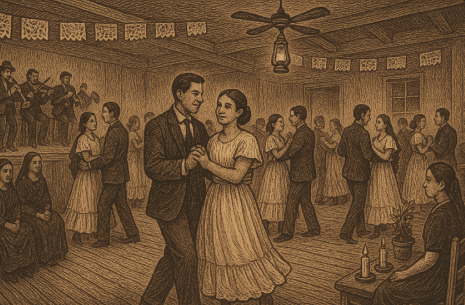
If there was a dance, there was an invitation, printed if time allowed, or delivered by an invitations committee if it didn’t. “Mr. and Mrs. ___ and family” was the standard address, and sometimes the household arrived exactly that way: all together.
Committees did everything: invitations, refreshments, music, “ceremonies.” Even a vocalist or reciter was escorted to center stage by two attendants who stood beside her until she finished.
Sunday dances and the watchful eye
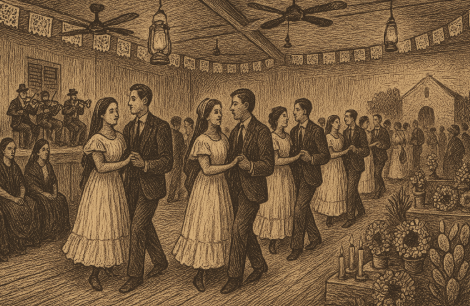
Dancing was the favorite pastime, often on Sundays. Young people moved with easy rhythm to American tunes softened by Mexican orchestras, traditional waltzes, and the occasional old-style number, sometimes a schottische-like danza, to coax elders onto the floor.
The evening began with a promenade around the hall; promenades returned during intermissions and at the end of sets.
Chaperonage was strict. A well-brought-up señorita went with her mother or another adult guardian.
Lingering on balconies or slipping outside to an automobile wasn’t part of the etiquette.
Red-letter days and a child’s pilón
Civic pride kept Mexican national dates alive on the Texas side. The Dieciséis de Septiembre (September 16, the Grito de Dolores), Cinco de Mayo, and birthdays of patriots like Hidalgo and Juárez were occasions for speeches, anthems (Mexican and American), and folk songs.
Shopkeepers practiced the small grace of the pilón, a little “extra” for children who made a purchase. A kid who didn’t get it might ask, “¿No tienes pilón?” A merchant who made a habit of forgetting could expect an informal boycott.
Courtship, serenades, and the wedding arras
Serenading survived into the 20th century, updated by hired musicians who made the rounds of sweethearts’ windows with “La Paloma” and “La Golondrina.” Engagements were formal affairs, too: the groom-to-be sent respected friends as emissaries to request the bride’s parents’ consent; the bride’s family answered through their own elders.
Weddings blended church solemnity and community festivity. Even modest couples aimed for a white dress, veil, and dance, sometimes the party lasted until dawn, with the ceremony at sunrise. Invitations listed both sets of parents on facing pages. The groom covered costs and was expected, if able, to have a household ready, linens included.
A distinctive feature was the arras: thirteen gold coins, placed in the bride’s hands as a pledge of provision and good fortune – often contributed by relatives and close friends.
Mourning, memory, and the Campo Santo
Funerals were as structured as weddings. Attendance required an invitation.
Women usually remained in a private room under black shawls; men accompanied the casket to the cemetery, on foot if near, by car if needed.
Infants’ coffins might ride to burial in a baby buggy, with children carrying flowers behind.
Mourning ran deep and long. Women wore the darkest black; mirrors were shrouded or turned to the wall; instruments were closed; some men let beards grow for a month.
Social events were avoided during the period, and a black crepe knot on the door was left to weather away on its own.
The cemetery – Campo Santo, the “holy field” – was tended with pride. Metal blossoms and wax wreaths stood up to the sun, and on All Souls’ Day (November 2) families brought candles, flowers, and food, lingering at graves while vendors set up booths outside the walls.
Folk belief: ojo, susto, and other signs
Working-class households carried a rich body of folk medicine and omens. Most famous was the ojo. the “evil eye,” but more precisely the idea that strong admiration could unintentionally harm a person (especially a baby) or an object unless the admirer touched it.
If illness was blamed on ojo, families might “test” by cracking an egg above the head and reading shapes in the yolk. The hoped-for cure? Bring the supposed admirer to touch the child and perform a ritual of water and prayer. (Period accounts stress that envy could cause ojo, but ignorance or affection could do so just as easily, hence the courtesy of touching what you praise.)
Another borderland diagnosis was susto, a fright that steals appetite and sleep.
Remedies included prayers, ribbons or blessed palm, and symbolic “dust from the four corners” (from crossroads or cemetery) brewed into a tea; some households made a dramatic counter-shock by pouring the brew into a hot brass pot to sizzle, or “swept” the patient lengthwise with an old broom while the Lord’s Prayer and twelve Hail Marys were recited.
Dreams and days had meanings, too.
- Snakes foretold enemies; defeating the serpent meant the danger would pass.
- Tuesday (not Friday) was the unlucky weekday for starting journeys or business.
- Nails weren’t driven after dark.
- Babies’ fingernails weren’t cut before one year (to “protect the eyes”), and a soft fontanel was said to signal “memory falling in.”