
In the early days of modern cities, when underground power lines, gas mains, and sewer systems tangled beneath the streets, manholes were both a marvel of engineering and a hidden danger.
From fiery blasts caused by dropped coals to gas build-ups powerful enough to send heavy iron lids flying through the air, the newspapers of the past are filled with stories of manhole explosions that startled entire neighborhoods.
1. Live Coal Triggers Four Explosions
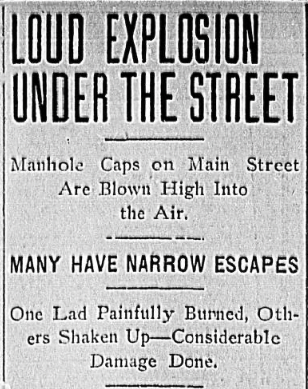
First, out of Richmond, Virginia, 1905, we find a report of four manholes exploding after a live coal is dropped into one of the manholes.
The report states:
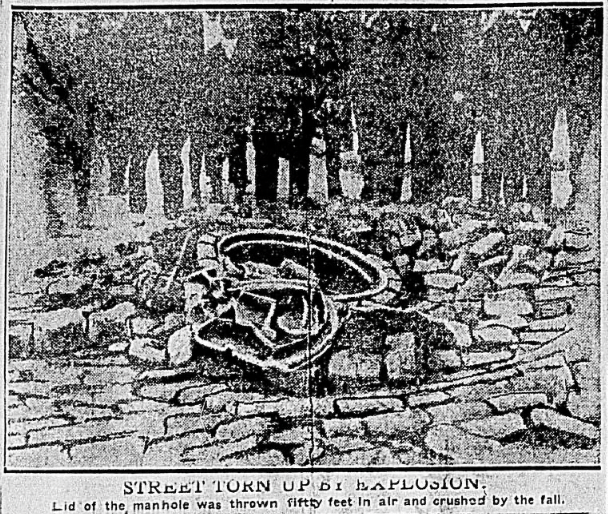
“The explosion was directly due to the dropping of a live coal into the manhole at Thirteenth and Main Streets from Engine No. 3, that had been called out in answer to an alarm from Thirteenth Street, where a small fire had started. The engine was just passing over the manhole when the explosion came. So quickly did the other three manholes explode that the reports sounded as one.”
Thankfully, no one was seriously hurt, though several pedestrians were bruised by flying debris.
Source: The Times Dispatch. Richmond, Va. October 24, 1905.
2. Gas in the Conduits
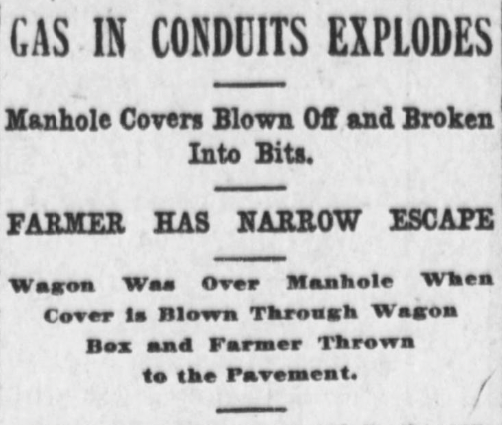
In Omaha, Nebraska, 1909, an accumulation of gas caused multiple explosions, one after the other. The manhole covers reportedly blew high into the air and were shattered. Dense clouds of smoke rose out of the holes.
One of the witnesses to the event left with one hell of a story to tell. The Omaha Daily Bee reported that:
“R. J. Harris, a farmer, had a narrow escape. He was driving east on Broadway and his wagon was just over the manhole at the corner of Glen Avenue when it was blown up. The heavy iron cover was blown against the bottom of the wagon, nearly lifting it off the ground and tearing a hole in the wagon box. Harris was thrown out of the wagon, but escaped with a few bruises. The horses ran away, and when last seen were going east on Broadway at a lively clip.”
Source: Omaha Daily Bee. Omaha, Neb. January 14, 1909.
3. City Worker Knocked 20 Feet
In New York City, 1921, an employee of the Department of Public Works planned on cleaning a manhole at Prince Street and Broadway. When he went to pull the cover off, however, there was a loud explosion and fragments flew into the air.
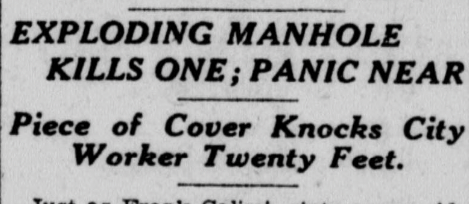
The New York Herald reported:
“Calimi was struck in the head by one of the pieces and knocked 20 feet. The other pieces came down harmlessly except for a few broken windows in the office building at the northwest corner. A patrolman who was directing traffic managed to handle a panicky situation as drivers of vehicles and pedestrians tried to escape from the immediate vicinity.
“A police patrol wagon took Calimi to New York Hospital, where he died. Accumulation of gas in the manhole caused the explosion.”
Source: The New York Herald. New York, N.Y. February 17, 1921.
4. Lost His Pants
In 1926, three manholes exploded in New York City with some rather comical results.
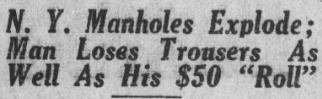
As was reported:
“Residents were giving manholes a wide berth after a freak explosion that threw a woman in the air, tore the trousers half off a man, and picked his pocket of $50.
“Three manhole covers, their vents sealed by snow and ice, blew up. Mrs. Mildred Connelly was standing on one at the time. She was tossed ten feet into the air.
“Robert Craig was near another. The blast ripped off one side of his trousers, turned the pocket inside out and frisked away with his roll. The torn trousers were cast back but the money failed to reappear.”
Source: Douglas Daily Dispatch. Douglas, Ariz. December 12, 1926.
5. Man Flies Through Air
And finally, in 1951, a Wisconsin man named Hovland found himself unexpectedly airborne when the street beneath him erupted in flame.

“Hovland had the misfortune to be standing on a downtown manhole cover when a sewer blew its top. He was tossed into the air and came to rest about four feet away. For no explained reason the cover had suddenly lifted into the air in an unexplained explosion followed by a burst of flame. Hovland and eight others waiting for a bus on the street corner were taken to a doctor’s office and treated for minor burns.”
Source: St. Ignatius Post. St. Ignatius, Mont. August 23, 1951.