August 6, 1890
6:38 AM
He didn’t look like a man moments away from death. He looked like a man heading to a Sunday social. William Kemmler was broad-shouldered, full-bearded, and remarkably composed. In a room filled with doctors, witnesses, and executioners, he was the coolest man in the party.
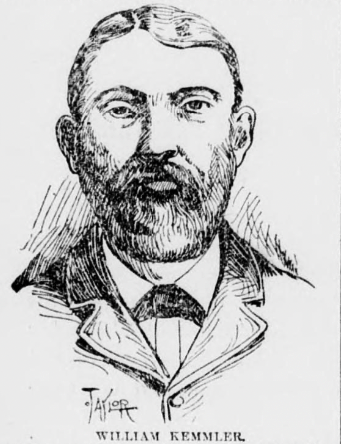
Kemmler pauses, looking slightly confused by the layout of the room. The Warden gestures to a wooden chair.
“Give me a chair, will you?” Asks the Warden.
An attendant places a simple wooden chair next to the imposing, leather-strapped electric chair. Kemmler sits. He looks around the room, making eye contact with the witnesses. He doesn’t look afraid. In fact, he looks pleased to be the center of attention.
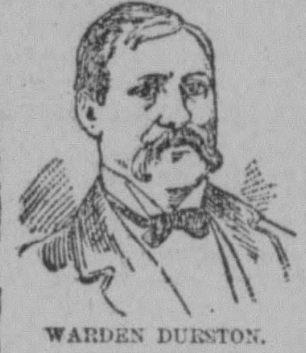
The Warden continued: “Now, gentlemen, this is William Kemmler. I have warned him that he has got to die, and if he has anything to say, he will say it.”
Kemmler was waiting for this moment, and said, “Well, I wish everyone good luck in this world. I think I am going to a good place… and the papers has been saying a lot of stuff that isn’t so. That’s all I have to say.”
When he was finished speaking, Kemmler stood up and removed his coat. The execution was about to begin.
THE CRIME: THE VEGETABLE PEDDLER’S RAGE
To the world, he would become a symbol of a new era. But in the slums of Buffalo, New York, William Kemmler was just another vegetable peddler struggling with a crippling addiction to alcohol.
March 29, 1889. Kemmler was coming down from a massive drinking binge the night before. His nerves were frayed, his mind clouded by a hangover and a mounting, paranoid rage. He turned that rage on his common-law wife, Matilda “Tillie” Ziegler.
He accused her of stealing his hard-earned money and plotting to run away with one of his own friends. As the argument reached its peak, a chilling calm fell over Kemmler.
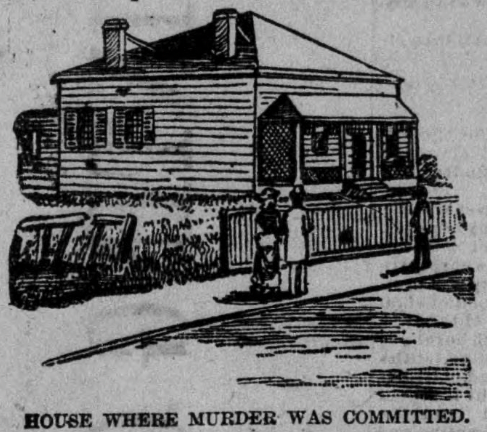
He walked to the barn, grabbed a hatchet, and returned to the house. In a matter of moments, the domestic dispute turned into a massacre. Kemmler struck Tillie repeatedly until she lay dead on the floor.
When he was done, he didn’t try to hide. He walked directly to a neighbor’s house and made a blunt confession: he had just murdered his girlfriend.
The wheels of justice turned with a speed that would be unheard of today. On May 10, less than two months after the murder, Kemmler was convicted of first-degree murder. Three days later, the sentence was handed down: Death.
But Kemmler wouldn’t face the gallows. Under New York’s brand-new execution law, he was destined for a different fate. A chair was already waiting for him at Auburn State Prison—a machine designed to replace the rope with the hum of electricity.
THE MACHINE: A NEW WAY TO DIE
The device waiting for Kemmler at Auburn Prison wasn’t the work of a seasoned executioner. It was the brainchild of a Buffalo dentist named Alfred Southwick, who had spent nine years perfecting a machine he believed would change the world of capital punishment.
On January 1, 1888, New York had become the first state to mandate death by electrocution. They called it “humane” and “modern.” But behind the scenes, the chair had become a pawn in a brutal corporate war.
This was the “War of the Currents.” Thomas Edison, the champion of Direct Current (DC), saw an opportunity to destroy his rival, George Westinghouse, the king of Alternating Current (AC).
Edison wanted the public to associate Westinghouse’s AC power with death. He supported an activist named Harold P. Brown, who surreptitiously acquired a Westinghouse generator to power Kemmler’s chair. The goal was simple: to make sure the “executioner’s current” was Westinghouse’s current.
Westinghouse fought back with everything he had. He didn’t want his product marketed as a killing machine. He hired high-profile lawyer W. Bourke Cockran to represent Kemmler, filing an appeal that would reach the highest court in the land.
The argument was simple: the electric chair violated the Eighth Amendment’s prohibition of cruel and unusual punishment. For months, the execution was stalled as the nation debated whether killing a man with lightning was a mercy or a massacre.
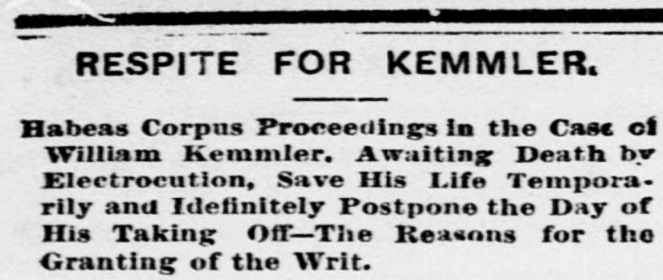
The appeal failed on October 9, 1889. The U.S. Supreme Court turned down the case, ruling that while death by electrocution was certainly unusual, it was not “cruel” in the eyes of the law.
The legal hurdles were gone. The corporate interests had done their worst. All that was left was the man, the chair, and the switch.
THE PREPARATIONS: “I WANT TO DO IT RIGHT”
The legal battles were over. Now, there was only the mechanical reality of the procedure. As Kemmler removed his coat, he revealed a morbid detail: a hole had been cut through the back of his trousers, exposing the base of his spine.
This was the contact point for the second electrode. While the Warden cleared away the “interfering drapery” of his clothing, Kemmler remained remarkably still. He sat down in the heavy oak chair with the quiet ease of a man sitting down to dinner.
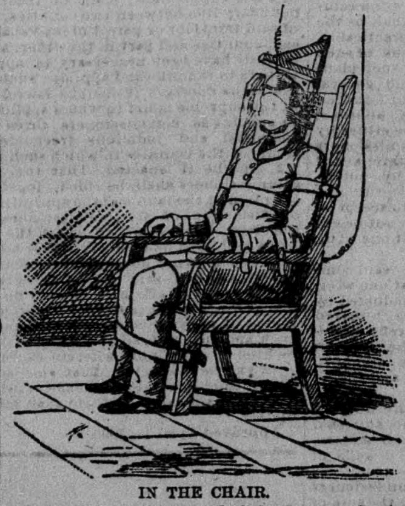
He was the most helpful person in the room and he seemed obsessed with the precision of the event. As the Warden pressed his head back against the rubber cushion, a deputy began to lower the metal frame holding the head electrode.
Kemmler felt the cup settle on his scalp and said, “Oh, you’d better press that down further, I guess. Press that down.”
The Warden unclamped the headpiece, pushed it firmly against Kemmler’s skull, and locked it back into place.
The connection was made.
THE SWITCH: “OR SO THEY THOUGHT”
The final step was the brine. Dr. George Fell stepped forward with a long syringe, deftly wetting the sponges at both electrodes with salt water to ensure maximum conductivity. He was turning Kemmler’s body into a perfect circuit.
Dr. Fell walked to the door leading to the dynamo room. He spoke to a man standing by a large wooden lever, and told him that everything was ready.
The time was 6:43 AM.
The current, one thousand volts of George Westinghouse’s alternating current, slammed into Kemmler’s nervous system.
The convulsion was so sudden and so violent that it seemed to shake the very foundations of the room. The current stayed on for seventeen seconds. Seventeen seconds that felt like an eternity to those watching.
The room was thick with the ozone smell of electricity. Kemmler was still. The doctors stepped forward, checking for a pulse, checking for breath. To the men in that room, the experiment seemed to be over. They believed they had just witnessed the first “clean” execution in human history.
Or so they thought.
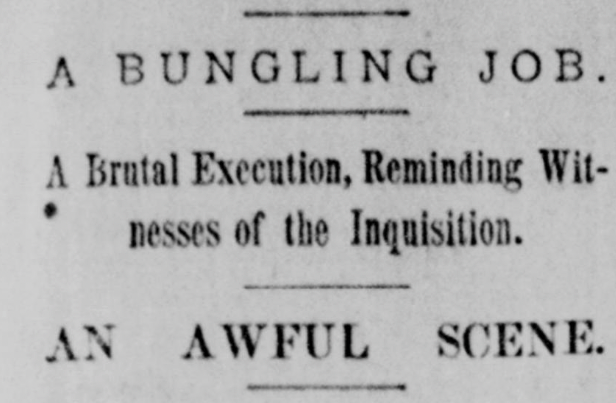
THE FAILURE: “FOR GOD’S SAKE, KILL HIM”
For a brief moment, there was no doubt. The doctors were certain the life had been snuffed out of William Kemmler. But then, a sharp-eyed physician noticed something impossible.
A rupture on his hand—caused by his own fingernails digging into his palm during the convulsion—was dripping blood. To the medical men in the room, it was a terrifying signal: the heart was still beating. The blood was still pumping.
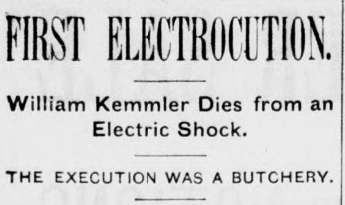
As the Warden frantically signaled the dynamo room, the unthinkable happened. Kemmler began to breathe. Spittle dripped from his lips, and his chest heaved. A heavy, wheezing groan—half-breath, half-sob—echoed through the chamber.
For seventy-three agonizing seconds, the witnesses stood helpless. The “humane” machine had failed, leaving Kemmler to struggle for air in a state of half-conscious torture.
The hum returned to the room, deeper and more aggressive than before. Kemmler’s body became rigid once again.
This time, there would be no mistake. The electricians pushed the machinery to its absolute limit. The current was thrown on and off repeatedly, jolting the body again and again.
And then, the “spruce-looking” man who had walked into the room was gone. The first execution by electricity had succeeded in killing William Kemmler.
THE AUTOPSY & LEGACY
The subsequent autopsy revealed that the current had literally carbonized his brain. The “War of the Currents” was over, and the electric chair would remain the standard in executions for decades.
As George Westinghouse famously remarked after hearing the details: “They would have done better with an axe.”
SOURCES:
- Iron County Register. Ironton, Iron County, Mo. May 8, 1890.
- The Evening World. New York, N.Y. August 6, 1890.
- The Daily State Chronicle. Raleigh, N.C. August 7, 1890.
- The Butler Weekly Times. Butler, Mo. August 13, 1890.
- The Monmouth Inquirer.Freehold, N.J. August 7, 1890.
- The Evening World. New York, N.Y. August 5, 1890.
- Richmond Dispatch. Richmond, Va. August 7, 1890.