The Battle of Calvary Cemetery
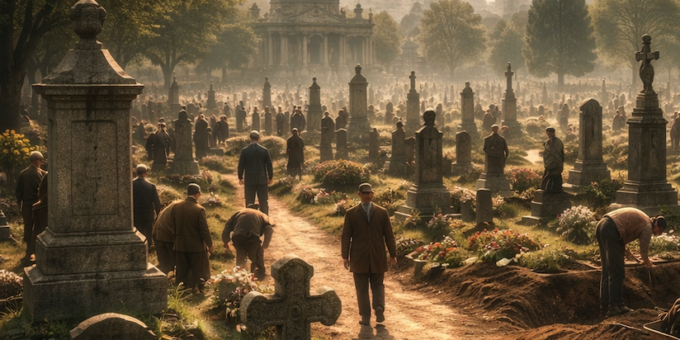
November, 1883. 8:00 PM. Calvary Cemetery, Long Island. The air is thick with the smell of turned soil and the salt of the East River.
Dennis Callahan has come to bury his child. It is the third time he has stood over this exact plot. Below the surface lie two more of his children, stacked one above the other in the “densely populated” Section 8.
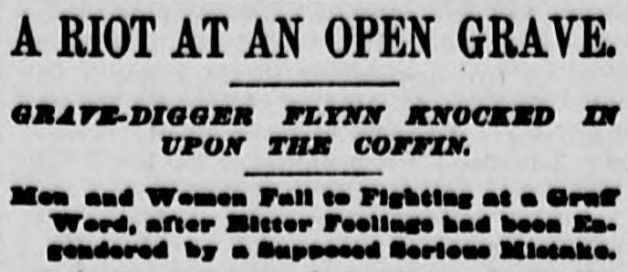
But as the coffin is lowered, a whisper turns into a shout. The grandmother cries out that this is the wrong grave.
To prove they are in the right spot, the gravediggers do the unthinkable. They exhume the upper coffin in the dark to check the nameplate of the child below. The crowd is furious. A shovel tears a brass plate away. A gravedigger is struck and falls backward into the open grave.
Suddenly, the night is filled with whistles. From the darkness of the tombstones, fifteen more men emerge, shovels in hand. By morning, the mourners are in jail, the gravediggers are in court, and the “quiet” life of the cemetery is revealed for what it truly was: a battlefield.
The Tier System
To understand why the Callahan family was so terrified of being at the wrong grave, you have to understand the Tier System. In the late 1800s, New York City was exploding in population, and its cemeteries couldn’t keep up. The solution wasn’t to expand outward, it was to dig deeper.
A standard plot wasn’t just a final resting place for one; it was a vertical shaft. In “densely populated” sections like Calvary’s Section 8, bodies were stacked like cordwood.

The process was a feat of grim engineering:
The First Burial: The grave diggers would excavate a hole much deeper than the standard six feet, sometimes reaching twelve or fifteen feet down.
The Stacking: The first coffin was placed at the bottom. The grave was then backfilled with earth.
The Next Layer: When the next family member died, or in the case of “public” graves, the next stranger, they were placed on top of the previous occupant.
This turned the cemetery into a massive, underground filing cabinet. But the system was prone to error. Wood rots, soil shifts, and as we saw in the Callahan case, the brass nameplates meant to identify the inhabitants could be easily torn off by a careless shovel.
For the gravediggers, this wasn’t a sacred ritual; it was a high-stakes game of depth and measurement. If they miscalculated the space, the top coffin might sit too close to the surface, violating city ordinances and risking a gruesome discovery during a heavy rain.
This vertical crowding created an environment where the living were literally walking over layers of the dead, separated by only a thin shelf of New York clay.
The Practicality of Death
But the “vertical filing cabinet” of the tier system was only one hurdle. The earth itself often refused to cooperate.
In 1895, William Trode arrived at a New Rochelle cemetery to bury his infant son in a plot he legally owned. But when he reached the site, he found a stranger waiting with a shovel, and a grave dug in the “public” section, near the family plot.
The gravedigger, Patrick Fox, had run into a common enemy of the trade: The New York Bedrock.
Fox had struck a massive rock in the Trode plot. With the funeral carriages already on their way, he made a split-second executive decision. He dug a temporary hole in the public ground, planning to blast the rock out later with dynamite.
To Fox, it was a logistical detour. To the Trode family, it was a scandal and they began to argue.
The “word war” turned physical when Fox grabbed a coffin support beam and swung it at a mourner. The response was a scene from a nightmare: the funeral party uprooted wooden crosses from neighboring graves to use as weapons.
In the end, the gravedigger was beaten and the mourners were bruised. It was a stark reminder that in the 1890s, the line between a sacred burial and a street brawl was as thin as the edge of a shovel.
The Sacred and the Secular Ground
To a 19th-century New Yorker, the cemetery was a map of the social hierarchy. There were two worlds divided by a single invisible line: Private Ground and Public Ground.
“Private Ground” was real estate for the afterlife. When a family like the Trodes purchased a plot, they were buying a permanent sanctuary for their loved ones.
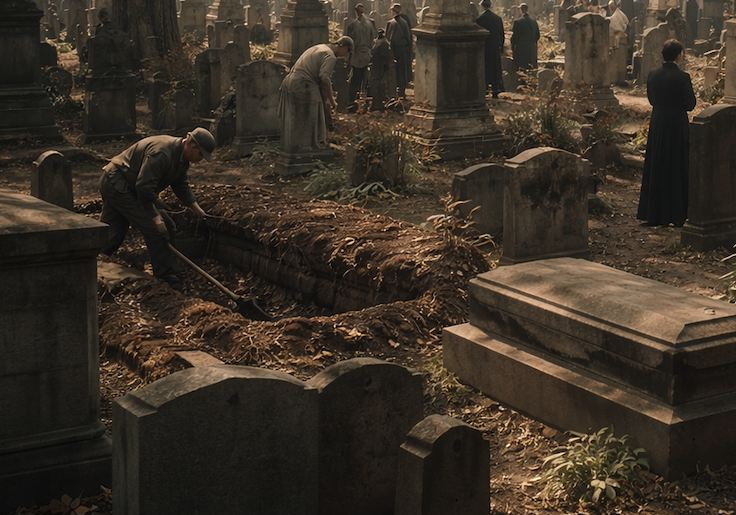
These plots were often deeded property. Families could surround them with fences, plant flowers, and erect monuments that shouted their status to the heavens.
In private ground, the family held the power. They decided who was buried there. To be moved to “Public Ground” — even temporarily, as Patrick Fox attempted — was seen as a catastrophic loss of dignity.
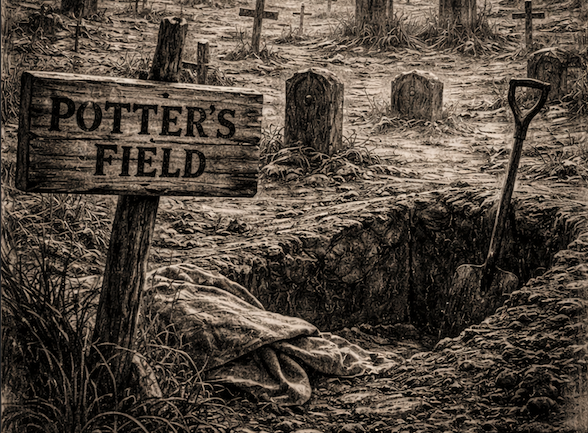
Then, there was the “Public Ground,” often referred to as the Potter’s Field or “Common Ground.”
Here, individual identity vanished.
Space here was rented, not owned. In many cities, public graves were “recycled” after a set number of years. Once the body had decomposed, the bones were moved to an ossuary or vault to make room for the next “tenant.”
For the working class, a public burial was the ultimate failure, the “pauper’s grave.” It meant you had no family to claim you, or no money to protect your remains from the indifferent shovel of the city.
The Outcasts of Fort Hill
If the “Public Ground” was for the poor, there was a place even lower on the social ladder: the Convicts’ Burying Ground. At Fort Hill Cemetery in Auburn, New York, the only thing separating the “righteous dead” in their marble tombs from the “unholy dead” was a strip of grass.
Fort Hill Cemetery was the home of the gravedigger and his wife. In 1890, they became the final, silent witnesses to one of the most controversial deaths in American history: the burial of William Kemmler, the first man to die in the electric chair.
But the state didn’t just want Kemmler dead; they wanted him forgotten. After doctors spent hours dissecting his body for science, the burial was ordered for 10:00 PM to avoid the prying eyes of the press.
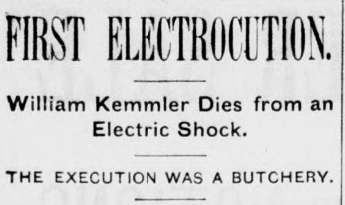
This reveals a hidden side of the gravedigger’s life: the vigil. Because the “death wagon” was constantly being chased by reporters, the schedule was non-existent. The gravedigger slept in his working clothes while his wife sat by the window, watching the dark street for the rattle of a wagon.
Twice, the wagon tried to leave the prison. Twice, it was forced back by the “knot of men” on the sidewalk. It wasn’t until midnight that the wagon finally dashed toward the cemetery.
And finally, there were no prayers and no mourners. By the dim light of a lantern, the gravedigger simply pulled the remains into the earth. The goal wasn’t to provide a “service”, it was to get the body out of sight and the dirt stamped down as quickly as possible.
The Chemical Erasure
To the public watching the gates of Auburn Prison, there was a rumor that William Kemmler would be buried in quicklime.
In the 1890s, officials used quicklime for two primary reasons:
Sanitation: In the era before modern embalming was perfected or widespread, quicklime was believed to “disinfect” the remains, preventing the spread of disease from the “unclean” bodies of the executed.
Destruction of Identity: It was a final sentence. The chemical reaction would rapidly decompose the soft tissue, often leaving the bones brittle. For a high-profile murderer like Kemmler, the state wanted to ensure there would be no body left to be stolen by “Resurrection Men” and no grave that could become a shrine for the morbidly curious.
The Profane Professional
Now not every interaction at the graveside ended in a riot or secrecy. Sometimes, the tension between the living and the dead was broken by a specific, hardened brand of “humor.”
In the village of Castine, Maine, around the turn of the century, there lived a man named Ordway. Ordway was the town’s jack-of-all-trades, but he was most famous for his work with a shovel. He was known for two things: being incredibly loud and “wonderfully profane.”
One afternoon, Ordway marched into the local general store. The shop was packed with wealthy summer tourists, the kind of people who treated the village like a quiet escape. But Ordway wasn’t there for quiet. He had just finished burying a “woman pauper”, a person buried at the town’s expense, and the Chairman of the Selectmen had forgotten to pay him his fee.
To the horror of the refined tourists, Ordway began demanding his wages in “no uncertain terms.” His voice boomed over the lace parasols and the jars of penny candy.
He finished his tirade with a line that became local legend: “Look here,” he said. “If I don’t get my pay before tomorrow night… up she comes!”
It was the ultimate “customer service” threat. And, needless to say, it got results.
The $2 Grave
By 1916, the men who dug the holes for New York and Philadelphia cemeteries were exhausted. In a rare moment of defiance, the diggers at Holy Cross and Fernwood cemeteries walked off the job.
They were striking for better pay.
The life of a gravedigger was measured in hours and inches:
The Quota: A digger and his helper were expected to finish a grave in exactly four and a half hours. That’s two graves a day, every day, regardless of the season.
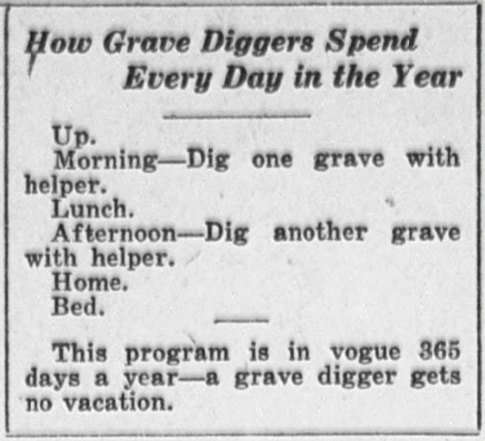
The Dimensions: A standard grave was 7 feet deep. But for the tier system we discussed, they dug to 9 feet for two coffins, and a staggering 11 feet or more for three.
The Environment: They worked in water up to their knees during spring floods and swung pickaxes into frozen earth when the temperature dropped below zero.
One veteran digger calculated he had dug over 16,700 graves in his career. He had never had a vacation. In his world, a day off didn’t mean rest, it meant a day without the $2.00 wage he needed to feed his three children.
When they were on strike, they “got the goat” of every undertaker in the city. Funeral parties would arrive to find empty plots and no workers. To the families, it was a scandal. But to the gravediggers, it was the only way to show that while the world might ignore them, it couldn’t bury its dead without them.
As one striker put it, “Everything’s up but wages for grave diggers.” Meat was expensive, bread loaves were getting smaller, and the men who spent their lives in the dirt were finally tired of being treated like it.
The Weight of the Earth
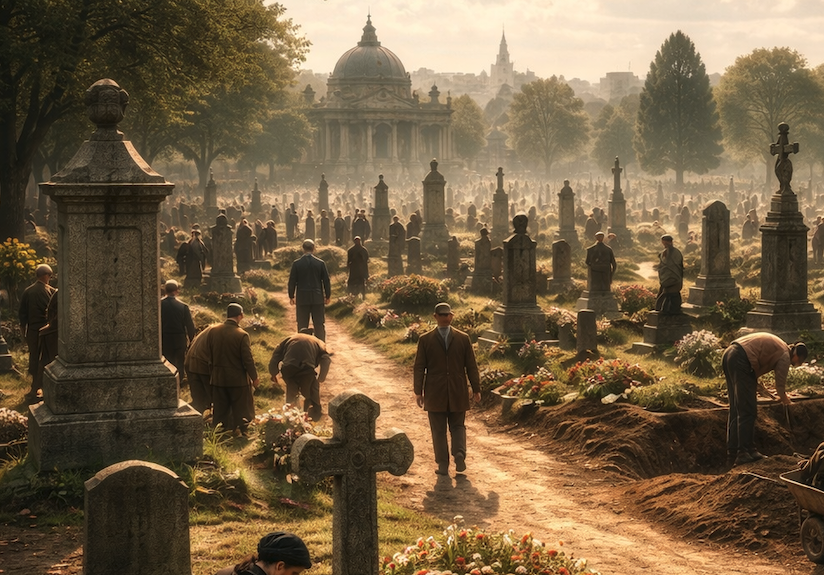
For all the fighting, the profanity, and the strikes for better pay, there was one constant shadow that followed every man who stepped into a grave: The Cave-in.
In 1920, a New York City gravedigger named Henry Wachenhut was doing what he had likely done thousands of times before. He was seven feet down, excavating a new plot, when the world above him simply gave way. Seven feet of sand and heavy snow slid into the trench in a single, silent second.
By the time the police could dig him out, Henry was dead. He wasn’t a “ghoul” or a “resurrection man.” He was a New Yorker who went to work and never came home.
The history of the late 1800s and early 1900s is often told through its towering monuments and the names of the “righteous dead” carved in marble. But the true story of the American cemetery lies in the calloused hands of the men who built it, one shovel at a time.
We often look back at them with a mix of fear or dark fascination. But when the lanterns were dimmed and the shovels were leaned against the cottage wall, they were simply people doing a brutal job in a world that preferred not to notice them.
And so, the next time you walk through an old cemetery, remember that beneath the grass isn’t just a history of the dead, it’s a history of the men who put them there.
SOURCES:
- The Sun. New York, N.Y. January 30, 1883.
- Pullman Herald. Pullman, W.T., Wash. May 16, 1891.
- The Tucumcari News. Tucumcari, N.M. February 10, 1906.
- Evening Public Ledger. Philadelphia, Pa. April 27, 1916.
- Iron County Register. Ironton, Iron County, Mo. March 25, 1920.