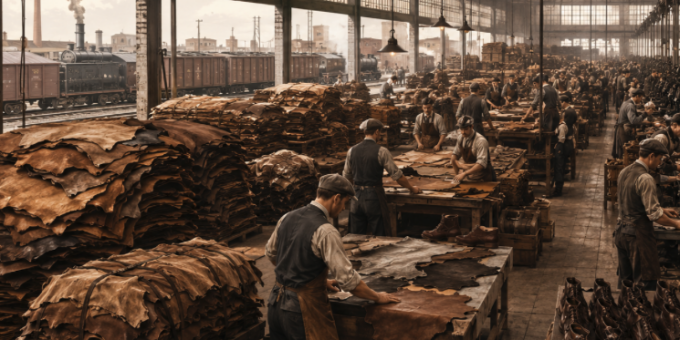
In 1906, the scale of American manufacturing could be measured in hides, railcars, and miles.
This short article offers a striking look at the Mayer Boot & Shoe Company of Milwaukee and the enormous quantity of animal hides required to keep one major shoe factory running for a single year. The numbers are almost difficult to picture: more than 416,000 hides, including those from steers, cows, calves, goats, sheep, horses, and even kangaroos, all transformed into footwear for men, women, children, and workers.
The article is clearly promotional in tone, praising the company’s modern equipment, skilled workers, and well-known shoe brands, including Honorbilt, Western Lady, and Martha Washington comfort shoes. Yet beneath the booster language is something far more interesting: a glimpse into the hidden supply chain behind an everyday object.
A pair of shoes might seem simple once it sits in a shop window or rests beside the front door. But behind it stood ranchers, slaughterhouses, tanneries, railroads, factory laborers, and a vast network of animals whose hides became part of daily life.
The article’s attempt to line up the animals, stretch out the railcars, and measure the hides by the acre shows just how fascinated people were by industrial scale in the early twentieth century.
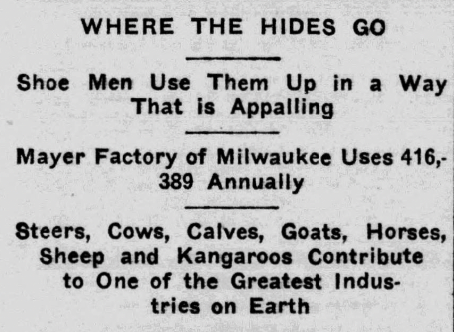
Where the Hides Go
In the mad whirl of business, people rarely pause long enough to consider the little things of life and how closely they are identified with the greater ones — how inseparable, in fact they are, from and how essential to them. Take for instance the shoe business — did ever anyone ponder long enough to realize the wealth of actual energy and animal life expended in the production of footwear for the human race?
As an example, take the Mayer Boot & Shoe Company, a Milwaukee concern that in its three hundred working days has consumed no less than 416,389 hides of all kinds during the past twelve months.
Here then we have the hides of 60,298 steers, 31,163 cows, 55,704 calves, 196,846 goats, 67,599 sheep, 2,523 horses, and 1,479 kangaroos, all consumed and distributed by the great Mayer factory within the period of a year. Stand these animals in a straight line and they would cover a distance of 351 miles, nearly one sixtieth of the earth’s circumference. To bring this livestock to its final point of destination, required no less than 3,000, 26-foot cars, which strung together would cover over 15 miles of railroad track. It takes the hides of nearly 1,500 animals daily to supply the demands of this monster shoe enterprise and were all of them spread out at the same time, it would require an area of over 5,000,000 square feet to accommodate them.
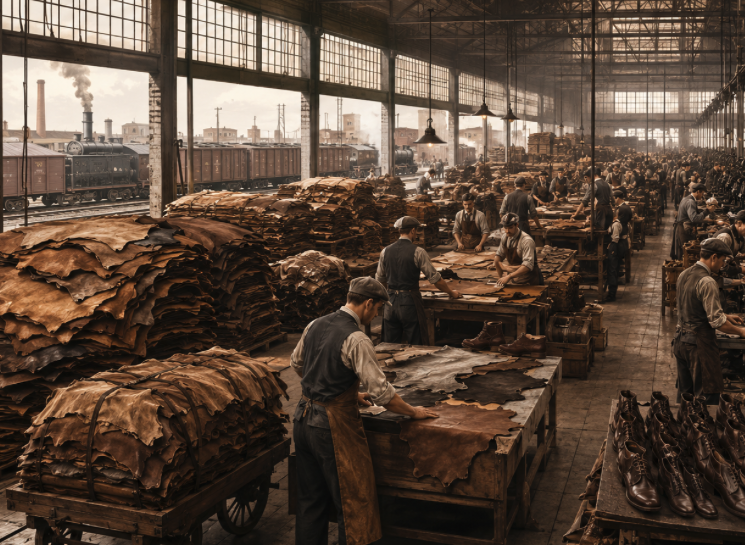
Nearly 1,000 skilled artisans are employed by the Mayer Company the year round making the Honorbilt shoe for men, Western Lady for women, and the celebrated Martha Washington comfort shoes; also school shoes that wear like iron and work shoes for all classes and purposes. The total capacity of the Mayer factory is 6,000 pairs of shoes a day.
The equipment of this factory is as thoroughly modern and up to date as money and experience can make it. Another decidedly favorable feature is that of location, which is in the greatest leather market in the world, thus enabling the company to secure first choice on products consumed. The uniformly excellent quality of all shoes turned out by the Mayer factory is largely attributed to this fact.
Source: The Independent. Lincoln, Neb. October 4, 1906.