The First World War had already introduced the world to horrors on a scale few could have imagined, but in 1915, a new terror drifted across the trenches at Ypres: poison gas.
Described by soldiers as a greenish-yellow cloud that blinded, burned, and suffocated the men in its path, the weapon turned the air itself into an enemy.
Those who survived spoke of lungs and throats seared as if by acid, of men clawing at the ground in agony, and of hospitals filled with the dying, their faces discolored and their eyes swollen red.
This firsthand account, published in 1915, captures the shock, outrage, and fear that followed the use of chemical warfare on the battlefield.
First Hand Description of How the Cruel War Gases Kill and Torture

The poisonous gas war which was started by the Germans in a surprise attack on the British at Ypres continues to be the subject of excited comment not only among all the belligerent nations, but in all countries that are considering the possibilities of future war.
The allies naturally accuse the Germans of brutality and treachery in employing this new and surprising method of war.
The French poet, Edmond Rostand, the most distinguished man of letters in France, has best expressed the feeling of the allies in a remarkable poem, in which he has poured all the sarcasm and satire he could command upon the Germans for their use of poisonous gases.
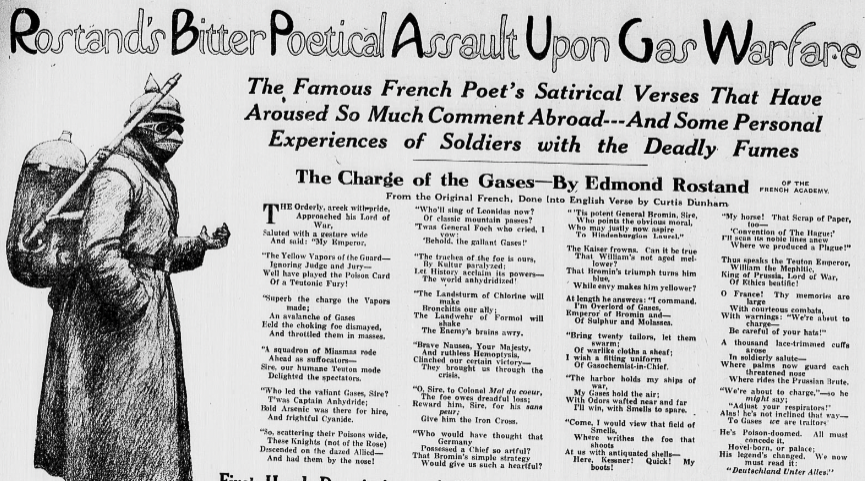
This composition, which is printed above, is considered by far the most original of the many poems that Rostand has published on war subjects.
It is charged that the Germans are violating a provision of The Hague Convention, to which they subscribed, by using poisonous gases. They reply that the French had already used such gases and that Ypres was a triumph for German chemistry. Lord Kitchener has now announced that the British will use similar gases in retaliation upon the Germans.
The reason for prohibiting poison gases is that they are excessively cruel, and destroy the health of the sufferer, even if he recovers. The interesting letters printed on this page, written by soldiers at the front who have suffered from the gases or seen their effects, appear to prove that these new terrors of war cause hopeless invalidism when inhaled in any quantity.
Many people will certainly wonder whether it is more inhuman to kill men with poisonous gases than to mangle them with shells and shrapnel. As most of the provisions of The Hague Convention have been thrown to the winds, is it not more logical that every country should prepare to use new and terrible weapons effectively? It certainly adds to the cruelties of war, but that has not unusually been an objection to the introduction of a new weapon.
Sergeant James A. Greenwood of the Lancashire Fusiliers
Toward evening we were sitting down or lolling quietly in the British trenches before Ypres, for the fighting had been slow.
I looked up from my newspaper and saw a long thick cloud of greenish color outlined against the sky in the direction of on the other side of the German positions, the Canal. At first I thought it was a storm cloud, but my knowledge of weather quickly told me that no natural cloud hung so low.
There was a strong wind blowing towards us and the yellow cloud was upon us in a few seconds. I called to the men in our trench to stand to their arms and climbed out of the rear of the trench and mounted a little hillock to see what was the matter. It was to this that I owed my escape from death, for hundreds of our men were suffocated where they lay in the trenches without having any idea that a new and horrible form of attack was being made on them.
From what I had breathed of the fumes, I suffered horribly. It was as if vitriol had been poured first into my throat and then into my lungs and into every corner of my body. Every attempt to breathe increased my sufferings and seemed to drive the fiery poison deeper into my tissues. I was blinded by the acrid gas. Every man who retained his consciousness started to rush back to the rear, for no one could stand against this devilish, intangible enemy.
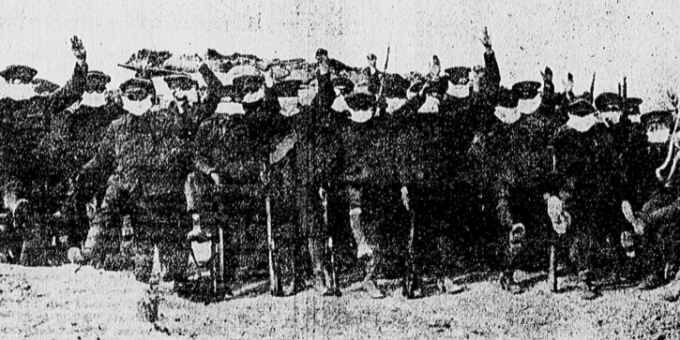
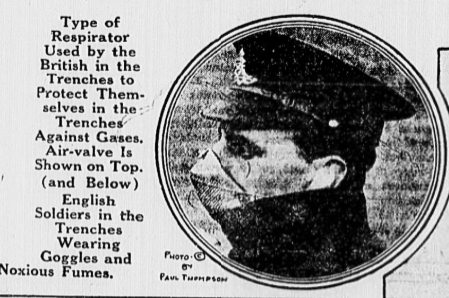
We had gone hundreds of yards to the read of our first line trenches before the stern commands of the higher officers brought us to a temporary stand. The gas had then been somewhat weakened and dissipated. The Germans came on through it, with their faces completely covered with masks and respirators, making them inhuman objects, but many of them succumbed to their own fumes as we afterwards found. They bayoneted our unconscious men as they passed over their trenches and came on till they were checked by our men beyond the deadly gas zone.
While we staggered under the poisoned wind, gas bombs burst over our heads with a roar and blaze as if the sun had fallen on us.
I woke up in hospital amid a scene that made me think I had been sent below.
Creatures with greenish-black faces and horribly red, protruding eyes lay all around, groaning and shrieking horribly. Others were already dead.
The pain they suffered must have been dreadful, for I had received a smaller quantity than most of them and my own sufferings were horrible. The poison eats up the lungs and throat, and even the few who recover after swallowing the gas must be helpless invalids the rest of their lives. The doctor tells me that I shall get well, but I feel that I shall never be well again. All our men say that they would gladly meet sure death by a bullet rather than swallow this gas.
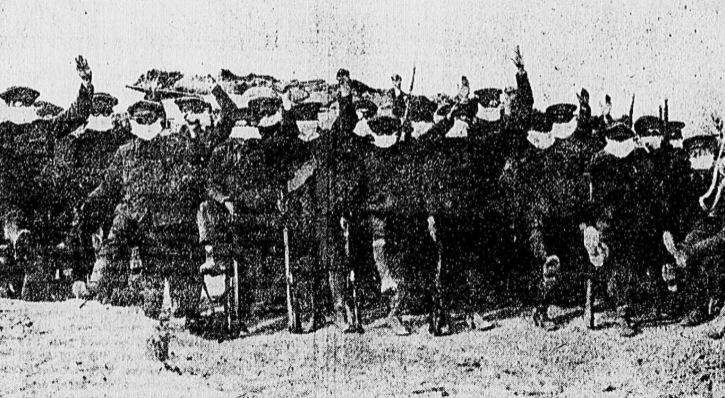
Thomas L. Wells of the Fourteenth Canadian Battalion
Having escaped by a miracle form death by the German poison gas, and having seen hundreds of my comrades dead and dying in untold agonies, I am able to send you some personal experiences about this fiendish surprise.
The Germans have employed poison gases in at least four different forms. They have liberated vast clouds of gas from tanks placed in their trenches, they have sent out gases from portable containers carried by their men, they have sprinkled the ground before their trenches with a liquid which, when ignited, gives rise to a poisonous gas, and they have fired poison bombs at use from mortars.
The gas driven upon us in large quantities at Ypres and other places is believed to have been chlorine. While among the other gases used with deadly effect, one of the most terrible was bromine.
For these reasons, some confusion has been caused by reports from the front. Some of our men have seen yellow clouds, others black, while others have come in contact with German soldiers spraying gas from portable containers.
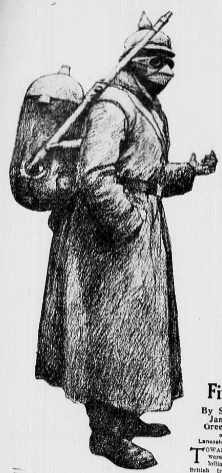
The first knowledge I had of the danger was when I saw some of our Canadian soldiers on lower ground holding their ands to their noses and then writhing in agony. We saw a fog rise from the ground, not yellow, but greenish, with a sheen like that of a soap bubble. It came with the wind, and the men it touched immediately began to claw the ground like maniacs.
The men I saw were a greenish gray with a most peculiar shiny appearance of the skin, which was tight stretched. Hands, neck and arms were covered with the indelible stains. They were horrible writhing caricatures of humanity. Trees, bushes, even the earth itself, were stained and turned into a hideous mockery of nature by the gas.
After learning how our front ranks had suffered, our commanders ordered a hasty retreat. In this way the Germans, advancing over the bodies of our suffocated companions, bayoneting and stamping on the dying as they came, secured an important advance.
The slight amount of diluted gas that reached me caused me acute suffering. Those who received the full force of the cloud had their throats and lungs literally torn to pieces. Our surgeons found that the gas had eaten great holes from the windpipe into the gullet and stomach of the victims. Those who were seriously attacked but did not die have been made hopeless invalids for life, as their lungs have been so injured that they can only draw insufficient breaths with great pain and labor.
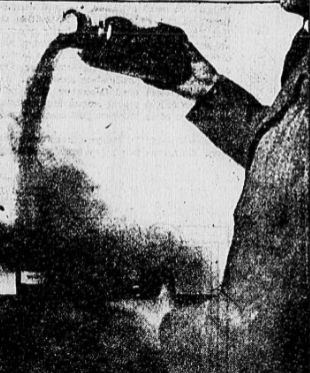
Colonel Sir Wilmot Herringham
It has been my painful duty to witness the effect of the poisonous gases employed by Germans, and so appalling are they that I wish I could make known this infamy throughout the civilized universe.
As an Army surgeon, I have had to face many duties that have shocked the roughest natures, but I declare on my honor that never, in the course of my experiences in savage warfare, with the tribes of the Sudan, Ashanti, and Northern India, ave I met with cases of inhuman torture to equal this poisonous gar procedure of the Germans.
The spectacle presented by this afflicted has made the blood of all onlookers boil, and to me, who have had many friends in the German nation — soldiers and doctors — is added an intense disappointment, a feeling of shame, in realizing that a Christian community should have employed our revered sciences, medical and chemical, in perpetrating this ghastly cruelty.
Source: Richmond Times Dispatch Richmond, Va. June 20, 1915