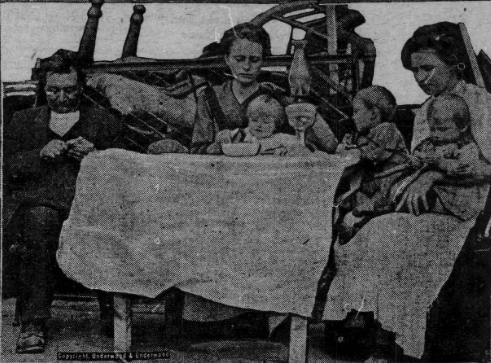

In the early 1900s, raising chicks successfully often depended on resourcefulness. Store-bought equipment could be costly, and many small farmers relied on homemade solutions built from scrap lumber, roofing paper, sheet iron, and whatever else was close at hand.
This 1908 article from Farm and Home, reprinted in The Roundup Record, describes a homemade brooder that could be built in a single day for about two dollars. Designed to keep young chicks warm and dry, the brooder used the heat from an oil lamp while keeping the lamp’s gas and fumes out of the chick compartment.
The design is practical and clever. Heat from the lamp passed beneath the floor, creating a warm, dry space without exposing the chicks directly to smoke or fumes. A perforated drum allowed gentle heat to rise into the hover, while small windows, air spaces, and ventilation holes helped regulate the interior.
For anyone interested in old-fashioned poultry keeping, this little brooder plan offers a glimpse into the ingenuity of farm life more than a century ago.
A Homemade Brooder
I have made and used a brooder that gives good results. The material costs about 2 dollars and a handy person can build one in a day.
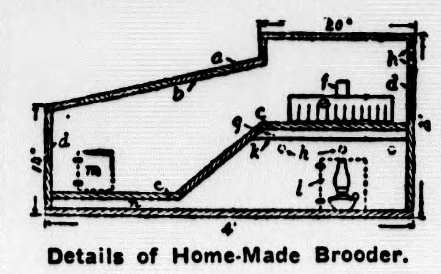
The gas from the lamp does not go into the chick apartment at all, but filters around under the floor, making it dry and warm, explains a writer in Farm and Home. The lamp flame is about three inches from the sheet iron.
The heat flows up gently through the drum, F, which is perforated with holes in the side, thus letting part of the heat out into the hover and the balance in the brooder above. The eat reservoir, G, between the sheet iron, K, and the floor, C, is about one inch deep. The tube, F, should not touch the sheet iron, merely extending through the floor, C.
It takes the least oil of any brooder I ever operated.
In the cut, A, is the paper roofing over inch-matched boards, B; C is board floor of same material; D are small windows, E is the hover, H are holes in each side of the brooder for the escape of gas and fumes, L shows door to reach the lamp, N air space below the floor.
Source: The Roundup Record. Roundup, Mont. May 8, 1908.