Jacob C. Arnold did not try to break out of the St. Louis workhouse. He tried to break back in.
In January 1903, Arnold appeared on the workhouse grounds shortly after being released and asked to be taken back. When officials told him they could not simply readmit him without a court sentence, he refused to leave.
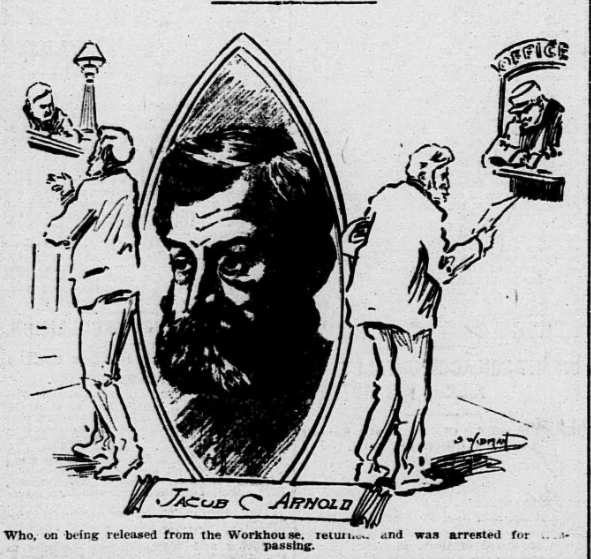
The situation was strange enough that a police officer had to be called.
His offense was trespassing, but his real crime seemed to be poverty. Arnold had been sleeping in boxcars and empty buildings, drifting in and out of confinement, wearing cast-off clothing left behind by other prisoners.
When asked why he did not find work outside, he looked down at his ragged garments and asked who would hire him dressed as he was.
The court was left with a curious problem: a prisoner who wanted to return, a workhouse that knew him as a good worker, and a winter still waiting outside. Judge Kleiber finally imposed a fine that would keep Arnold sheltered until spring.
Then, in a final odd turn, the court handed Arnold his own commitment papers and trusted him to walk himself back to the workhouse unguarded.
He did exactly that.
Procures Sentence and Returns to the Workhouse Unguarded
St. Louis, Missouri. —The unusual proceeding of a prisoner being entrusted with his commitment to the workhouse and being allowed to depart from the Police Court unguarded, on his promise that he would present himself for incarceration, occurred yesterday in the case of Jacob C. Arnold.
He made good his word and is now serving out a $50 fine.
Arnold is not a stranger at the workhouse. For the last year he has spent most of his time there. His offenses have been trespassing by sleeping in box cars or unoccupied buildings. His last offense was trespassing on the workhouse grounds.
He returned last Tuesday night and asked to be taken back. He was told that that could not be done unless he was fined and sent there by order of court. He would not depart, however, and it was found necessary to send for a police officer and have him arrested.
He was discharged from the workhouse a few days ago, having worked out a fine.
He spent the night in the police station and was arraigned yesterday morning before Judge Kleiber in the South St. Louis Police Court.
The charge against him was made under a special ordinance, which evidently had not been passed for such a case. It covered the offense, however. The ordinance provides for a penalty for trespassing on the workhouse grounds, or interfering with the superintendent of the institution.
It is presumed that it was intended for the punishment of persons entering upon the grounds for the purpose of aiding prisoners to escape or interfering with the superintendent or his guards while in charge of prisoners at work outside the grounds.
Arnold did not question the fact of whether the ordinance applied to his case. He was willing to abide by any decision that would result in his being sent back to the workhouse.
Assistant City Attorney Albert Burgess made close inquiry as to Arnold’s career at row workhouse. Edward Baxy, yard foreman, testified that Arnold was a good worker and an easy prisoner to manage.
It did not appear, therefore, that he was anxious to return to the workhouse for the purpose of avoiding work.
The officer who arrested Arnold said he asked him why he did not try to get work on the outside. For answer, the prisoner looked down at his ragged garments and said:
“Who would employ me dressed in such clothes as these?”
Arnold’s wardrobe is made up of cast-off garments of other prisoners. On leaving the workhouse after serving their time, many leave the clothes they wore while imprisoned.
Arnold is entered on the workhouse records as 42 years old. He is reticent as to himself other than to state he is a carpenter and was born in Ohio.
He told Judge Kleiber that he had relatives, but would not state where they are.
The Judge was puzzled in regard to the case. He decided to impose a fine which will keep Arnold in the workhouse until the winter is over, and then see if he cannot be induced to shift for himself on the outside.
Under the circumstance, it was not regarded necessary to of to the trouble of sending Arnold to the Four Courts, to be taken from there to the workhouse in the patrol wagon, as is the custom.
Judge Kleiber ordered the Marshal to make out Arnold’s commitment and give it to him and let him go direct to the workhouse alone.
The commitment was given to him about 9 a.m. One of the officials told him he had better hurry, so that he would reach the workhouse in time for dinner.
Arnold placed the commitment in his pocket and departed. An hour later, Judge Kleiber telephoned to the workhouse and asked if Arnold had arrived. He was told that Arnold presented himself at the office some little time before, armed with his commitment. It was placed on file and he was assigned to his old quarters.
Source: The St. Louis Republic. St. Louis, Mo. January 29, 1903.