It was the summer of 1907, and New York was gripped by a series of horrifying discoveries that newspapers quickly tied together under the shadow of a supposed “Ripper” panic.
Women had been found murdered and mutilated in different parts of New York and the surrounding region, and each new report seemed to deepen the fear spreading through the city.
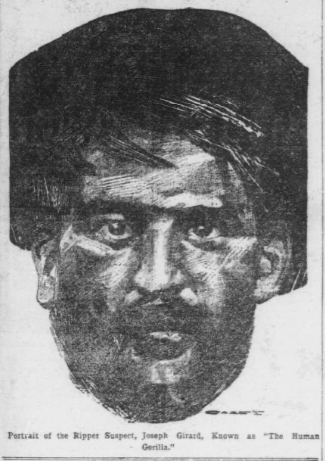
Police hunted for a suspect they called Joseph Girard, “the man gorilla,” believed by some to be connected to earlier killings.
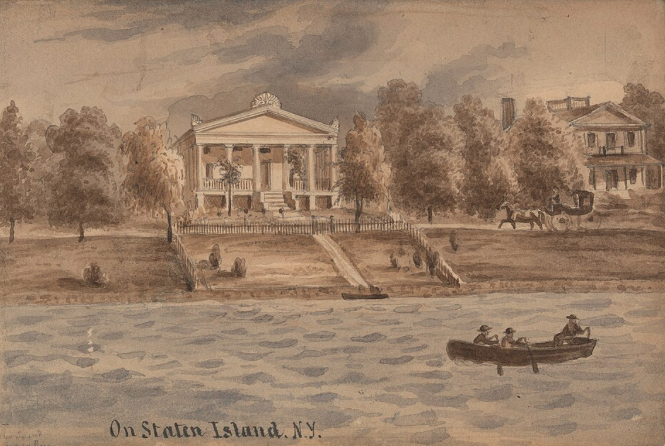
Then another terrible discovery came ashore at South Beach, Staten Island: part of an unidentified woman’s body, weighted down and left in the water. As investigators tried to determine who she was and how she died, word came that a man matching Girard’s description had been captured near Peekskill.
Part of Woman Found; Human Gorilla Caught
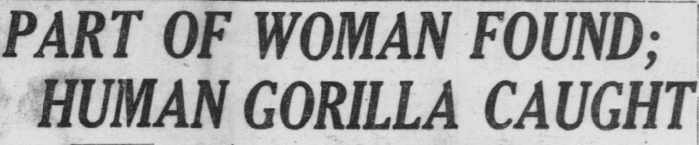
NEW YORK. — The body of another woman, more terribly mutilated than those found earlier in the week, has given reason for a new feeling of terror throughout the city as a result of the reign of crime which has kept mothers and their children indoors at night and put the police to unusual effort.
Today the authorities are trying to learn the identity of a woman, part of whose body came ashore at South Beach, Staten Island.
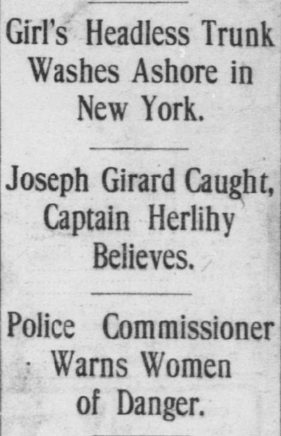
As these new and increasing evidences of some strange monster being free in the streets of New York came to light, the police redoubled their efforts to find Joseph Girard, “the man gorilla.”
This man, believed to have been responsible for the heinous murder of Gussie Pfeiffer, in the Bronx, near “the haunted oak,” two years ago, is thought to be captured today at Verplanck, near Peekskill.
In the very closest details this man answers the description of the fiend who killed Gussie Pfeiffer, as well as Miss Edith Davis, whose mutilated body was found in the Wallkill River at Walden, N.Y., and of the man wanted in connection with the similar murder of the unidentified young woman, whose lacerated corpse was found in the area of a 19th Street building last Tuesday.
Constable Otto Henry, of Verplanck, communicated with the New York police today that he had captured a man who he was certain was Girard. The man had been in town only a few hours when he was arrested, and offered a stubborn fight, and Constable Henry was compelled to use his club vigorously.
Herlihy Credits Story
“I have no doubt that this man at Verplanck is the man for whom we have been searching for two years,” said Acting Police Captain Herlihy, at police headquarters, “but to make certain, I have sent two detectives from the Bronx Bureau who knew Girard, and I expect to hear from them at any time.”
The finding of parts of the horribly mutilated body of a young woman which had been weighted down and sunk off Fort Wadsworth, S.I., further complicated the “Ripper” mysteries today, and the police fear they will have another charge against the fiendish slayer of women.
A bit of hemp twine, less than two feet in length, dangling from the trunk of the woman’s body, furnishes the only clue to the perpetrators of what the police believe to be another Guldensuppe murder.
The portion of the body found consisted of the hips and thighs only. The legs had been disarticulated at the knee joints. The upper part of the fragment was separated just below the ribs.The manner in which the dismemberment had apparently been made, despite the length of time the parts found had been in the water, first led to suspicion.
Another Murder Mystery
Working on the theory that the bay had given up another murder mystery, Coroner;s Physician Mord, with Coroner Cahill, began an investigation of the case. The body has been removed to the New York City farm colony, where it was placed in the morgue to await a probable inquest.
“It is my opinion,” said Dr. Mord, “that the woman was killed, and after the body had been dismembered, the several parts, with weights attached, were thrown into the bay or one of the rivers by those responsible for her death.”
“The body had been in the water for a long time — possibly for weeks,” said the coroner. “Still, it was in a fair state of preservation. I am not yet willing to make a positive statement about the case, no matter what the police may believe.”
Source: The Washington Times. Washington, D.C. August 1, 1907.