In Canton, Ohio, 1910, a battery of seven boilers at the American Sheet and Tin Plate Company suddenly blew apart. The plant was left in ruins and nearby homes were struck by the remains of the dead. Fourteen men were killed, about thirty others were injured, and several of the wounded were not expected to survive.
The cause of the disaster was unknown. The men who might have explained what happened were among the dead. Those who lived could only describe a series of terrible blasts, followed by wreckage, fire, screams, and the frantic search for missing fathers, husbands, sons, and brothers.
The following account, published in 1910, is a grim reminder of the dangers faced by industrial workers in an era when a single mechanical failure could tear through a factory, a workforce, and an entire community in an instant.
Deaths Number 14
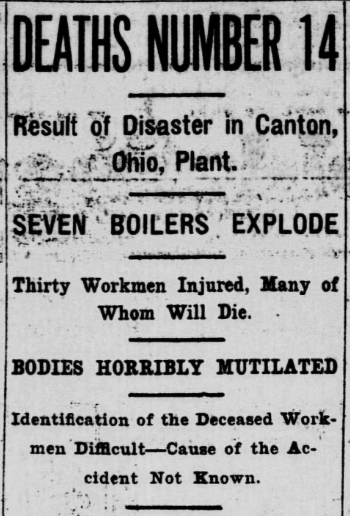
CANTON, Ohio. — With a roar heard three miles away, a battery of seven boilers at the plant of the American Sheet and Tin Plate Company exploded, killing 14 men and injuring about 30. Among the injured are a half dozen who, it is said, will probably die.
The cause of the explosion is at present unknown. The fireman and engineer, who were in the boiler room, are dead. No one else about the plant who survived can explain the accident. One workman says that he heard three distinct explosions in quick succession. They came so close, however, that it was all over in an instant. The force of the concussion was terrific. The big plant is in such a state of ruin as to be practically a total loss. A mere shell of the building is left.
Bodies Are Mutilated
Identification of the men was difficult, many of them being so mutilated that even their most intimate friends could not recognize the features. Heads were down off and arms and legs were torn from the trunks. Fragments of bodies were blown several squares from the scene, and bits of human flesh have been picked up on porches and roofs of houses and in trees.
There were 100 persons at work in the plant at the time of the accident. Only about a dozen escaped injury. These and others, who rushed to the plant as soon as the disaster was known, worked heroically to rescue the injured. The ruins soon took fire, but the fire department extinguished the flames.
Searching for the Dead
Members of the bereaved families rushed frantically to the plant and thence to hospitals and residences near the ruined shops in an effort to find a trace of their loved ones. It was thought at 8 o’clock at night that all the dead had been removed from the debris. It was then stated that so far as known the dead numbered 20, but this did not include those who had died at their homes after removal from the ruins.
The body of one man, unknown, was blown through a house over 700 feet from the plant. The body entered the house from the east side and continued in a straight line through a bedroom and out on the other side of the house to Louis Avenue.
The torso of another man was found in the garden of a yard about 500 feet west of the scene.
The bodies of seven men, mutilated beyond recognition, were found in the north end of the mill.
“For God’s sake, hit me on the head and kill me,” cried one workman to a man who found him. The injured man had an arm torn off and a great hole in his side.
The plant had five mills. All the employees working at mills 1, 2, 3, and 4 were either killed or injured, while the men in mill 5, furthest from the boilers, escaped serious injury.
Source: Evening Star. Washington, D.C. May 18, 1910.