

In 1925, Florida prison officials were openly discussing whether to bring back one of the state’s most brutal punishments: the lash.
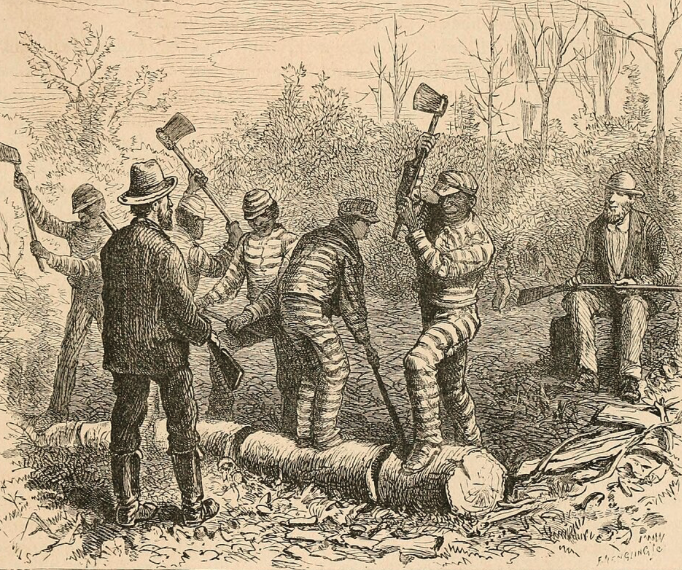
Only two years earlier, the Florida Legislature had abolished whipping in prison camps after the notorious Martin Tabert case drew national attention to abuses in the convict labor system. But some officials now argued that prisoners were taking advantage of the ban, choosing solitary confinement over labor in the hot sun.
Supporters claimed the whip could be made “humane” if used under a physician’s supervision. Prison supervisors complained that confinement cells were too comfortable to serve as an effective punishment, and some believed the lash would force prisoners back to work.
Lash in Florida’s Prisons to Return
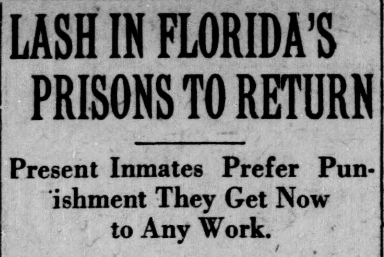
TALLAHASSEE, Florida. — Restoration of the lash in Florida prison camps is regarded as not unlikely by state prison officials.
Prisoners are now taking advantage of the protection the law banning whipping gives them and many times would rather undergo the present forms of punishment than to work, according to prison officials.
The state legislature which, in 1923, abolished the lash from Florida prison camps as an outgrowth of the famous Martin Tabert case would have to enact legislation nullifying its former action. Forces not visible, it was said, already are at work to create sentiment for the return of the lash.
Those favoring whipping declared that with its administration under the care of physicians would be proper protection for the prisoners.
T.E. Andrews, chief prison clerk said that while expressions probably would be difficult to obtain, he believes practically all of those in charge of road or other camps, where prisoners are worked, favor limited use of the whip.
Solitary confinement is the punishment, which has been substituted for the lash. Commissioner of Agriculture Nathan Mayo sent out a questionnaire to prison supervisors asking their opinion on solitary confinement as a punishment for prisoners. A letter from B.H. Dickson, one of the supervisors, is typical, he said, of this general opinion.
The letter follows:
“In answer to your question, ‘Do I believe in solitary confinement, such as we have in this state, is effect?’ I must answer, most assuredly, no.
“I have noticed on several occasions, convicts refused to work as they preferred the confinement cell and restricted diet to the hot sun. Remaining in confinement for ten days, they are taken out and placed in the barracks and fed for five days as the law prescribes, then worked for two or three days, then refuse to work and go over the same performance again and again. The confinement cells are cool and comfortable in hot weather, double walls and ventilated from above.
“In answer to your question, ‘What would I recommend as a humane punishment that would be effective?’ I would say that the lash applied under the prescription of the camp physician would be effective and humane.
“Under this system, I don’t think the lash would be abused as it was under the old lease system, especially under the present rigid inspection law.”
Source: South Bend News Times. South Bend, Ind. November 6, 1925.


I think this is in humane and sickening this country is going backwards.
100% INHUMANE!!!! Unbelievable. The people who are pushing for these laws or allowed to hand out years in the penetentiary should have to serve at least a i10 days n prison confinement and at least 20 amongst general population. That way they can experience these things first hand before handing out years like it’s playtime. Seriously bringing back the lash, WTF!!
WHEN YOU GIVE A MINOR CRIMINAL A YEAR IN JAIL THE OK ONLY PEOPLE BEING PUNISHED ARE TAXPAYERS
These evil racist as ppl is trying bring back everything they did wrong to black ppl back again to justify their hate towards us bc they have most of these prisons pack with black ppl 60-70% All bc they don’t wanna slave for free and give free labor to the billionaires