At the beginning of the twentieth century, exhausted parents could purchase “soothing syrups,” cordials, and drops intended to quiet a crying baby or help a restless child sleep. What many of those bottles did not advertise plainly was that their soothing power came from opium-derived narcotics such as morphine, laudanum, and paregoric.
A few drops might calm a child. A few drops too many could bring convulsions, coma, or death.
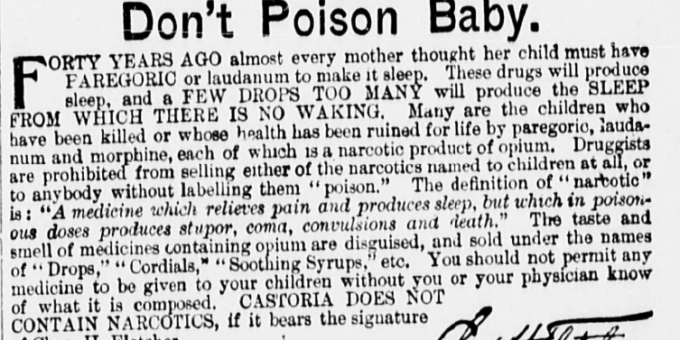
Published in a New York newspaper in 1908, this alarming advertisement warned parents against giving children unidentified patent medicines. The warning was also a sales pitch, using the deadly history of narcotic-laced remedies to promote Castoria as the safer choice.
The message is shocking today, but it reveals a time when dosing babies with powerful narcotics was not an unthinkable act.
Don’t Poison Baby
Forty years ago almost every mother thought her child must have paregoric or laudanum to make it sleep.
These drugs will produce sleep, and a few drops too many will produce the sleep from which there is no waking. Many are the children who have been killed or whose health has been ruined for life by paregoric, laudanum and morphine, each of which is a narcotic product of opium.
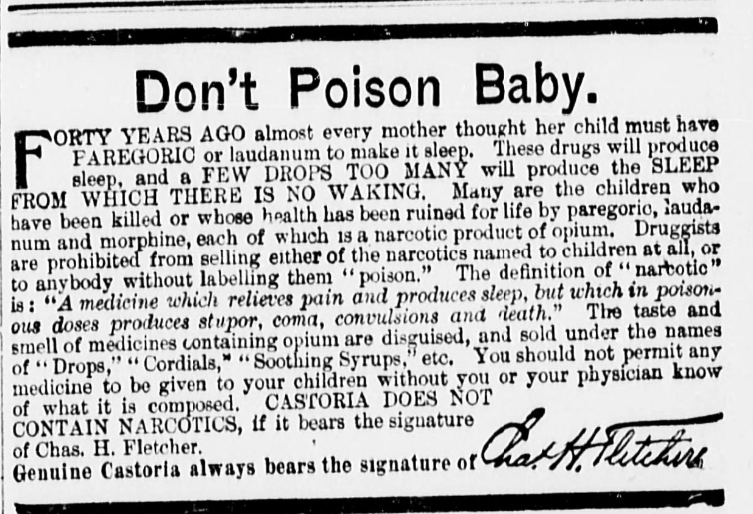
Druggists are prohibited from selling either of the narcotics named to children at all, or to anybody without labeling them “poison.”
The definition of “narcotic” is: “A medicine which relieves pain and produces sleep, but which in poisonous doses produces stupor, coma, convulsions and death.”
The taste and smell of medicines containing opium are disguised, and sold under the names of “Drops,” “Cordials,” “Soothing Syrups,” etc.
You should not permit any medicine to be given to your children without you or your physician know of what it is composed.
Castoria does not contain narcotics, if it bears the signature of Chas. H. Fletcher.
Source: The Evening World. New York, N.Y. September 4, 1908,