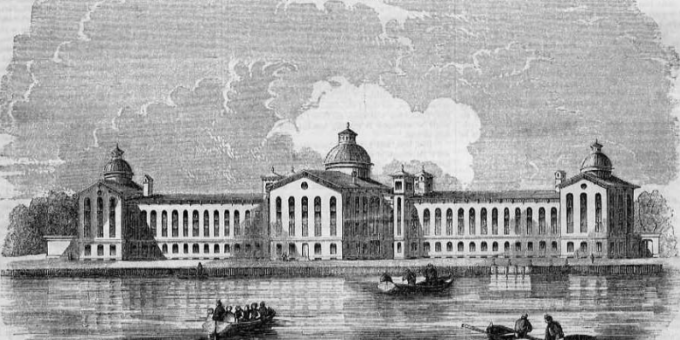
In 1903, seventeen-year-old Gentle had already slipped past the guards, crossed a mile of institution grounds, and reached the northern end of Randalls Island before anyone realized he was missing.
Still dressed in the uniform of the House of Refuge, the fugitive dove into the river and began swimming for the Bronx shore. Behind him, whistles screamed, police boats launched, and keepers pulled hard against the current. Ahead of him was open water and, perhaps, freedom.
The tide carried the boy faster than the pursuing boats could follow. After climbing from the river soaking wet, he calmly told curious strangers that he had fallen out of a boat, accepted advice from an unsuspecting policeman, and boarded a Mount Vernon trolley.
Then he disappeared.
Fugitive Beats Boats
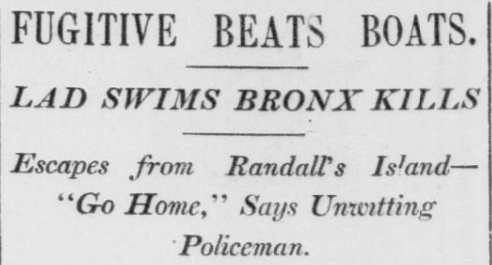
RANDALLS ISLAND, New York. — The fourth attempts to escape from the House of Refuge on Randalls Island within the last three days occurred last night, and proved a success, the prisoner, by swimming the Bronx Kills, although pursued by keepers and harbor police, escaping in the New York, New Haven and Hartford Yards, and vanishing on a Mount Vernon trolley car.
Although Warden Sage would last night make no statement beyond admitting that one of the inmates had escaped, it was ascertained that the boy who escaped was named Gentle, and had been an inmate for some months. He is said to be about 17 years old.
Just as he reached a small pier at the north end of the island at 10 a.m. yesterday, he was missed at the House of Refuge and a search begun for him. Meanwhile, fully clad in the uniform of the inmates of the House of Refuge, the boy dived from the pier, and, with long sweeping overhand strokes, headed for the Bronx shore.
By some means the boy got a permit allowing him to leave the House of Refuge and go into the grounds. Getting by the guards about the east side of the island, he slowly made his way to the north end, passing through the grounds of the Foundling Asylum, Baby’s Hospital and other institutions, until, without detection, he reached the north end of the island, a mile from the House of Refuge.
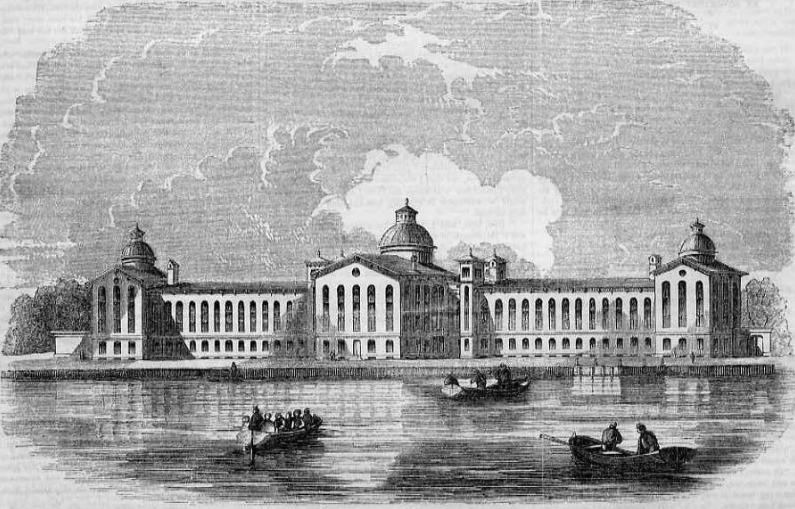
The water was clear of craft, and no one on the Manhattan or the Bronx shore paid particular attention to the swimmer. He had gained a ten minute start, when the search for him revealed to Warden Sage that he had escaped.
Instantly the shrill scream of the institution’s whistle told the police along the waterfront that an inmate had escaped. The whistle brought policemen to the Manhattan shore, but owing to the wind being in an opposite quarter it did not reach the police of the Bronx shore.
Policemen Cagney and Kelly, attached to the harbor police substation jumped into their boat and pulled up along the river northward while William Astain, under warden of the institution, put out from the House of Refuge pier, at the southern end of the island, a mile below where the boy had taken to the water, and rowed northward. But by this time the escaping boy had got into the chop of the Harlem River and had half won his way to freedom.
The tide running strong up the Harlem aided every stroke, while the pursuing boats were buffeted by the contrary currents of the East River. Once or twice they caught sight of the boy’s head bobbing in the choppy tide, and then it was lost to sight as the lad turned over on his back and let the tide carry him toward freedom.
Meanwhile, the continual scream of the whistle on the island brought a number of rowboats out, all headed north in the wake of the police boat. But the boy had too great a lead. He was seen to climb on the floats of the New York, New Haven and Hartford pier at East 130th Street, stand a moment looking back at the covey of boats coming up the stream, a mile away, and then turn and disappear in the yard back of the floats.
Dripping at every step, the boy was seen by persons as he walked calmly up 130th Street. Some stopped and asked him how he got wet.
“I fell out of me boat,” he said to some.
One policeman recollected that he had advised the boy to hurry home and get some dry clothes on.
“That’s what I am going to do,” he responded, proceeding on his way.
Then he jumped aboard a Mount Vernon trolley car, and all trace of him was lost.
Source: New York Tribune. New York, N.Y. July 6, 1903.