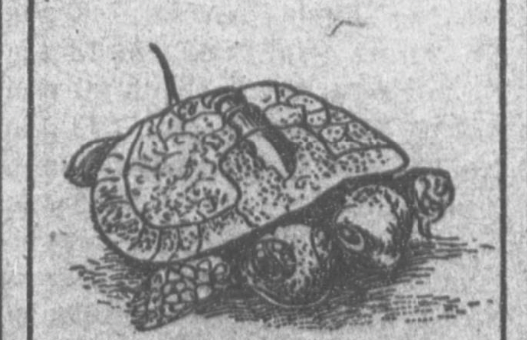
A remarkable little box tortoise found in Fairfax County, Virginia, attracted attention in the early 1900s for an unusual feature that was impossible to overlook: it had two fully formed heads.
The animal was discovered near Mount Vernon and eventually came into the possession of E. S. Schmid, a Washington taxidermist. Its unusual appearance was considered noteworthy enough to be featured by Scientific American, which published a photograph and description of the living curiosity.
Aside from its second head, the tortoise appeared much like any other member of its species. Identified at the time as Terrapene carolina, the common box turtle, it was believed to be approximately four months old and measured only about two inches long by one and three-quarter inches wide. Its shell may have been slightly larger than usual, but no other obvious abnormalities were visible.
Both heads were nearly equal in size and appeared perfectly developed. Even more interesting was their behavior. The heads did not seem to act as a single unit when feeding. Instead, each ate separately and at different times, suggesting that they functioned at least somewhat independently of one another.
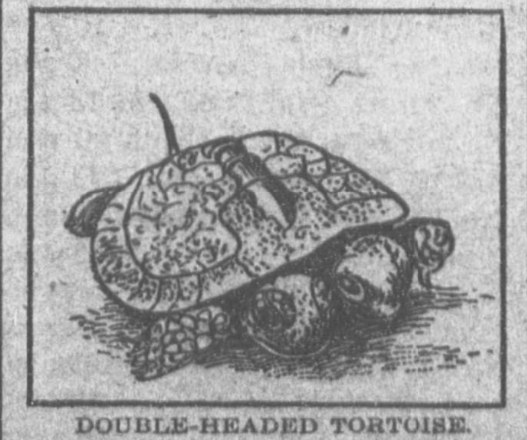
Double-Headed Tortoise
Fairfax County, Virginia. — That nature is not without a latent sense of humor is often demonstrated by the strange abnormal creatures and freak growths she produces and rarely does a week pass by that some one of the many illustrated publications does not contain a photograph of a curiosity of this character.
Accordingly, the Scientific American adds one more to the list of oddities in the accompanying engraving of a two-headed box tortoise, the property of Mr. E.S. Schmid, a taxidermist of Washington.
The turtle, which is of a common and well-known variety and whose scientific name is Terrapene Carolina, was found in Fairfax County, Virginia, near Mount Vernon, and with the exception of its superfluity of heads, appears to differ little from the ordinary representatives of its kind.
The truth of this, however, could only be ascertained at the cost, we fear, of the creature’s life, for its armor-like shell would make an investigation of its internal economy hazardous if not impossible.
The animal appears to be about four months old, and measures some two by one and three-quarters inches, the shell being possibly a trifle larger than would ordinarily be the case.
The two heads are nearly of the same size, and as far as can be seen are perfect in all respects.
Its other visible members do not exceed the usual number, and it is probably not incorrect to conclude that the multiplicity is confined to the heads. These do not feed together, but do so separately and alternately, and appear, furthermore, to be otherwise independent.
The photograph clearly shows the disposition and the perfect state of both heads.
Source: Mexico Missouri Message. Mexico, Audrain County, Mo. March 22, 1906.