Before highways, neon dance halls, and coin-operated jukeboxes, the rural West made its own fun.
A cowboy dance was not a ticketed event with posters and programs. It was a neighborly promise that if you could hear a fiddle and find a horse, you belonged.
What followed was part barn raising, part courtship, part dust storm, and entirely community.
The invitation: “Everybody invited and nobody slighted”
No committee, no flyers. News rode the range on talk and hoofbeats. A few riders “worked the country,” passing the word to whomever they met.
The phrase that sealed it was simple and sincere: everyone was welcome.
In scattered ranch communities this mattered. Winter was long, work was hard, and a night of laughter kept spirits from going dry.
Getting there was half the story
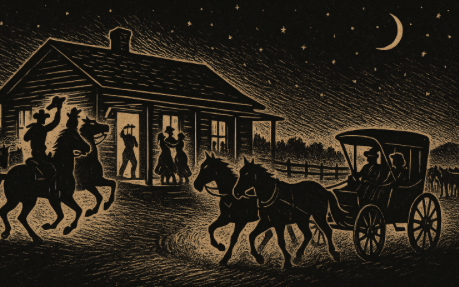
Transport was the first test of devotion. Buggies were scarce and towns were far. A hand might ride dozens of miles to borrow a rig, double back for his sweetheart, then push on to the dance.
By sunrise he would retrace every mile the other way. It was extravagant, impractical, and completely worth it.
Turning a ranch house into a ballroom
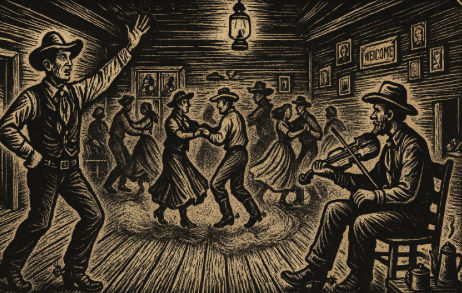
By afternoon neighbors drifted in to help. Furniture slid into a spare room or out into the yard. The corral made room for visitors’ horses. Family portraits and wall mottoes served as decorations: “Welcome,” “God bless our home,” “What is a home without a mother.”
There was no hired staff, only a shared understanding that if you could lend a hand, you did.
The fiddler’s kingdom
All eyes went to the musician. He tuned and tested for an age, sometimes pinning a pocketknife to the bridge for extra bite and swearing by a rattlesnake rattle tucked in the sound box as a charm against damp.
Whatever his reputation in daylight, when the bow met the strings he ruled the room.
Each dancer slipped him a coin when they took the floor. The first tune was often a waltz, hand to hand and arm around the waist, with a clean handkerchief in the cowboy’s palm to keep from smudging a dress.
Choosing partners, minding manners
Girls sat lined along a wall in chairs, trunks, and boxes if seating ran short. A partner request sounded like, “Pardner for the next?”
Refusal stung. Two refusals in a night meant you tipped your hat and tried your luck elsewhere.
Courtesy kept the edges smooth in a crowded room.
When the far riders arrived
Distant crews timed their approach to the music. Once the fiddle carried on the wind, they “poured the quirt” to their horses and whooped up to the very door. The farther the ride, the warmer the welcome. Distance implied grit, and grit was fashionable.
The caller: loud voice, louder style
Square dances needed a caller, and the caller needed presence.
Fancy boots, bright shirt, big rowels, buckskin gloves, maybe a rattlesnake skin over the belt. He sang directions in a rhythmic chant that braided with the tune, sometimes inventing figures as he went.
If he forgot a line, he filled the gap with swagger.
Dancers followed his voice, not a rulebook, and every set took on the personality of that one room on that one night.
A few calls you might have heard
Not the exact 19th-century rhymes, but the flavor is true:
- “Circle up tight, make a ring, swing your corner and let it sing.”
- “Head two forward, split the sides, meet your own and take a ride.”
- “Ladies to the center, gents you shade, back you go and promenade.”
- “Allemande left with the corner there, right to your own and show you care.”
- “Balance once, balance twice, turn that partner nice and nice.”
How it moved: swing, shuffle, and thunder
Most figures ended in a swing, either forearm-to-forearm or hand-in-hand, a quick turn and a laughing release. The step was more shuffle than bounce, timed to bow strokes rather than metronomes.
Floors trembled. Dust rose through the board seams until the host paused the music to sweep it into the yard. Girls sometimes danced through their shoe soles in a single night. Cowhands fared better in thick boots.
Coffee, a nip, and the church line
Black coffee steamed in the kitchen. Children slept there on quilts, arranged like dropped dominoes. Somewhere outdoors, a bottle made a quiet circuit.
If a man tipped too far into “high lonesome,” friends applied frontier first aid: a few corrective thumps, a spell in the harness shed, and a guard until the world stopped spinning. Some church members came only to watch.
Sooner or later the music won, feet edged in, and the next revival counted one more soul to reclaim.
Style without uniform
Fashion was democratic and personal. Girls favored long skirts with pale ribbons. Powdering a nose in public would have been bold for the setting, so touch-ups happened in a side room.
Boys ran from store suits to full cowboy regalia.
Farm kids borrowed the look with “hand-me-down” boots and pride that shone just as bright.
Initiation by dizziness
Newcomers were welcomed with mischief. Partners and neighbors spent an extra minute “helping” a beginner learn the swing. If he pinwheeled into a wall, the room cheered and the fiddler kept time.
Everyone remembered their own first night and paid the joke forward.
Farewells that never ended
Dances ran until dawn and sometimes past it. A hand who needed to make morning work would call a “farewell dance,” mount up, and head out.
If the fiddler struck his favorite tune before he reached the gate, he turned back, spurs jingling, and took one last whirl in chaps and trail dust.
Riding away at last, he might loose the long, low night-herd call that quieted cattle and comforted men.