For seven days, Henry Ford sat on the witness stand in Mt. Clemens, Michigan, answering questions in a trial that had already drawn national attention.
But in the final hour of his testimony, the focus shifted from Ford himself to his son, Edsel, and the wartime accusation that the young president of the Ford Motor Company had shirked military duty.
Ford took full responsibility for Edsel’s draft exemption, saying his son had wanted to enlist but was needed in the factory for war work. He also revealed that Edsel had refused offers of comfortable commissions that would have given him a uniform without taking him away from the plant.
In Ford’s telling, there was no “swivel chair” soldiering for his son. His son failing to serve in the military was merely a difficult decision made in the name of wartime production.
No Swivel Chair For Ford’s Son
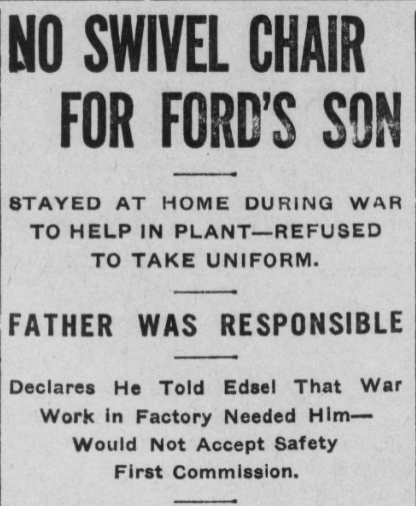
MT. CLEMENS, Michigan. — Henry Ford, during the last hour of his seven days on the witness stand, took occasion to claim full responsibility for his son, Edsel Ford’s claim for exemption from the selective draft.
“He wanted to enlist,” said Mr. Ford, “but I told him that he could do more good where he was. He was offered several commissions which would have permitted him to wear a uniform and stay right in the factory, but he wouldn’t accept them.”
Having made their decision, it was shown, both Mr. Ford and his son refused to camouflage it behind a swivel chair commission carrying boots and spurs.
This subject, the introduction of which has been awaited ever since the trial opened, did not develop along the lines which had been generally expected. Mt. Ford’s inclination to should full responsibility, his statement that his son was absolutely essential to the war work being done in the factory and his revelation of the fact that Edsel Ford turned down several offers of a commission, disarmed criticism.
The charges, spread during a political campaign, and recently on the floor of the United States Senate, to the effect that the young president of the Ford Motor Company had shirked his duty were so fully refuted that Tribune Counsel did not pursue the point.
It was the first time that a full explanation of the facts in connection with Edsel Ford’s war work has been made public and it was easily the feature of the eleventh week of the trial.
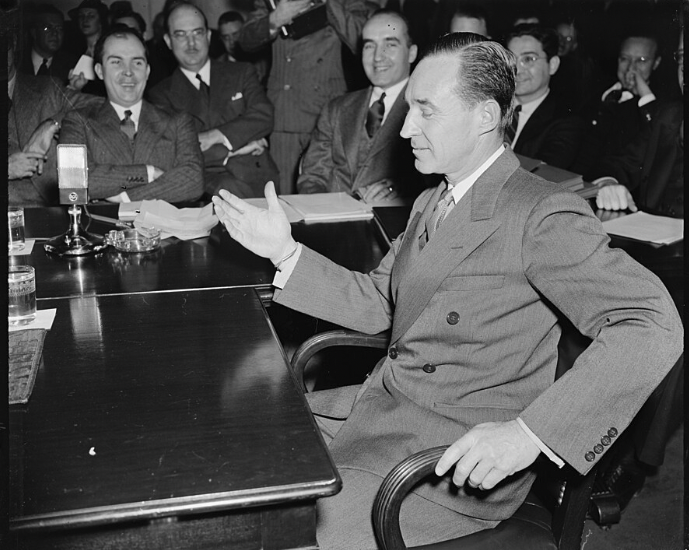
Henry Ford spent seven days on the witness stand and of this time he gave less than two hours to his own lawyers. As long as counsel for The Tribune was hammering him, Mr. Ford sat quietly in the witness chair answering the constant fire of questions with great patience. But the instant his own lawyers took him in hand his attitude changes. He became self conscious and diffident. He would not accept the efforts of his counsel to provide him with an opportunity to reveal the full extent of his patriotic work during the war, his humanitarian views, or his advanced ideas of the relations which should exist between capital and labor.
“It is all in the records,” said Mr. Ford. “I have told it all here once.”
He avoided, with care, anything that verged on boasting. He would not even describe the extent of the war work which his factories did and when record breaking performances in the production of munitions was mentioned he declared,
“we did all we could, let it go at that. I want to forget about it. I feel just as the soldiers feel. I don’t want to talk about my war work.”
The witness did, however, after being pressed, explain that his son had bought out the minority stockholders of the Ford Motor Company because these interests had insisted on Mr. Ford squeezing the last dollar out of the public, the government, the workers and the product. He wanted to cut loose from his associates, he said, so that he could carry out his ideas of the distribution of profits to employees through increased wages and to the public through lower prices. It was either buy or sell and Mr. Ford had considered selling and organizing a new company.
His son, however, took up the task of buying out the minority stockholders and succeeded, despite the general belief in the financial world that this stick could not be purchased.
One of the most interesting developments of Mr. Ford’s testimony came out when it was testified that the only legislation he has ever sought was that for the protection of birds. Other men of millions, it was shown, keep lobbyists in the national and state capitol to urge and work for special privileges, but the one favor that Mr. Ford has ever asked form the lawmakers had nothing to do with his own interests. It was a curious bit of testimony and left a deep impression on the audience in the court chamber.
The subject was a result of questions concerning Mr. Ford’s list of friends. He named Thomas Edison and John Burroughs, the naturalist, as his best friends outside of his immediate associates.
Source: Arizona State Miner. Wickenburg, Ariz. August 8, 1919.